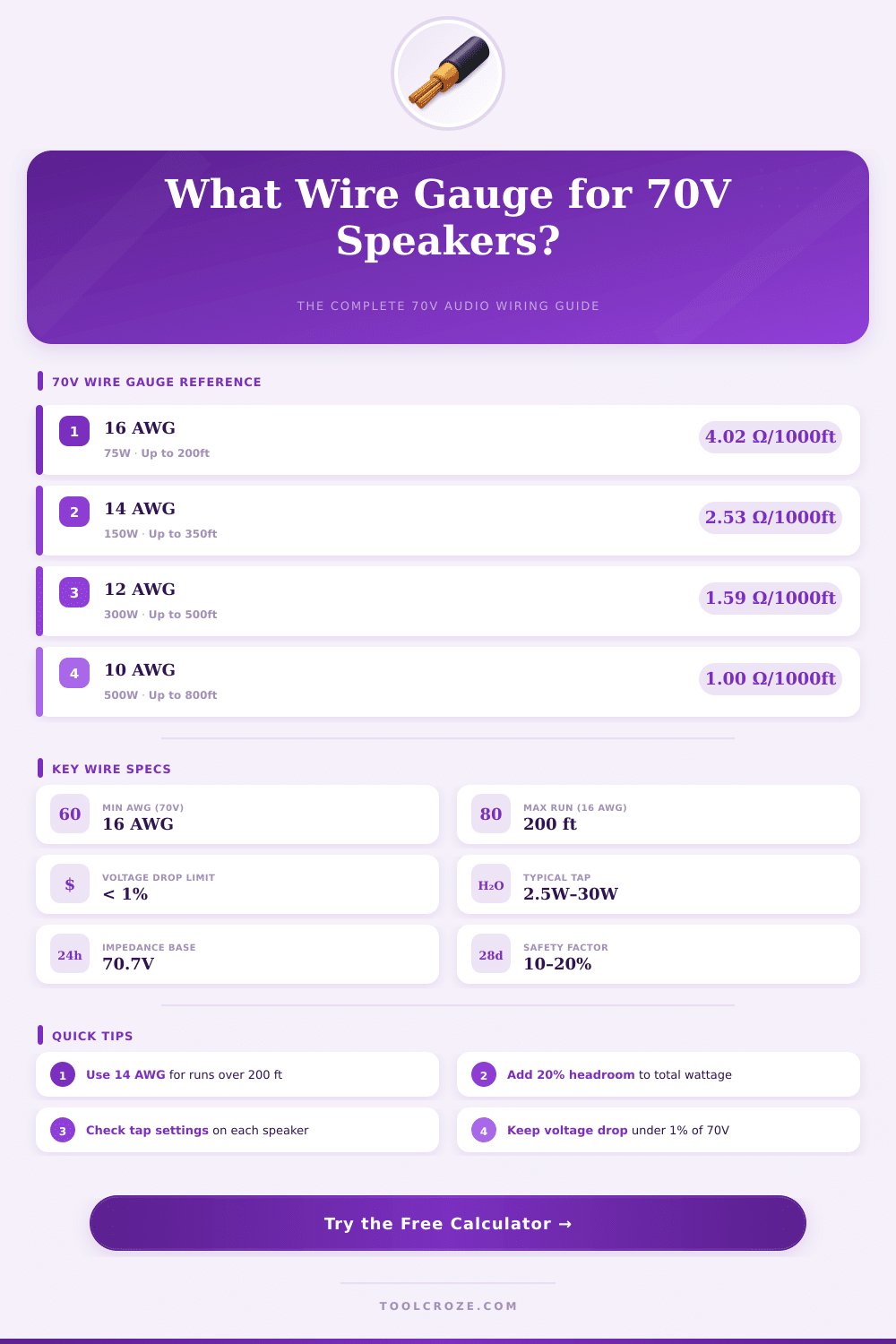
🔊 70V Speaker Wire Gauge Calculator
Find the correct AWG for your 70V distributed audio system — enter run length, wattage & tap settings for instant results
| AWG | Resistance (Ω/1000ft) | Resistance (Ω/km) | Max Current (A) | Diameter (mm) | Recommended Use |
|---|---|---|---|---|---|
| 22 AWG | 16.14 | 52.95 | 0.92 | 0.64 | Very short, low-power runs (<50ft) |
| 20 AWG | 10.15 | 33.30 | 1.5 | 0.81 | Short background music runs |
| 18 AWG | 6.385 | 20.95 | 2.3 | 1.02 | Short-to-medium 70V runs (<150ft) |
| 16 AWG | 4.016 | 13.17 | 3.7 | 1.29 | Standard up to 200ft / 75W total |
| 14 AWG | 2.525 | 8.28 | 5.9 | 1.63 | Most commercial 70V installs |
| 12 AWG | 1.588 | 5.21 | 9.3 | 2.05 | Long runs, high-power systems |
| 10 AWG | 0.999 | 3.28 | 15.0 | 2.59 | Very long runs, outdoor, high watt |
| 8 AWG | 0.628 | 2.06 | 24.0 | 3.26 | Amplifier feeder / trunk lines |
| AWG | 100ft Run | 200ft Run | 300ft Run | 500ft Run | Max Recommended Run |
|---|---|---|---|---|---|
| 22 AWG | 2.28% | 4.57% | 6.85% | 11.4% | ~65 ft @ 75W |
| 20 AWG | 1.44% | 2.87% | 4.31% | 7.18% | ~100 ft @ 75W |
| 18 AWG | 0.90% | 1.81% | 2.71% | 4.52% | ~160 ft @ 75W |
| 16 AWG | 0.57% | 1.14% | 1.70% | 2.84% | ~260 ft @ 75W |
| 14 AWG | 0.36% | 0.71% | 1.07% | 1.79% | ~420 ft @ 75W |
| 12 AWG | 0.22% | 0.45% | 0.67% | 1.12% | ~660 ft @ 75W |
| 10 AWG | 0.14% | 0.28% | 0.42% | 0.71% | >1000 ft @ 75W |
| Material | Resistivity Factor | Weight vs CU | Cost Factor | Corrosion Resistance | Notes |
|---|---|---|---|---|---|
| Copper (CU) | 1.00× (baseline) | 100% | Highest | Very Good | Best conductivity; standard for audio |
| Copper-Clad Al (CCA) | 1.25× | ~50% | Medium | Good | De-rate by 1 AWG; lighter; check connections |
| Aluminum (AL) | 1.64× | ~30% | Lower | Moderate | De-rate by 2 AWG; use AL-rated terminals only |
| Tap Setting | Impedance (70.7V) | Current Draw (A) | Typical Application | Max Speakers @ 250W Amp |
|---|---|---|---|---|
| 1W | 5000 Ω | 0.014 | Quiet background areas | 250 |
| 2.5W | 2000 Ω | 0.035 | Office, hallway | 100 |
| 5W | 1000 Ω | 0.071 | Retail, restaurant | 50 |
| 10W | 500 Ω | 0.141 | Gym, school, large retail | 25 |
| 15W | 333 Ω | 0.212 | Warehouse, large rooms | 16 |
| 20W | 250 Ω | 0.283 | High-output commercial | 12 |
| 30W | 167 Ω | 0.424 | High SPL, outdoor | 8 |
The rating of speaker wire depends simply on its thickness. To measure that one uses the name American Wire Gauge, AWG; and here the part that surprisingly flips the logic: smaller numbers point to thicker wires, while bigger numbers show slimmer. That flipped thought commonly messes up the expectations of many folks.
For the most common home sound setups, wire of 16 rating works entirely well. When your speakers stand closer than 50 feet from the receiver, you will not notice any clear drop in sound quality if you use 16 rating copper cable with standard 8-ohm speaker. It simply does its task.
Choose the Right Speaker Wire Size for Home Speakers
For distances under 20 feet? Then any 16 rating wire will work without a problem.
Here is the key spot about the thickness: thick wires have less resistance. Because of that power flows more easily from your amplifier to the speaker. If the cable is too slim and the distance long, you probably lose part of the amplifier energy right inside the wire itself.
Like this you waste power, which forces the amplifier to work harder to push teh signal through that extra resistance. At longer cable runs that can make your sound weak or even risk overloading your gear.
The relation between distance and rating becomes very precise. Wire of 14 rating, tied to 8-ohm speaker, should not pass around 80 feet. If you choose 22 rating for the same 8-ohm speaker, the maximum is only around 12 feet.
On the other hand, 12 rating wire with 8-ohm load can well go across until 120 feet, keeping everything crystal clear. The more long the cable goes, the more the resistance builds. With slimmer wire happens the same trouble.
For average home or car speakers (assuming that they are not subwoofers), 18 rating works perfectly. Subwoofers and high-tone drivers still benefit from stepping to 12 AWG or even 10 AWG. When you have speakers with low impedance at 4 ohms, thick cables truly help.
Around 24 feet is the practical limit for 16 rating wire, if it runs too a 4-ohm speaker.
Use of thicker wires does no harm. The price difference between 16 and 14 rating is fairly small, actually. One warning deserves to mind: 12 rating wire sometimes does not pass through the holes of speaker connections and can be difficult with basic fixtures.
Hence 14 rating commonly hits the ideal level for the most common setups.
Oxygen-free copper is the commonly chosen type today. Standard copper however does its role well for typical home usage under 250 watts and shorter distances. You truly do not need costly special cables.
Speaker wire is not the most important part in the system, when one uses normal ratings and fit lengths. The signaldrop that they cause is almost impossible to measure in real conditions.