🔧 Serpentine Belt Length Calculator
Calculate the exact belt length for any multi-pulley drive system using real geometry formulas
Enter each pulley in the drive system. Belt wraps around all pulleys in sequence. Add idler pulleys with a negative wrap direction if needed.
| Vehicle / Application | Belt Length (mm) | Belt Length (in) | Ribs | Width (mm) | Part # Prefix |
|---|---|---|---|---|---|
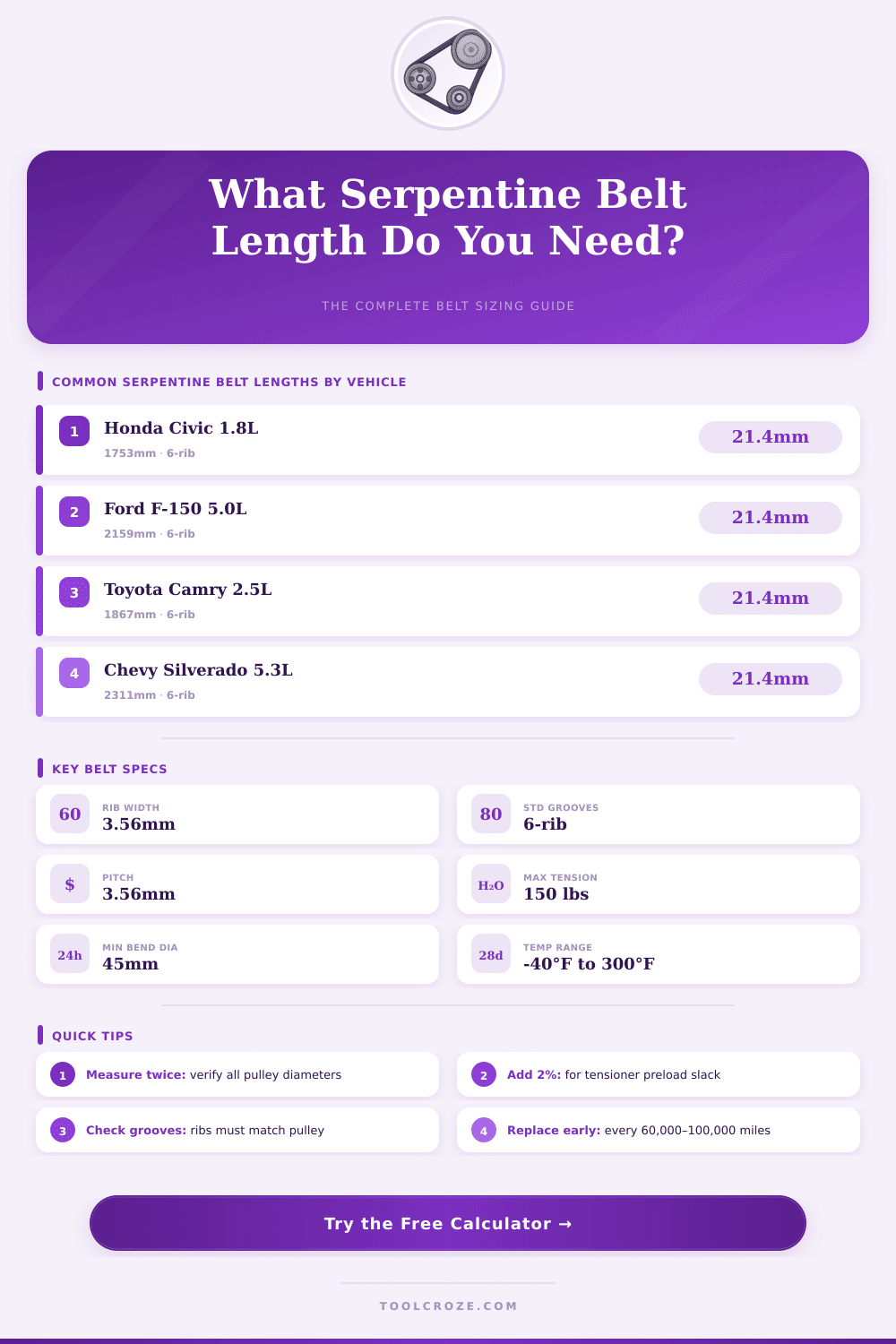
| Honda Civic 1.8L (2006–2011) | 1753 | 69.0 | 6 | 21.4 | 6PK1753 |
| Toyota Camry 2.5L (2012–2017) | 1867 | 73.5 | 6 | 21.4 | 6PK1867 |
| Ford F-150 5.0L (2015–2020) | 2159 | 85.0 | 6 | 21.4 | 6PK2159 |
| Chevy Silverado 5.3L (2014–2019) | 2311 | 91.0 | 6 | 21.4 | 6PK2311 |
| Ford F-250 6.7L Diesel (2017–2022) | 2442 | 96.1 | 8 | 28.5 | 8PK2442 |
| Toyota Tundra 5.7L (2008–2021) | 2080 | 81.9 | 7 | 24.9 | 7PK2080 |
| Honda Accord 3.5L V6 (2013–2017) | 1994 | 78.5 | 6 | 21.4 | 6PK1994 |
| Lawn Mower / Small Engine | 1270 | 50.0 | 4 | 14.3 | 4PK1270 |
| Industrial Compressor (std) | 2540 | 100.0 | 10 | 35.6 | 10PK2540 |
| Dodge Cummins 6.7L (2010–2018) | 2388 | 94.0 | 8 | 28.5 | 8PK2388 |
| Rib Count | Belt Width (mm) | Belt Width (in) | Max Power (hp) | Typical Application | ISO / DIN Code |
|---|---|---|---|---|---|
| 3-Rib | 10.7 | 0.42 | ~5 | A/C compressor, small accessories | 3PK |
| 4-Rib | 14.3 | 0.56 | ~10 | Lawn mowers, light duty | 4PK |
| 5-Rib | 17.8 | 0.70 | ~18 | Smaller car engines, alternator-only | 5PK |
| 6-Rib | 21.4 | 0.84 | ~28 | Most passenger cars (standard) | 6PK |
| 7-Rib | 24.9 | 0.98 | ~38 | Trucks, V6/V8 engines | 7PK |
| 8-Rib | 28.5 | 1.12 | ~50 | Diesel trucks, heavy duty | 8PK |
| 10-Rib | 35.6 | 1.40 | ~70 | Industrial, commercial vehicles | 10PK |
| Pulley Dia (in) | Pulley Dia (mm) | Belt Speed @ 1000 RPM | Belt Speed @ 3000 RPM | Belt Speed @ 6000 RPM | Typical Component |
|---|---|---|---|---|---|
| 2.0" | 50.8mm | 524 ft/min | 1571 ft/min | 3142 ft/min | Water pump / idler |
| 2.5" | 63.5mm | 654 ft/min | 1963 ft/min | 3927 ft/min | A/C compressor |
| 3.0" | 76.2mm | 785 ft/min | 2356 ft/min | 4712 ft/min | Alternator |
| 3.5" | 88.9mm | 916 ft/min | 2749 ft/min | 5497 ft/min | Power steering pump |
| 5.0" | 127.0mm | 1309 ft/min | 3927 ft/min | 7854 ft/min | Crankshaft (4-cyl) |
| 6.0" | 152.4mm | 1571 ft/min | 4712 ft/min | 9425 ft/min | Crankshaft (V8) |
| 7.0" | 177.8mm | 1833 ft/min | 5497 ft/min | 10,996 ft/min | Large industrial drive |
Choosing the right serpentine belt is more important than many folks think for your car. If the serpentine belt is either too small or too big, it can create big damage in the engine. There are some easy methods for finding the right length.
One of the simplest ways is simply checking the part number of your old serpentine belt. The length of the serpentine belt is coded directly in that number. For example for a Continental multi-rib V-belt marked 4060805, the final figures (805) show that it is 80.5 inches.
How to Find the Right Serpentine Belt Length
For V-belts the same idea applies. A number like 3V630 means a belt wide 3/8 inches, that runs 63 inches.
There is also a metric system used around the world, sometimes called PK-number. Something like 8PK2515 carries three bits of useful info in those signs. If the part number starts with “P”, the following measure is in millimeters instead of inches.
Like this 7PK1000 is a 7-rib belt with length of 1000 mm. Here the thing is, some makers totally skip showing the legnth of the belt and simply give you the part number. In such cases, reading the PK-number directly off the original belt is your most reliable option.
When you do not have the old belt for reference, using string or similar material to measure helps well. Wrap a few times around all pulleys and tensioners, mark where the ends cross, later lay it flat and measure that distance. Another method is to stretch string along the path of the belt, with the tensioner fixed in its final state.
Keep it pretty tight, mark both ends wear they cross and measure between those spots. One tip from manuals about serpentine belt systems is to cut the old belt, that you did not plan to reuse, wrap it around the pulleys to reach a more exact real length.
Keep your tensioner in middle position while you measure with string for best results. Starting to pick a belt around 10 mm shorter than that measure can place the tensioner in a more useful spot. A difference of 2 mm between old and new belt falls inside normal ranges, and your tensioner shouldhandle it well.
Also the thickness of the belt matters, which commonly surprises folks. Heavy belts sometimes slip on certain pulleys with their back side against the pulley, instead of the ribbed side, that normally touches. This uses more length from the belt, especially on pulleys with big radius, like the water pump pulley.
Like this you can end with a belt that is too short.
Most stores offer V-belts in different sizes and lengths, that come in half-inch steps. If an 87-inch belt turns out a bit too long, trying 86 or even 85 inches could work. Simply searching in a catalogue by your year, make, model and engine type helps to find the right belt without effort.