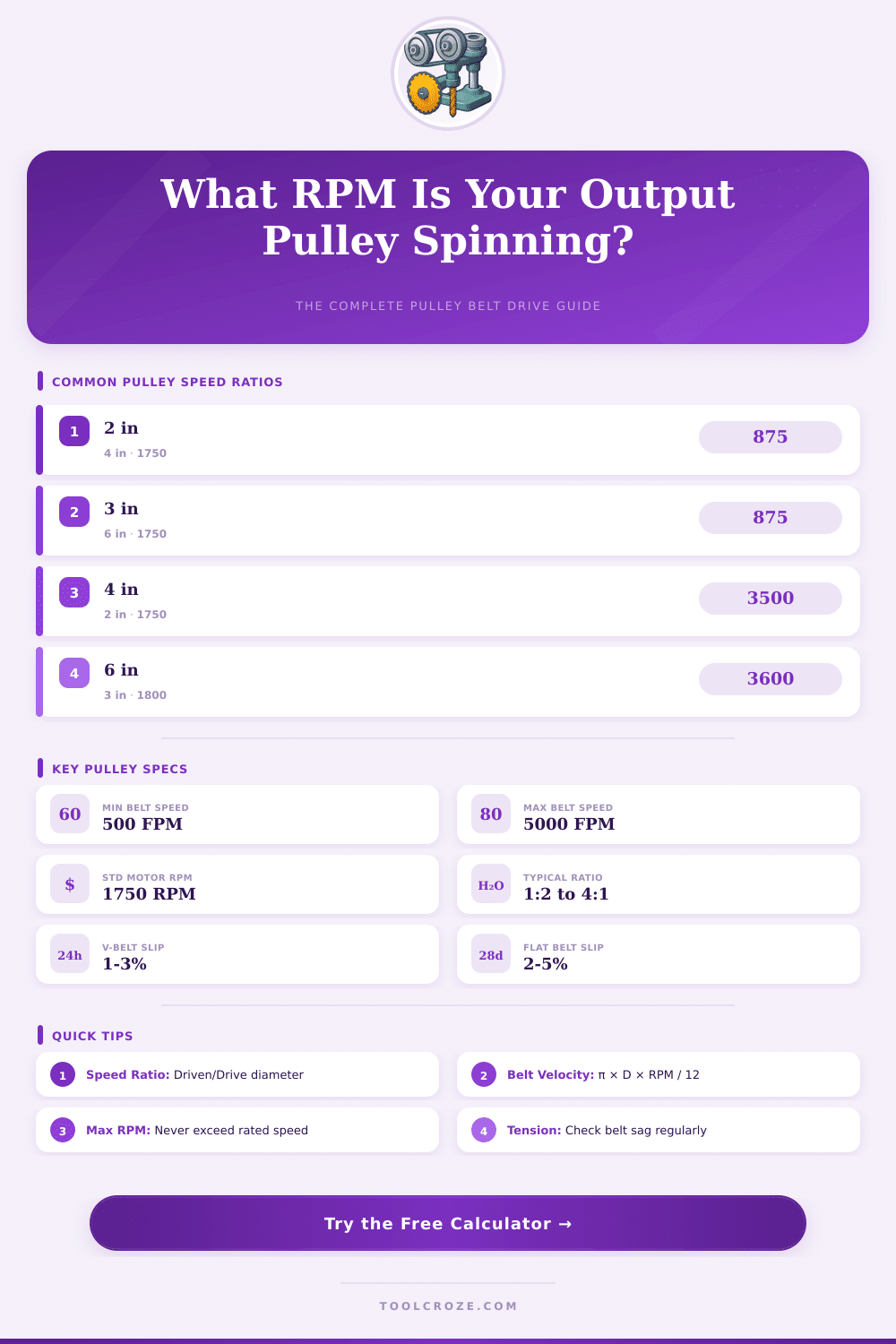
⚙️ Multiple Pulley RPM Calculator
Calculate output RPM, speed ratios, and belt velocity for single or compound pulley belt drive systems
| Pulley Dia (in) | Pulley Dia (mm) | Belt FPM @ 1750 RPM | Belt FPM @ 3450 RPM | Max Rec. RPM | Common Use |
|---|---|---|---|---|---|
| 2" | 51 mm | 916 | 1806 | 8000 | Drill press high speed |
| 3" | 76 mm | 1374 | 2710 | 6000 | Lathe, grinder |
| 4" | 102 mm | 1833 | 3613 | 5000 | General workshop |
| 5" | 127 mm | 2291 | 4516 | 4500 | Band saw, lathe |
| 6" | 152 mm | 2749 | 5419 | 4000 | Air compressor |
| 8" | 203 mm | 3665 | 7225 | 3500 | Pump, conveyor |
| 10" | 254 mm | 4581 | 9031 | 3000 | Industrial fan |
| 12" | 305 mm | 5497 | 10838 | 2500 | Heavy machinery |
| Belt Type | Slip % | Max Speed (FPM) | Power Range (HP) | Typical Ratio | Best Use |
|---|---|---|---|---|---|
| A-Section V-Belt | 1-3% | 4000 | 1-5 HP | Up to 6:1 | Drill press, grinder |
| B-Section V-Belt | 1-3% | 4500 | 3-15 HP | Up to 6:1 | Lathe, compressor |
| C-Section V-Belt | 1-3% | 5000 | 10-40 HP | Up to 7:1 | Industrial pump, fan |
| Flat Belt | 2-5% | 6000 | 1-100 HP | Up to 10:1 | Line shafts, mills |
| Timing Belt (XL) | 0% | 5000 | 0.5-5 HP | Up to 8:1 | CNC, servo drives |
| Timing Belt (L) | 0% | 6000 | 2-15 HP | Up to 8:1 | Machine tools |
| Poly-V Belt | 0.5-1% | 7000 | 1-20 HP | Up to 8:1 | Automotive, HVAC |
| Round Belt | 3-8% | 2000 | Up to 1 HP | Up to 4:1 | Light duty, crafts |
| Machine | Motor RPM | Drive Pulley (in) | Driven Pulley (in) | Output RPM | Belt Type |
|---|---|---|---|---|---|
| 14" Metal Lathe | 1750 | 3" | 6" | ~875 | V-Belt B-section |
| Drill Press (low) | 1750 | 2" | 6" | ~583 | V-Belt A-section |
| Drill Press (high) | 1750 | 6" | 2" | ~5250 | V-Belt A-section |
| 14" Band Saw | 1750 | 3" | 4" | ~1313 | V-Belt A-section |
| 6" Bench Grinder | 3450 | Direct drive | -- | 3450 | None (direct) |
| Air Compressor | 1750 | 6" | 12" | ~875 | V-Belt B/C-section |
| Wood Lathe | 1725 | 2" | 8" (step) | ~431 | V-Belt A-section |
| Milling Machine | 1750 | 4" | 2" | ~3500 | V-Belt B-section |
Calculators, as far as quickly twist Pulley in system with several Pulley, genuinely is useful knowledge. Calculator for two Pulley uses the RPM and diameter of the first Pulley together with that of the second to find the speed of the next Pulley. The main idea is quite easy when one understands it well.
Calculator for Pulley can study system with two Pulley, that binds belt, commonly called belt drive. It finds the RPM of Pulley, their diameters and other parts of the whole setup, as tension of the belt, speed or torque. When you know the RPM of the engine, the diameter of the motor Pulley and that of the driven Pulley, then you can find the missing value by means of standard formula for the speed ratio of Pulley.
Pulley and Belt Speed Calculator
To find the ratio between two Pulley, it is enough to look at their diameters. If the diameter of one Pulley is x and that of the other is y, then the ratio of their turns is reversed regarding their sizes. Like this the bigger Pulley twist more slowly, while the smaller twist more quickly.
Belt on bigger Pulley will rotate more slowly then the engine, that it moves. For instance, the factor could be around 0.5652, when one compares the output RPM with the input RPM.
When dealing about set of several Pulley, the causes become a bit more complex. The first driven shaft moves the second smaller Pulley, thus last. One handles them in pairs and later multiplies the results.
In system with three shafts and four Pulley, the RPM of the final Pulley depends on the RPM of the first and all diameters in the chain.
If the driver engine runs at 1800 RPM and you want around 300 RPM, then the whole ratio needs to be six. You can reach that in one step by means of small Pulley at the driver and big at the driven, or split it in two steps, where the ratios multiply until six.
Double or halve the motor speed needs to halve or double the size of the motor Pulley, so that the driven Pulley stays at same speed. For instance, replacing 3500-RPM engine with 2-inch Pulley by means of 1750-RPM engine forces you to put 4-inch Pulley on the new engine. Power stays steady through shafts and Pulley in the belt drive, although with a bit of loss because of friction.
Power matches torque multiplied by means of turning speed. Two Pulley set on same shaft have same turning speed, but their belt speeds differ from each other.
Although the whole ratio of Pulley stays same, the driver parts twist at same speed for same motor RPM. Interactive programs with lively diagrams help tounderstand, how belt drives work, showing relative speeds and turning moves in real time.