⚡ Multi Strand Wire Gauge Calculator
Calculate AWG, total cross-sectional area, ampacity & resistance for bundled multi-strand wire
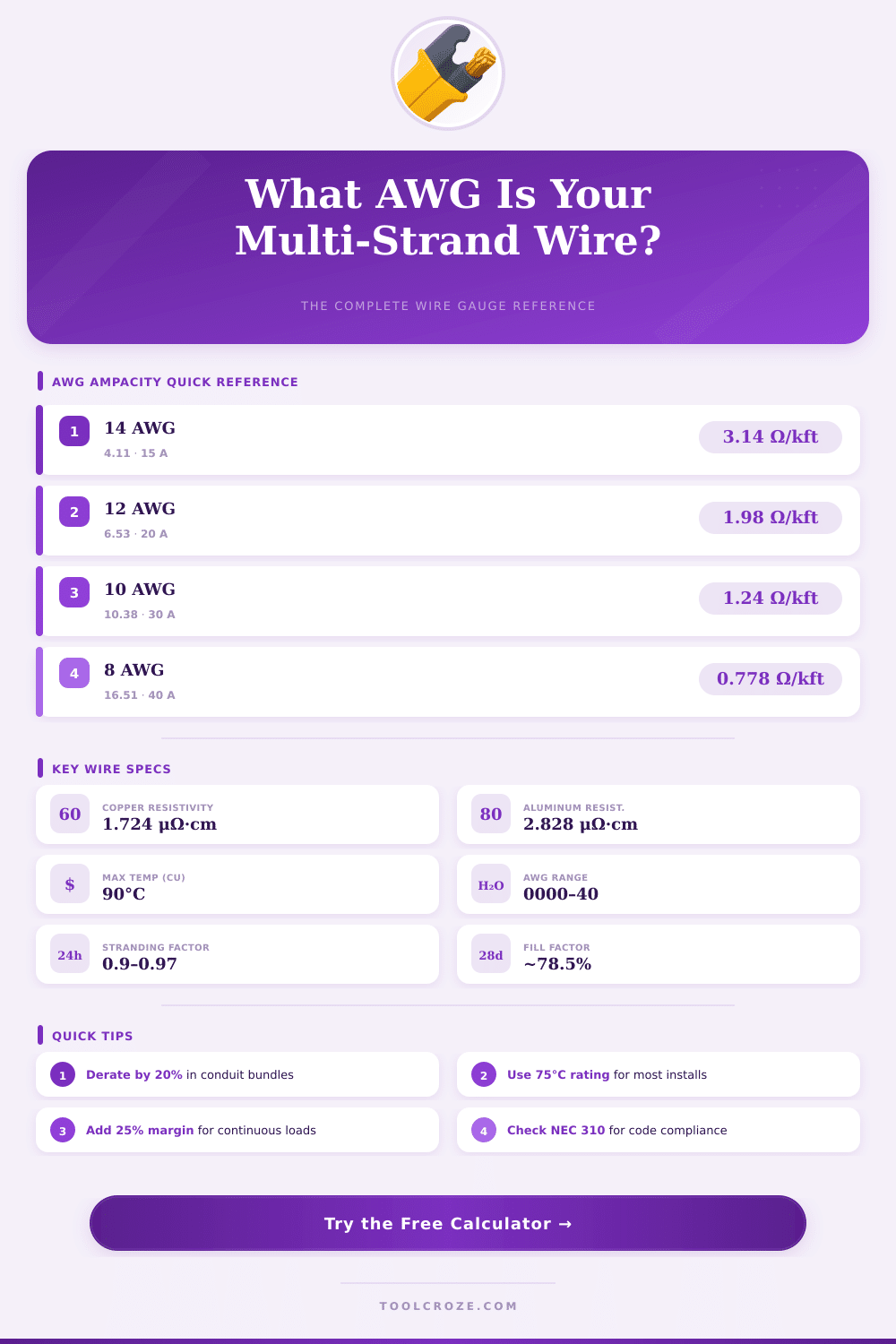
| AWG | Stranding | OD (in) | Area (kcmil) | Cu 75°C Amps | Al 75°C Amps | DC Resist. (Ω/kft) |
|---|---|---|---|---|---|---|
| 18 AWG | Solid / 7×0.015 | 0.040 | 1.62 | — | — | 6.386 |
| 16 AWG | Solid / 7×0.019 | 0.051 | 2.58 | 13 | — | 4.016 |
| 14 AWG | Solid / 7×0.024 | 0.064 | 4.11 | 20 | — | 2.525 |
| 12 AWG | Solid / 7×0.030 | 0.081 | 6.53 | 25 | 20 | 1.588 |
| 10 AWG | Solid / 7×0.038 | 0.102 | 10.38 | 35 | 30 | 0.999 |
| 8 AWG | 7×0.049 / 19×0.030 | 0.128 | 16.51 | 50 | 40 | 0.628 |
| 6 AWG | 7×0.061 | 0.162 | 26.24 | 65 | 50 | 0.395 |
| 4 AWG | 7×0.077 | 0.204 | 41.74 | 85 | 65 | 0.248 |
| 2 AWG | 7×0.097 | 0.258 | 66.36 | 115 | 90 | 0.156 |
| 1/0 AWG | 19×0.066 | 0.332 | 105.6 | 150 | 120 | 0.098 |
| 2/0 AWG | 19×0.074 | 0.373 | 133.1 | 175 | 135 | 0.0779 |
| 4/0 AWG | 19×0.093 | 0.470 | 211.6 | 230 | 180 | 0.0490 |
| Conductors in Conduit | Derating Factor | Example Use | Effect on Ampacity |
|---|---|---|---|
| 1–3 | 100% | Single circuit | Full rated ampacity |
| 4–6 | 80% | Two circuits | Multiply by 0.80 |
| 7–9 | 70% | Three circuits | Multiply by 0.70 |
| 10–20 | 50% | Panel feeder | Multiply by 0.50 |
| 21–30 | 45% | Large panel | Multiply by 0.45 |
| 31–40 | 40% | Distribution | Multiply by 0.40 |
| 41+ | 35% | Cable tray | Multiply by 0.35 |
| Ambient Temp | 60°C Rating | 75°C Rating | 90°C Rating |
|---|---|---|---|
| 21–25°C (70–77°F) | 1.08 | 1.05 | 1.04 |
| 26–30°C (79–86°F) | 1.00 | 1.00 | 1.00 |
| 31–35°C (88–95°F) | 0.91 | 0.94 | 0.96 |
| 36–40°C (97–104°F) | 0.82 | 0.88 | 0.91 |
| 41–45°C (106–113°F) | 0.71 | 0.82 | 0.87 |
| 46–50°C (115–122°F) | 0.58 | 0.75 | 0.82 |
| 51–60°C (124–140°F) | 0.33 | 0.58 | 0.71 |
| Configuration | Strands | AWG Range | Typical Use | Flexibility |
|---|---|---|---|---|
| Solid | 1 | 22–10 AWG | Fixed wiring, NM cable | Rigid |
| 7-strand | 7 | 18–2 AWG | General purpose | Moderate |
| 19-strand | 19 | 6 AWG–4/0 | Feeder, service entry | Good |
| 37-strand | 37 | 2–250 kcmil | Power cables | Very good |
| Class B (7–61) | 7–61 | 14 AWG–1000 kcmil | Standard stranded | Good |
| Class C (19–133) | 19–133 | 14 AWG–1000 kcmil | Flexible cable | High |
| Class K (fine) | 133–2646 | 30–2 AWG | Welding, portable | Very high |
| Class M (ultra-fine) | 2646+ | 30–2 AWG | Welding leads | Extreme |
Multi-strand wire rating can seem difficult at the start, but when you dig into the basics, everything falls in place. That depends on the kind of building or repair that you plan; so, they come in various sizes. We use the American system of Wire Ratings, in short AWG, for describing the diameter of wires everywhere.
But here the key: the rating relates to the total cross-section area of all threads together not to one alone thread by itself.
How Multi-Strand Wire Ratings Work
Stranded wire shows several little conductors, that are twisted or combined inside insulating cover. For instance, 18 AWG isolated multi-strand wire commonly stores 19 of those more fine threads, flatly packed. Even so, here it becomes complex: wires with same equal rating not always has identical number of threads.
One type of 14 AWG wire carries 19 threads, while other version passes easily the 100. Because of that, one can not set precise outer diameter for such wire… It adjusts acording to the case.
Here good way to recall, how the number of threads bind to the rating. Doubling of the conductors indeed lowers the rating by three steps. Two wires of 17-rating side by side match to one of 14-rating.
Well worth to recall that for more eventual use.
Electrically, between multi-strand cable and one solid wire exists almost no important differences. The whole cross-section area of the conductors must be same, regardless of their arrangement. Truly, the stranding cause a bit of differences in diameter, that can ease flow or capacity, but nothing exciting.
Where multi-thread truly projects? In flexibility, certainly. It curves without problems and does not break because of repeated bends.
What happens with solid wire of same rating? It tires quickly, usually at the place where you solder it.
The most usual wire in homes uses solid 14- or 12-rating. Multi-thread however can create troubles, when you work with connectors. It does not hold well under those clamps, rather to the solid kind.
To measure multi-strand wire, you require more effort than one thinks. A caliper can measure the diameter of one thread. Put that number in a list of AWG references, and you have the result.
One can use also calculations of circular area. Wire rating tools seem practical, but that disk metal tool for ratings? They answer only for solid wires.
Because the outer diameter of multi-thread passes that of solid wire with same rating, such tools wrongly measure quite alot commonly.
According to definition of AWG, 36 AWG measures 0.005 inches in diameter, while 0000 AWG reaches 0.46 inches. Every step in rating expands the cross-section area in same proportion always. Bigger numerical ratings point to thinner wire…
What commonly confuses folks initially.