🦷 HSS Drill Speed & Feed Calculator
Calculate exact RPM, feed rate, and cutting parameters for High-Speed Steel drill bits
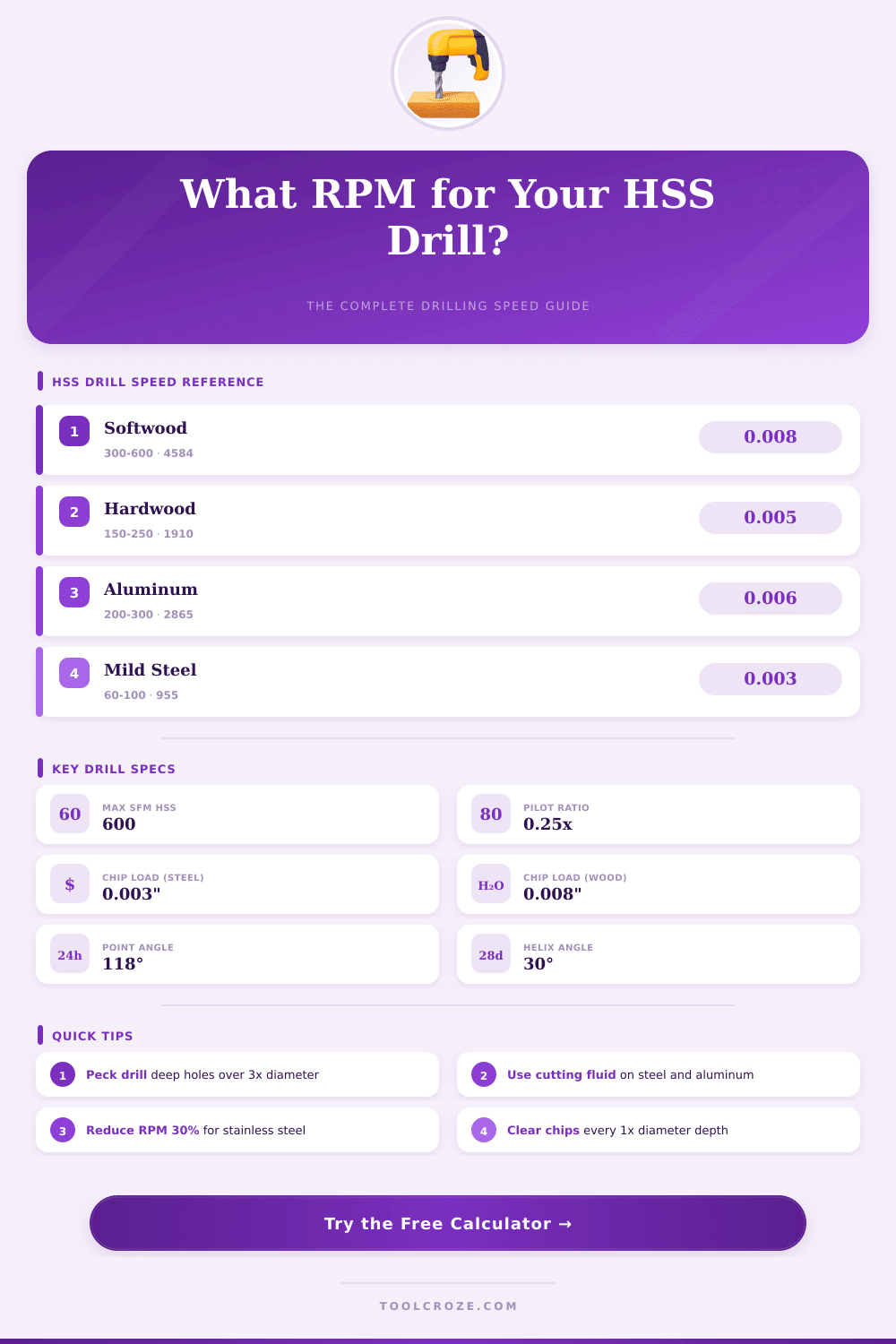
| Material | Recommended SFM | RPM (1/4" bit) | RPM (1/2" bit) | Feed Rate (IPR) | Chip Load/Flute |
|---|---|---|---|---|---|
| Softwood (Pine) | 300–600 | 4,584–9,167 | 2,292–4,584 | 0.008–0.012 | 0.006–0.010 |
| Hardwood (Oak) | 150–250 | 2,292–3,820 | 1,146–1,910 | 0.004–0.007 | 0.003–0.005 |
| Plywood | 200–400 | 3,056–6,112 | 1,528–3,056 | 0.005–0.010 | 0.004–0.007 |
| MDF | 250–450 | 3,820–6,875 | 1,910–3,438 | 0.006–0.010 | 0.004–0.007 |
| Aluminum 6061 | 200–300 | 3,056–4,584 | 1,528–2,292 | 0.004–0.008 | 0.003–0.006 |
| Brass | 150–300 | 2,292–4,584 | 1,146–2,292 | 0.004–0.008 | 0.003–0.005 |
| Mild Steel 1018 | 60–100 | 917–1,528 | 458–764 | 0.002–0.005 | 0.002–0.003 |
| Stainless 304 | 30–60 | 458–917 | 229–458 | 0.001–0.003 | 0.001–0.002 |
| Cast Iron | 50–80 | 764–1,222 | 382–611 | 0.002–0.004 | 0.002–0.003 |
| Acrylic | 100–200 | 1,528–3,056 | 764–1,528 | 0.003–0.006 | 0.002–0.004 |
| Bit Size | Decimal (in) | Metric (mm) | Common Use | Max RPM (steel) | Flutes |
|---|---|---|---|---|---|
| #60 | 0.040" | 1.0 mm | Pilot holes, PCB | 12,000 | 2 |
| 1/16" | 0.0625" | 1.6 mm | Small pilot holes | 8,000 | 2 |
| 1/8" | 0.125" | 3.2 mm | Pilot, anchors | 4,000 | 2 |
| 3/16" | 0.1875" | 4.8 mm | Light fasteners | 2,800 | 2 |
| 1/4" | 0.250" | 6.4 mm | General purpose | 2,000 | 2 |
| 5/16" | 0.3125" | 7.9 mm | Bolts, dowels | 1,600 | 2 |
| 3/8" | 0.375" | 9.5 mm | Common fasteners | 1,300 | 2 |
| 1/2" | 0.500" | 12.7 mm | Large holes | 1,000 | 2 |
| 5/8" | 0.625" | 15.9 mm | Conduit, dowels | 800 | 2 |
| 3/4" | 0.750" | 19.1 mm | Large applications | 650 | 2 |
| 1" | 1.000" | 25.4 mm | Hole saws, spade | 500 | 2 |
| Project | Bit Size | Material | Rec. RPM | Feed (IPR) | Notes |
|---|---|---|---|---|---|
| Deck screw pilot | 3/32" | Softwood | 2,400 | 0.010 | Countersink first |
| Cabinet door hinge | 5/64" | Hardwood | 1,800 | 0.006 | Use brad-point bit |
| Anchor bolt | 1/2" | Concrete | 400 | Manual | Use hammer drill |
| Furniture dowel | 3/8" | Hardwood | 1,200 | 0.005 | Use depth stop |
| Sheet metal screw | 7/64" | Mild Steel | 1,400 | 0.003 | Use cutting oil |
| Electrical conduit | 7/8" | Aluminum | 800 | 0.006 | Use step bit |
| Tap drill (1/4-20) | #7 (0.201") | Mild Steel | 1,600 | 0.003 | Follow with tap |
| Tap drill (10-32) | #21 (0.159") | Aluminum | 2,400 | 0.005 | Cutting fluid rec. |
Find the right speed and feed for drills from HSS can be hard. For soft materials you need bigger RPM, but for hard ones you must lower it. The feed rate shows how quickly the drill goes into the material, and one measures it usually in millimeters each revolution or inches each minute (IPM).
When those two elements combine they very affect the quality of the hole and the life of the tool.
How to Set Speed and Feed for HSS Drills
The simple formula for the feed is the cut depth times the flute number and times the RPM. For the RPM one uses surface feet each minute (SFM) times 3.82, divided by the diameter of the drill. This method gives good results, before you finally set everything at the machine.
The top speeds change a lot according to the kind of material. Aluminium runs at 200 to 300 feet per minute. For low carbon or hot rolled steel it sits aruond 60 to 100.
Cold rolled steel reaches 40 to 70, while cast iron and high carbon or tool steel stays between 25 and 50. For high grade stainless it is only 20 to 30, and for cheaper stainless around 50 to 75. Really, the material type decides everything.
For half-inch drill at 250 feet per minute the RPM results around 2000. Half-inch HSS Drill in 50 SFM would reach about 375 RPM with feed of 0.007 to 0.012 inches each revolution. For number-7 large drill at same surface pace it wood be around 955 RPM with 0.003 to 0.006 inches each revolution.
Start with low feed and a bit raise it is good method.
During drilling of 316 stainless with 3mm HSS Drill, starting values could be 1275 RPM and 2.25 IPM for feed. For cobalt drill in 304 stainless the SFM drops to 35 to 40 with feed of 0.001 to 0.002 inches each revolution. HSS reaches even lower SFM than cobalt, and the tool life will not be long.
The angle of the drill point also matters. 135-degree tip works more for steel, while 118 degrees works well for aluminium. Cobalt tools handle stainless more well than pure HSS.
Carbide drills commonly show themselves more efficient than dulling HSS bits, especially after every two hundredth holes in steel.
Cutting stronger material like A2 tool steel requires to lower the usual speeds and feeds by around a third compared to cold rolled 1018 steel. Quarter-inch drill in 1018 steel reaches around 1200 RPM, but for A2 it falls to about 900. HSS does not well handle materials like 4140 widely.
At strong setups, doing around 30 holes is good production for HSS. HSS Drill bits should stay in brown color range if possible, because the color of chips shows the reached heat during cutting. If you use any HSS Drill at 100 feet per minute, the feed rate for all HSS Drill bits sits between 4 and 8 IPM.
Speeds andfeeds change always according to the actual work.