⚡ Generator Breaker Size Calculator
Calculate the correct circuit breaker size for any generator — residential, portable, or standby
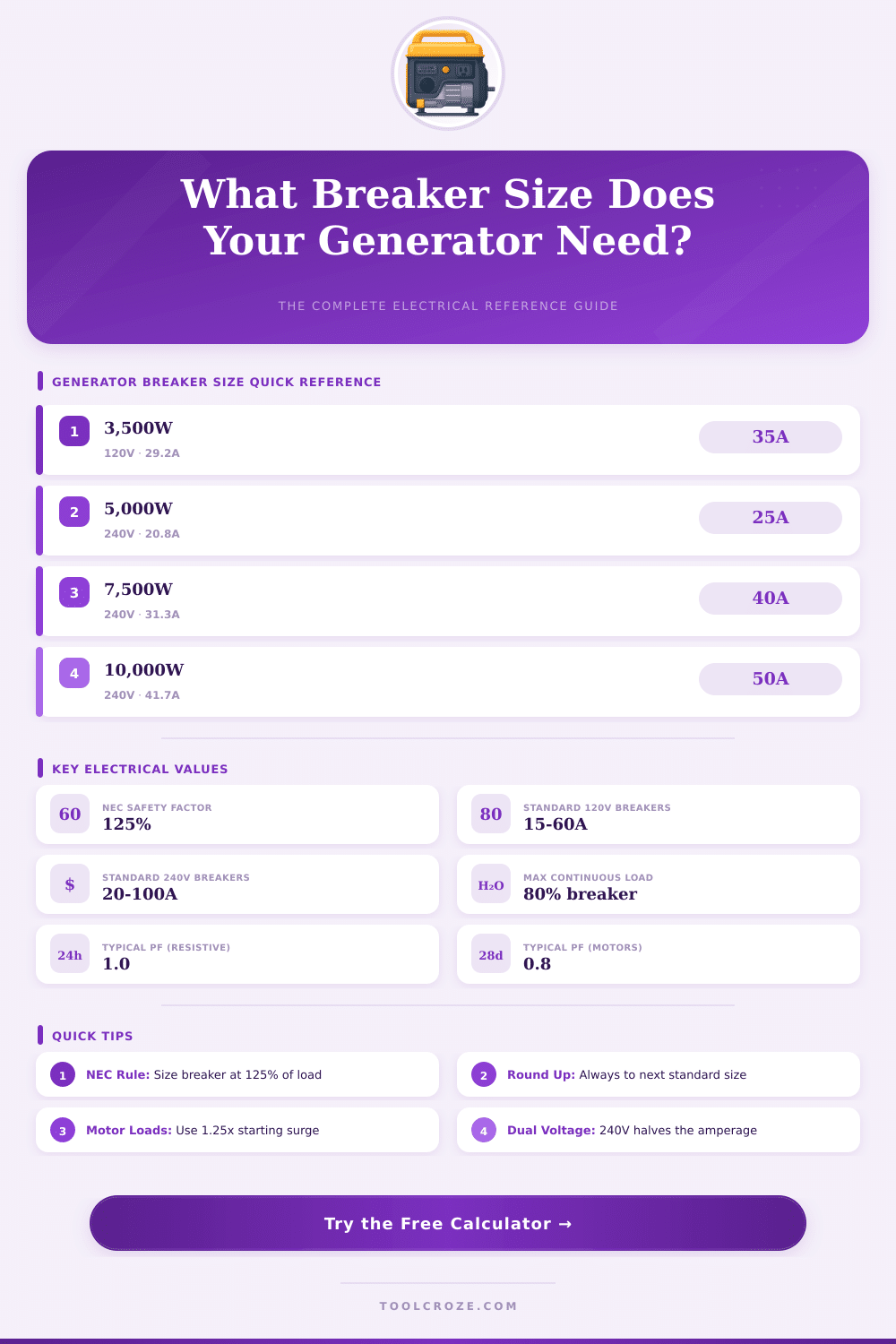
| Generator Output | Voltage | Calc. Amps | Min. Breaker (NEC 125%) | Std. Breaker Size |
|---|---|---|---|---|
| 2,000W | 120V | 16.7A | 20.8A | 25A |
| 2,200W | 120V | 18.3A | 22.9A | 25A |
| 3,500W | 120V | 29.2A | 36.5A | 40A |
| 3,500W | 240V | 14.6A | 18.2A | 20A |
| 5,000W | 240V | 20.8A | 26.0A | 30A |
| 7,500W | 240V | 31.3A | 39.0A | 40A |
| 10,000W | 240V | 41.7A | 52.1A | 60A |
| 12,500W | 240V | 52.1A | 65.1A | 70A |
| 15,000W | 240V | 62.5A | 78.1A | 80A |
| 20,000W | 240V | 83.3A | 104.2A | 110A |
| Breaker Size | Copper AWG | Aluminum AWG | Max Amps (Cu) | Max Amps (Al) |
|---|---|---|---|---|
| 15A | 14 AWG | 12 AWG | 15A | 15A |
| 20A | 12 AWG | 10 AWG | 20A | 20A |
| 25A | 10 AWG | 8 AWG | 30A | 25A |
| 30A | 10 AWG | 8 AWG | 30A | 25A |
| 40A | 8 AWG | 6 AWG | 40A | 40A |
| 50A | 6 AWG | 4 AWG | 55A | 55A |
| 60A | 6 AWG | 4 AWG | 55A | 55A |
| 70A | 4 AWG | 2 AWG | 70A | 65A |
| 80A | 3 AWG | 1 AWG | 85A | 75A |
| 100A | 1 AWG | 2/0 AWG | 110A | 100A |
| 110A | 1/0 AWG | 3/0 AWG | 125A | 115A |
| Load Type | Power Factor | Surge Factor | NEC Multiplier | Notes |
|---|---|---|---|---|
| Resistive (heaters, lights) | 1.0 | 1.0x | 125% | No surge |
| Mixed Residential | 0.9 | 1.25x | 125% | Some motors |
| Motor / Compressor | 0.8 | 2.0x | 125% | High inrush |
| Welder | 0.8 | 1.5x | 125% | Duty cycle |
| HVAC / AC Unit | 0.85 | 2.5x | 125% | Hard start |
| Breaker Rating | Typical Application | Common Voltage | Poles |
|---|---|---|---|
| 15A | Lighting, small outlets | 120V | 1-pole |
| 20A | Kitchen, bathroom outlets | 120V / 240V | 1 or 2-pole |
| 25A | Small generator output | 240V | 2-pole |
| 30A | Dryers, water heaters | 240V | 2-pole |
| 40A | Ranges, large generators | 240V | 2-pole |
| 50A | Large ranges, EV chargers | 240V | 2-pole |
| 60A | 10kW generator output | 240V | 2-pole |
| 70A | 12.5kW generator output | 240V | 2-pole |
| 80A | 15kW generator output | 240V | 2-pole |
| 100A | Sub-panel, large standby | 240V | 2-pole |
| 110A | 20kW generator output | 240V | 2-pole |
| 125A | Main panel, large standby | 240V | 2-pole |
| 150A | 30kW standby generator | 240V | 2-pole |
| 200A | Whole-home standby | 240V | 2-pole |
Election of the right size for generator breaker can confuse. The main thought is to match the generator breaker with the rated output of the generator. Generator of 20 kW delivers around 83 amps at 240 volts during unit of 8000 watts reaches about 33 amps at 240 volts.
So for device of 8000 watts, panel with 30-amp generator breaker would work. For generator of 20 kW with single-phase 120/240V and 83.3 amps one usually picks 80-amp or 90-amp generator breaker.
How to Choose the Right Generator Breaker Size
The question comes up, does the rule of 80% count for generators. The rating of 80% relates to the decrease of the generator breaker to meet the demand of 125% oversizing for constant loads according to the National Electrical Code. One usually sizes generator breakers between 100% and 125% of the rated amps of the generator.
For instance, device with 138 amps output could use generator breaker of 175 amps, reduced to 140 amps. Common chioce is the nearest size above the rated output.
Generator of 10 kW with single-phase 120/240V would require two-pole generator breaker of 40 amps. If it is three-phase 120/208V, then three-pole generator breaker of 30 amps works. For generator of 7 kW at 58.3 amps, one would use 60-amp generator breaker in most cases.
Size of wires matters just as much as that of the generator breaker. The generator breaker must match with the wiring sizes of the house, not only with the generator. Copper wires of size 8 AWG is rated four 50 amps at 75 degrees.
If the generator has 80-amp generator breaker, that works for aluminum wires of size 3 at 75 amps. One unit of 13 kW arrived with installed 100-amp generator breaker. Wire from the generator to the electrical system should have size that matches what the generator breaker allows.
Capacity of leads must reach 115% of the output of the generator, according to section 445.13 of the code. This differs from the rule of 125% for constant loads.
Most portable generators carry generator breaker of 20 to 30 amps. For small units around 3600 watts, 30-amp generator breaker is usual. At generators of 6000 watts, setup of 50 amps happens commonly.
The generator itself does not overload truly, because it automatically shuts off. The generator breaker serves to protect the cable line from the generator to the panel.
Generator breaker of the output on the generator does not help much against overload, except in case of bad short. Generator breaker of 40 amps can work fine, but using parts rated for 50 amps strengthens the system for future needs. When one expects heavy loads, smaller generator breaker of 30 amps can protect the generator better against beingoverloaded.
Range of generators extends from small portable units of 3 kW to huge, truck-mounted ones. Size of the generator breaker always depends on the usage and the capacity of the generator.