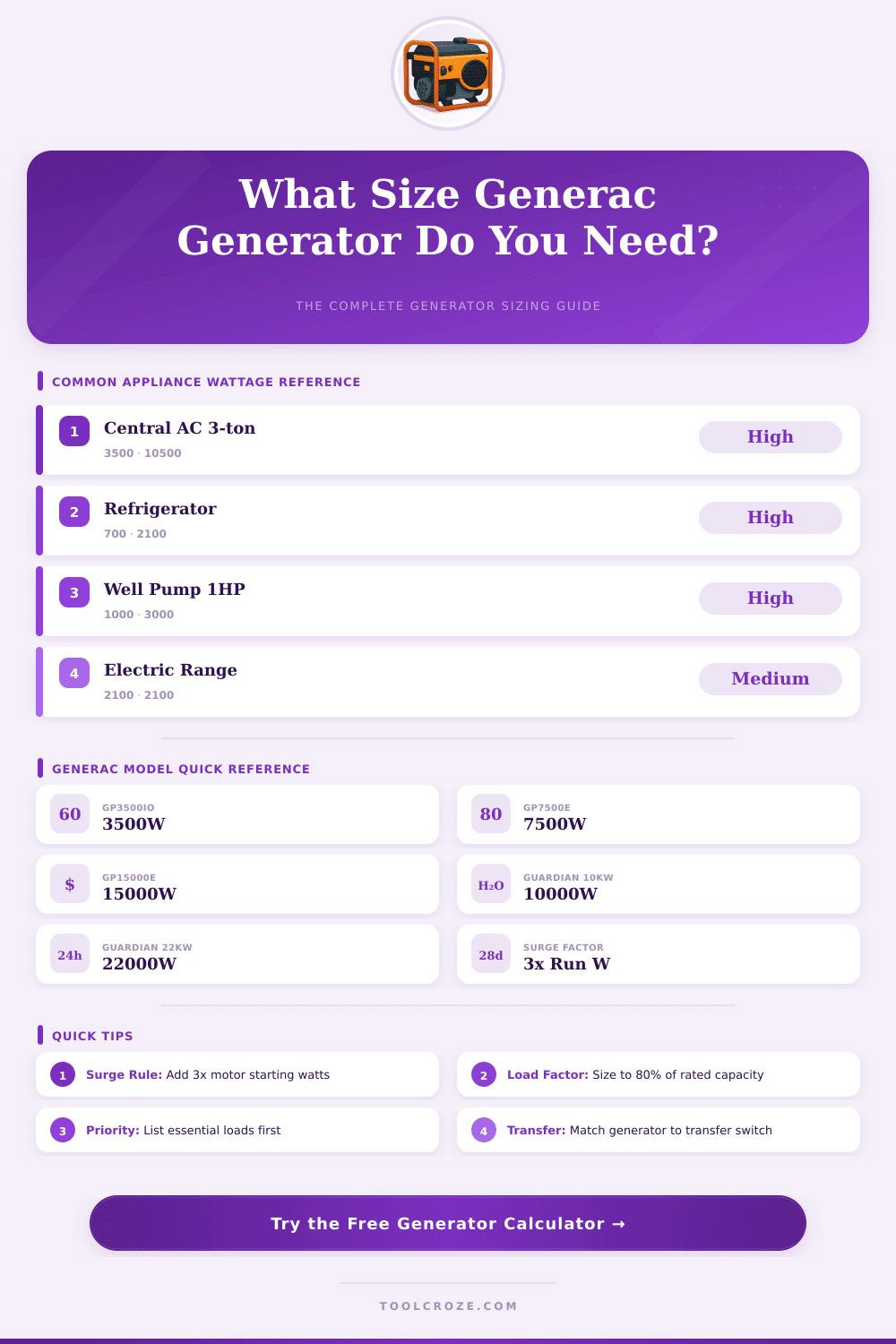
⚡ Generac Generator Size Calculator
Enter your appliances to calculate total wattage and find the right Generac generator model
| Appliance | Running Watts (W) | Starting Watts (W) | Qty | Priority | Remove |
|---|
| Appliance | Running Watts | Starting Watts | Surge Factor | Notes |
|---|---|---|---|---|
| Central AC (3 ton) | 3,500 W | 10,500 W | 3x | Largest surge load |
| Central AC (5 ton) | 6,000 W | 18,000 W | 3x | Consider soft starter |
| Window AC (10,000 BTU) | 1,200 W | 3,600 W | 3x | Common bedroom unit |
| Refrigerator (18 cu ft) | 700 W | 2,100 W | 3x | Cycles on/off |
| Chest Freezer | 500 W | 1,500 W | 3x | Always include |
| Well Pump (1/2 HP) | 750 W | 2,000 W | 2.6x | Critical for households |
| Well Pump (1 HP) | 1,000 W | 3,000 W | 3x | Deeper wells |
| Sump Pump (1/3 HP) | 600 W | 1,300 W | 2.2x | Critical during storms |
| Electric Water Heater | 4,000 W | 4,000 W | 1x | No motor surge |
| Electric Range (1 burner) | 1,500 W | 1,500 W | 1x | Resistive load |
| Microwave (1000W) | 1,000 W | 1,000 W | 1x | No surge |
| Clothes Dryer (electric) | 5,000 W | 6,750 W | 1.35x | Heavy load |
| Furnace Blower (1/2 HP) | 875 W | 2,350 W | 2.7x | Gas furnace fan |
| LED Lighting (whole house) | 500 W | 500 W | 1x | No surge |
| Desktop Computer + Monitor | 300 W | 300 W | 1x | Add UPS for sensitive equip |
| CPAP Machine | 30–60 W | 30–60 W | 1x | Medical — always include |
| Table Saw (10 in) | 1,800 W | 4,500 W | 2.5x | Workshop use |
| Air Compressor (1 HP) | 1,500 W | 4,500 W | 3x | High surge motor |
| Model | Running Watts | Surge Watts | Type | Best For |
|---|---|---|---|---|
| Generac GP3500iO | 3,000 W | 3,500 W | Inverter | RV, Camping, Sensitive electronics |
| Generac GP5500 | 5,500 W | 6,875 W | Portable | Essential home circuits |
| Generac GP7500E | 7,500 W | 9,375 W | Portable | Most homes, 1 AC unit |
| Generac GP10000E | 10,000 W | 12,500 W | Portable | Larger homes, workshops |
| Generac GP15000E | 15,000 W | 22,500 W | Portable | Large homes, 2 AC units |
| Generac Guardian 10kW | 10,000 W | 10,000 W | Standby | Whole-home essential circuits |
| Generac Guardian 16kW | 16,000 W | 16,000 W | Standby | Most homes with AC (automatic) |
| Generac Guardian 22kW | 22,000 W | 22,000 W | Standby | Large homes, full backup |
| Generac Protector 25kW | 25,000 W | 25,000 W | Standby | Large home / light commercial |
| Generac GP2200i | 1,700 W | 2,200 W | Inverter | Tailgating, small appliances |
| Category | Surge Factor | Typical Running W | Power Factor | Priority |
|---|---|---|---|---|
| Resistive (heaters, lights) | 1.0x | 100–5,000 | 1.0 | Optional |
| Motor loads (pumps, AC) | 2.5–3.5x | 750–6,000 | 0.8–0.9 | High |
| Electronic (computers, TV) | 1.0x | 50–400 | 0.9–1.0 | Medium |
| Medical equipment (CPAP) | 1.0x | 30–100 | 0.95 | Critical |
| Power tools (saws, drills) | 2.0–3.0x | 500–2,500 | 0.8–0.9 | Optional |
| Lighting (LED/CFL) | 1.0x | 5–15 per bulb | 0.9–1.0 | High |
| Refrigeration | 2.5–3.0x | 100–700 | 0.85 | Critical |
Choosing the right size for a Generac Generator can seem hard, but everything depends on what you want to keep running when you lack electricity. Generac is the most popular brand in the country because seven out of ten homeowners choose a Generac Generator home standby unit. Those devices restore power to the whole home during electrical outages which is really useful during storms or bad weather.
Generac has a website for counting the size, where you enter your list of devices and receive advice. The process of sizing starts by rating energy needs, that includes both the running watts and the starting watts. Starting watts are especially important, because heavy machines like air conditioners require a sudden rise of energy when they turn on.
How to Choose the Right Size Generac Generator for Your Home
Commonly that extra demand beats the usual use of the house.
Generac Generator standby units come in various size levels. There is a model of 10 kW with a 16-circuit transfer switch, that protects main circuits. The 14 kW version backs more than a 3-ton air conditioner, well pump or water heater.
The 18 kW model is especially popular, because it uses hydraulic valve lifters, so it does not require changing valves. The 22 kW unit has a different engine and requires valve refills, which is worth recalling. In addition, the 24 kW comes with a 200-amp transfer swtich, and even a big 48 kW unit for bigger setups.
The size of the home service panel also matters. For 100-amp service, you can match it with a 12 to 14 kW generator. At a 200-amp panel, the calculations show that a 48 kW generator wood cover the whole load, but that usually is too much.
A unit of 22 kW can run almost everything on 100-amp service. Home models mostly reach around 25 kW, which does not cover a 3,600-square-foot house on a 200-amp panel without risk of overload.
The 24 kW Generac Generator is the most commonly used size in many regions, and it rarely covers the whole home load. One homeowner used the Generac Generator calculator and received advice of 19 to 20 kW. They ultimately bought 24 kW, that operates on propane, although it drops to around 21 kW on natural gas.
About fuel talking, Generac Generator units run on natural gas or propane, and some models give several fuel options. The electronic systems for fuel and ignition optimize the use of fuel for less pollution and better cost savings. Knowing your home size, the amps of the panel andwhich devices are most important helps to simply make the decision about size.