⚙️ Gear Ratio Speedometer Calculator
Calculate speedometer correction, actual vehicle speed, and required speedometer gear teeth for any tire size or axle ratio change.
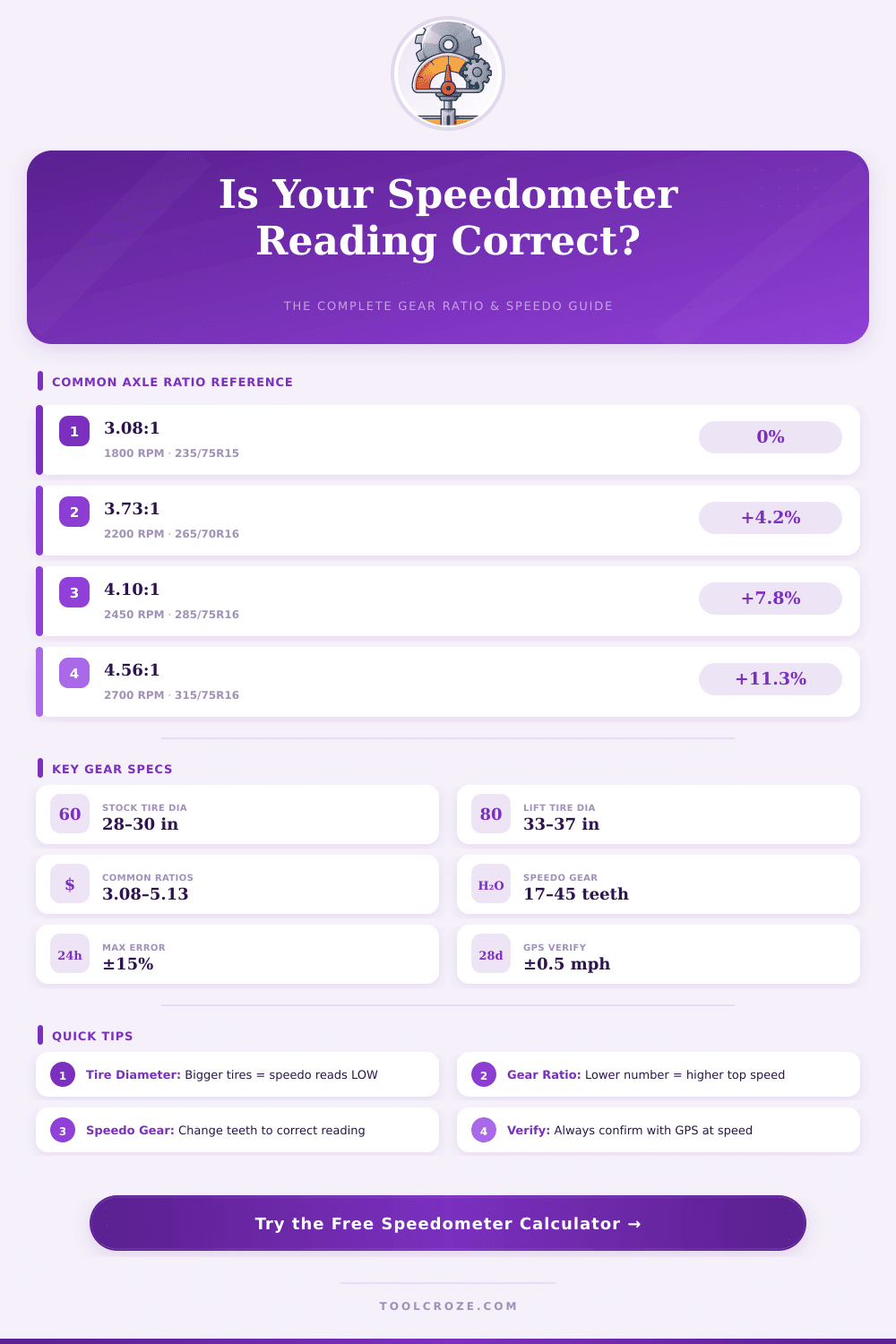
| Tire Size | Tire Dia (in) | Recommended Ratio | Alt Ratio | Speedo Error (Stock 3.73) | Notes |
|---|---|---|---|---|---|
| 235/75R15 | 28.0 | 3.55 – 3.73 | 3.08 | 0% | Stock spec |
| 265/70R16 | 30.6 | 3.73 – 4.10 | 3.55 | +9.3% | Light lift |
| 285/75R16 | 32.8 | 4.10 – 4.56 | 3.73 | +17.1% | Popular 33″ equiv |
| 315/75R16 | 34.6 | 4.56 – 4.88 | 4.10 | +23.6% | 35″ equiv |
| 37x12.5R17 | 37.0 | 4.88 – 5.13 | 4.56 | +32.1% | Rock crawler |
| 40x13.5R17 | 40.0 | 5.13 – 5.38 | 4.88 | +42.9% | Extreme off-road |
| Teeth Count | Color (GM) | Approx Tire Dia Range (in) | Typical Axle Ratio | Application |
|---|---|---|---|---|
| 17 | Pink | 25–26 | 3.08 | Economy cars |
| 19 | Orange | 26–27 | 3.23 | Small trucks |
| 21 | White | 27–28 | 3.42 | Mid-size trucks |
| 25 | Green | 28–29 | 3.55 | Stock 1/2 ton |
| 28 | Blue | 29–30 | 3.73 | Most common |
| 31 | Purple | 30–31 | 3.73–4.10 | Mild lift |
| 34 | Red | 31–33 | 4.10 | 2–3″ lift |
| 38 | Yellow | 33–35 | 4.56 | 4–6″ lift |
| 41 | Gray | 35–37 | 4.88 | Large lift |
| 45 | Black | 37–40 | 5.13 | Rock crawler |
| Vehicle | Stock Tire Dia | Stock Axle Ratio | Stock Speedo Gear | 33″ Tire Error | Corrected Gear (33″) |
|---|---|---|---|---|---|
| Jeep Wrangler JK | 29.9″ | 3.73:1 | 34 teeth | +10.4% | 38 teeth |
| Jeep Wrangler TJ | 28.2″ | 3.73:1 | 34 teeth | +17.0% | 40 teeth |
| Ford F-150 (Gen 13) | 31.9″ | 3.55:1 | Electronic | +3.5% | Programmer needed |
| Toyota Tacoma 2nd | 29.5″ | 3.91:1 | Electronic | +11.9% | Calibrator needed |
| Chevy Silverado 1500 | 31.9″ | 3.73:1 | Electronic | +3.4% | Electronic correction |
| Dodge Ram 1500 | 31.1″ | 3.92:1 | Electronic | +6.1% | Calibrator needed |
| Ford Bronco (2021+) | 31.5″ | 4.46:1 | Electronic | +4.8% | Ford calibration |
The speedometer uses gear teeth to estimate the speed of the car. It includes a driven gear bound to the transmission system of the vehicle. The driven gear teeth mesh with the sweeping gear and their shared ratio has big importance.
When the gear teeth do not match, the speedometer will show wrong speed.
How a Speedometer Works and How to Fix It
Changing the ratio of the back differential or fitting tyres of other size, the speedometer usually starts to err. For example, transfer of 2.73 to 3.73 ratios fits to shift the reading by around 35 percent. The meter then shows higher speed than the car really reaches.
Drive with 70 according to GPS could appear as 73 on the speedometer, even so it must not ever understate the real value, because safety requires that.
One can use a formula to find the right teeth of the sweeping gear. Multiply the number of teeth in the driven gear by the axle ratio, then multiply that by the tire turns each mile and divide the total by 1,001. The turns of tire each mile come by dividing 20,168 by the diameter of the tire in inches.
Hence, know the size of the tire hear really matters.
To get the diameter of the tire, multiply the section width by the side ratio and follow the P-metric side numbers. In one case that gave 27 inches. The count of teeth for the sweeping gear builds on the driven gear, that usually sits in the transmission housing.
In many Muncie-transmissions the driven gear has 8 teeth. With 8-tooth driven gear and 3.36-ratio back gear, one requires 20- or 21-tooth sweeping gear.
Some transmissions require different sweeping gear teeth according to the tooth count. Gear teeth for speedometer come for several transmissions, among that 2004R, TH350, TH400, 700R4, Torqueflite and Ford-units. The formula counts for Chevy, Ford and Chrysler, because their cable speeds for the meter match.
Other simple formula one uses instead. The teeth of the speedometer match 270.29 times the axle gear ratio divided by the listed outer diameter of the tire. Some versions apply 262.19 instead for vehicles with special transfer cases.
Websites offer calculators, that automatically do all these sums. Just enter the teeth of the driven gear, the back ratio, the height of the tire in inches and the turns each mile for the meter.
In some new cars the speed sensor takes data from the ABS tone ring in the back differential instead of counting gear teeth. Here the fixing of the speedometer happens at the store or through the PCM-file. Under the tab of the speedometer in the setup program shows a list where “Use VID” must not turn on.
Otherwise it takes factory data and does not consider uploaded values. After turning that off one can correct the meter right. Worn tyres also affect, because between brand-new and used until the legal limit differ around 3 percent in thereading of the meter.
Motorcycles work a bit differently. Many two-wheelers get data for the speedometer from the front wheel. Adding a part on such cycles will absolutely not change the reading of the meter.