⚡ Electric Motor HP Calculator
Calculate horsepower, power consumption, torque & efficiency for AC and DC motors
| Motor Type | HP Range | Typical Efficiency | Power Factor | Typical RPM | Application |
|---|---|---|---|---|---|
| Single-Phase Induction | 0.25–5 HP | 72–80% | 0.70–0.85 | 1725, 3450 | Compressors, grinders, fans |
| Three-Phase Induction | 1–500+ HP | 85–96% | 0.80–0.95 | 1200, 1800, 3600 | Industrial machinery, pumps |
| NEMA Premium Efficiency | 1–200 HP | 91–96% | 0.85–0.95 | 1800, 3600 | High-duty industrial |
| DC Shunt Motor | 0.1–100 HP | 75–90% | 1.00 (DC) | Variable | Variable speed drives |
| DC Series Motor | 0.1–50 HP | 70–85% | 1.00 (DC) | Variable | Traction, cranes |
| BLDC Motor | 0.01–20 HP | 85–95% | 1.00 (DC) | Variable | EVs, robotics |
| Universal Motor | 0.05–2 HP | 60–75% | 0.75–0.90 | 5000–20000 | Power tools, appliances |
| Capacitor-Start | 0.25–10 HP | 75–85% | 0.75–0.90 | 1725, 3450 | Compressors, pumps |
| HP Rating | kW Output | 120V Amps (est.) | 240V Amps (est.) | Full Load Torque @1800 RPM | Wire Size (AWG) |
|---|---|---|---|---|---|
| 0.25 HP | 0.19 kW | 3.1 A | 1.6 A | 0.88 lb·ft | 14 AWG |
| 0.5 HP | 0.37 kW | 6.2 A | 3.1 A | 1.75 lb·ft | 14 AWG |
| 0.75 HP | 0.56 kW | 9.3 A | 4.7 A | 2.63 lb·ft | 14 AWG |
| 1.0 HP | 0.75 kW | 12.5 A | 6.3 A | 3.50 lb·ft | 14 AWG |
| 1.5 HP | 1.12 kW | 18.7 A | 9.4 A | 5.25 lb·ft | 12 AWG |
| 2.0 HP | 1.49 kW | 25.0 A | 12.5 A | 7.00 lb·ft | 10 AWG |
| 3.0 HP | 2.24 kW | 37.5 A | 18.8 A | 10.50 lb·ft | 8 AWG |
| 5.0 HP | 3.73 kW | 62.5 A | 31.3 A | 17.50 lb·ft | 6 AWG |
| 7.5 HP | 5.59 kW | 93.8 A | 46.9 A | 26.25 lb·ft | 4 AWG |
| 10.0 HP | 7.46 kW | 125.0 A | 62.5 A | 35.00 lb·ft | 2 AWG |
| HP Rating | kW Output | 208V 3Φ Amps | 240V 3Φ Amps | 480V 3Φ Amps | Efficiency Class |
|---|---|---|---|---|---|
| 1 HP | 0.75 kW | 4.0 A | 3.5 A | 1.8 A | Standard |
| 2 HP | 1.49 kW | 7.5 A | 6.5 A | 3.3 A | Standard |
| 5 HP | 3.73 kW | 17.5 A | 15.2 A | 7.6 A | NEMA Eff. |
| 10 HP | 7.46 kW | 33.2 A | 28.7 A | 14.3 A | NEMA Eff. |
| 25 HP | 18.65 kW | 83.0 A | 72.0 A | 36.0 A | Premium |
| 50 HP | 37.3 kW | 166.0 A | 144.0 A | 72.0 A | Premium |
| 100 HP | 74.6 kW | 332.0 A | 288.0 A | 144.0 A | Premium |
| Application | Typical HP | Voltage | Duty Cycle | Recommended Derate |
|---|---|---|---|---|
| Bench Grinder | 0.5–1.5 HP | 120V 1Φ | Intermittent | 10% |
| Air Compressor (small) | 1–2 HP | 120/240V 1Φ | Intermittent | 10% |
| Air Compressor (large) | 3–10 HP | 240V 1Φ / 480V 3Φ | Continuous | 15% |
| Table Saw (contractor) | 1.5–2 HP | 120/240V 1Φ | Intermittent | 10% |
| Table Saw (cabinet) | 3–5 HP | 240V 1Φ | Continuous | 10% |
| HVAC Fan Motor | 0.5–5 HP | 208/240/480V | Continuous | 15% |
| Pump (centrifugal) | 1–50 HP | 240/480V 3Φ | Continuous | 15% |
| Conveyor Belt | 2–25 HP | 480V 3Φ | Continuous | 20% |
| EV Drive (small) | 5–20 HP | 24–96V DC | Intermittent | 10% |
| CNC Spindle | 1–15 HP | 240/480V 3Φ | Continuous | 10% |
An electric motor horsepower ranks between those themes, that seems easy but holds subtle meaning. The idea of final horsepower comes from the start of the 20th century, when engines began to replace steam tools and water wheels. Companies making electrical devices found that saying horsepower helped sell because already one measured mechanical force by means of horsepowers, so that market accepted electrical engines similarly.
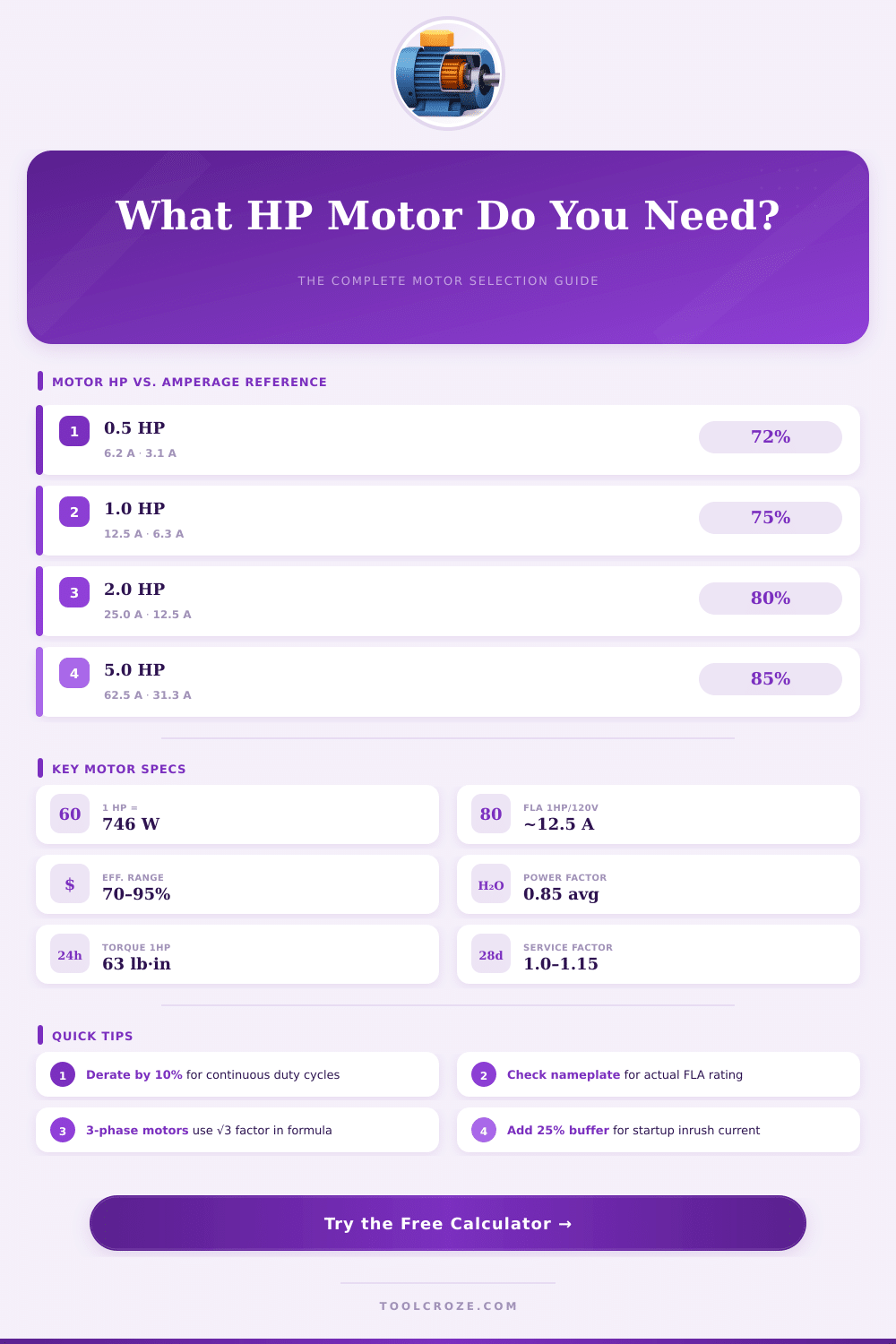
Here the basic math. One horsepower matches to 746 watts. That forms the usual conversion.
What Horsepower Means for Electric Motors
To estimate the horsepower of an electric motor from it, one multiplies the voltage number by the current and the efficiency, later divide by 746. At three-phase engines enter also the power factor and a multiplier of 1.73 in the calculation. The nameplate of the engine, that points values for efficiency and power factor, simplify a lot this task.
Horsepower points the speed, by means of that an electric motor does mechanical work, not the electrical stream. In practice, to receive one horsepower from an electric motor, you need around 900 watts, because part of energy gets lost as heat. An engine of 20 horsepowers with a load of only 5 horsepowers will use fewer power then the same engine at 15 horsepowers of load.
Like this the actual load matters a lot, when one thinks about the real draw of power.
Electrical engines and those on gas reach horsepower entirely different. An engine with internal burning usually delivers its peak horsepower only at one precise number of rotations per minute. Such engines own steep curves of power, where the bottom values reach only a third of the peak.
Electrical engines, rather, give their whole horsepower at almost any rotations per minute. This wider range of power forms a big advantage. An electric motor of 5 horsepowers delivers those 5 horsepowers always, until something breaks, while a gas engine of 5 horsepowers rates at its peak, but actually delivers only the half all the time.
Most engines with alternating electricity in United States spin at 3600 or 1800 rotations per minute, because the American electricity has 60 hertz. In Europe engines run at 3000 or 1500 rotations per minute, because of the 50 hertz of frequency. The horsepower on the nameplate has direct link to the rotations per minute.
Ratings of horsepowers at some engines can mislead. One finds engines of 1/3 horsepower up to 500 horsepowers for industrial heavy tasks. Some cheap engines for home use advertise with too big numbers of horsepowers.
A nameplate of an engine that shows 4 amps for claimed 1 horsepower lies clearly. Watching the amp rating at single-phase home electricity helps to guess the real force. Old engines rated at 1/4 or 1/3 horsepower sometimes seem stronger thannew models of 1/2 horsepower, what raises doubts, did the standards of rating change during the years.