🔧 Drill Cutting Speed Calculator
Calculate optimal RPM, feed rate, and cutting time for any drill bit and material combination
| Material | 1/8" (3mm) | 1/4" (6mm) | 3/8" (10mm) | 1/2" (13mm) | 3/4" (19mm) | 1" (25mm) |
|---|---|---|---|---|---|---|
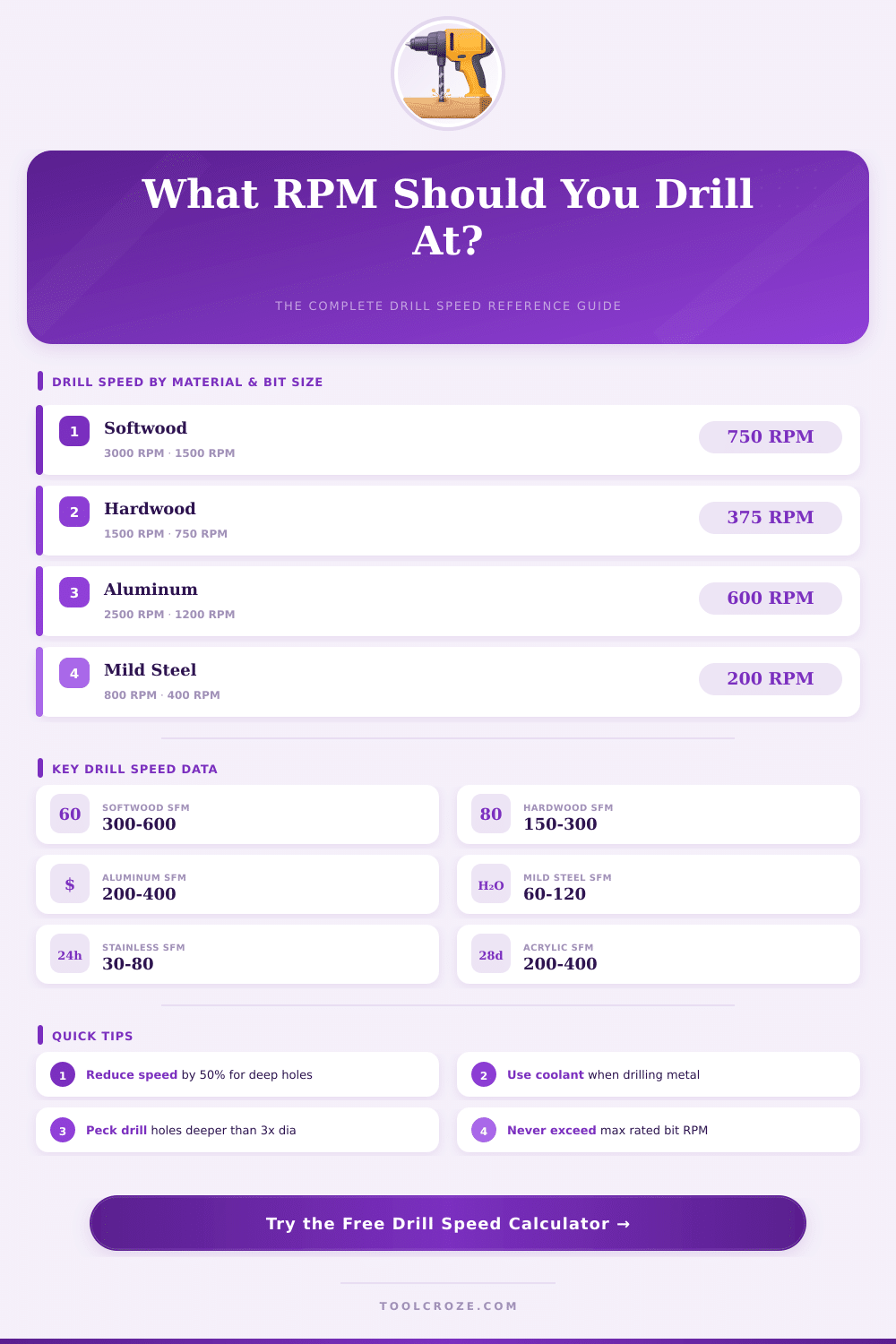
| Softwood | 5730 | 2865 | 1910 | 1430 | 955 | 716 |
| Hardwood | 2865 | 1430 | 955 | 716 | 477 | 358 |
| Plywood | 3820 | 1910 | 1270 | 955 | 636 | 477 |
| MDF | 3820 | 1910 | 1270 | 955 | 636 | 477 |
| Aluminum | 3820 | 1910 | 1270 | 955 | 636 | 477 |
| Mild Steel | 1146 | 573 | 382 | 286 | 191 | 143 |
| Stainless Steel | 764 | 382 | 255 | 191 | 127 | 95 |
| Brass | 2865 | 1430 | 955 | 716 | 477 | 358 |
| Cast Iron | 955 | 477 | 318 | 239 | 159 | 119 |
| Acrylic | 3820 | 1910 | 1270 | 955 | 636 | 477 |
| Bit Size | Type | Flutes | Point Angle | Max RPM | Best For |
|---|---|---|---|---|---|
| 1/16" (1.6mm) | HSS Twist | 2 | 118° | 15,000 | Metal, Wood, Plastic |
| 1/8" (3.2mm) | HSS Twist | 2 | 118° | 7,500 | Metal, Wood, Plastic |
| 3/16" (4.8mm) | HSS Twist | 2 | 118° | 5,000 | Metal, Wood, Plastic |
| 1/4" (6.4mm) | HSS Twist | 2 | 118° | 3,750 | General Purpose |
| 3/8" (9.5mm) | HSS Twist | 2 | 118° | 2,500 | General Purpose |
| 1/2" (12.7mm) | HSS Twist | 2 | 118° | 1,875 | General Purpose |
| 3/4" (19mm) | HSS Twist | 2 | 135° | 1,250 | Wood, Soft Metal |
| 1" (25.4mm) | Brad Point | 2 | 90° | 600 | Clean Wood Holes |
| 1" (25.4mm) | Spade | 1 | 180° | 500 | Rough Wood Holes |
| 1" (25.4mm) | Forstner | 2 | 90° | 400 | Flat-Bottom Holes |
| Material | Chip Load/Flute | Feed Rate at 1/4" | Feed Rate at 1/2" | Coolant |
|---|---|---|---|---|
| Softwood | 0.010" | 28.7 IPM | 14.3 IPM | None needed |
| Hardwood | 0.006" | 8.6 IPM | 4.3 IPM | Optional |
| Plywood | 0.008" | 15.3 IPM | 7.6 IPM | None needed |
| MDF | 0.007" | 13.4 IPM | 6.7 IPM | None needed |
| Aluminum (6061) | 0.004" | 7.6 IPM | 3.8 IPM | Recommended |
| Mild Steel | 0.002" | 1.1 IPM | 0.6 IPM | Required |
| Stainless (304) | 0.001" | 0.8 IPM | 0.4 IPM | Required |
| Brass | 0.003" | 4.3 IPM | 2.1 IPM | Optional |
| Cast Iron | 0.002" | 1.0 IPM | 0.5 IPM | None/Air |
| Acrylic | 0.005" | 9.6 IPM | 4.8 IPM | Air blast |
| Project / Task | Bit Size | Material | Rec. RPM | Est. Time/Hole |
|---|---|---|---|---|
| Cabinet screw pilot | 1/8" | Hardwood | 2,865 | 3 sec |
| Deck board through-hole | 3/8" | Softwood | 1,910 | 5 sec |
| Metal bracket hole | 1/4" | Mild Steel | 573 | 25 sec |
| Plumbing pipe chase | 1" | Softwood | 716 | 8 sec |
| Anchor bolt hole | 1/2" | Stainless | 191 | 90 sec |
| Shelf pin holes | 1/4" | Plywood | 1,910 | 4 sec |
| Electrical conduit | 3/4" | Softwood | 955 | 6 sec |
| Aluminum plate hole | 3/8" | Aluminum | 1,270 | 12 sec |
Sharp pace simply shows the motion at the outer edge of the knife. Imagine it as the amount of material that it goes across per minute here. That depends on things like the kind of raw material, the setup of the tool and the nature of the used process.
Usually one says it in metres each minute. The heat from the cutting itself is a main factor however the hardness, wear and form of the tool also matter.
What Speed to Use When Drilling
Suggested speeds for drills and cutters are basic only for turning the straight sharp pace into rotary form, that is simpler to use. The speed point, as far as times the shaft twist, and one measures it in RPM. The feed gives the tool motion in the direction of the cut hole.
Together the feed and sharp pace control the efficiency of the drill.
For every material there is an ideal pace. High-speed steel cuts average steel at around 100 feet per minute. Like this for a drill of half inch, the calculation gives around 800 RPM as a start.
The formula for speed is the sharp pace times 4, and then divided by the diameter of teh drill. The 4 is a rough number, really it is 3.82, but 4 is simpler to recall.
Big drill bits need fewer turns to remove the same amount of material than little. In 1018-steel with a quarter-inch drill, around 1200 to 1300 RPM work well. For three-eighths, around 900 RPM.
With half-inch, almost 600 RPM. Simple carbon steel allows higher RPM then stainless steel.
Stainless steel barely removes heat. It almost right away destroys the knife. In most metals one can drop the RPM by around 25 percent of the normal boring without coolant, but for stainless the drop must be much more strong.
Cutting fluids help to avoid too much heat.
While hand boring, lower RPM and strong feed help to extend the life of the tool. Folks are fairly weak compared to the force of drill pressure or cutter, so one must avoid pushing too hard to avoid warp or break of the bit. Keep steady pressure, but not too heavy, so that thebit does not bend or break.
Wood is a whole other thing. Boring wood at 2000 to 3000 RPM all day, everything goes well without too much heat or damage of the bit. But boring steel at such paces, the bit quickly warms, the tool loses its knife and stops working.
A good starting rule is 700 to 1000 RPM for steel and more than 2000 for aluminium. If the bits have wrong colours or the drill wears out quickly, slow a bit.
HSS tools are usually used for boring and smoothing, but carbide tipped tools work for special tasks or long production runs. Solid carbide bits allow much more high pace than HSS. Various types of boring have different rules, so these numbers are only a guide.