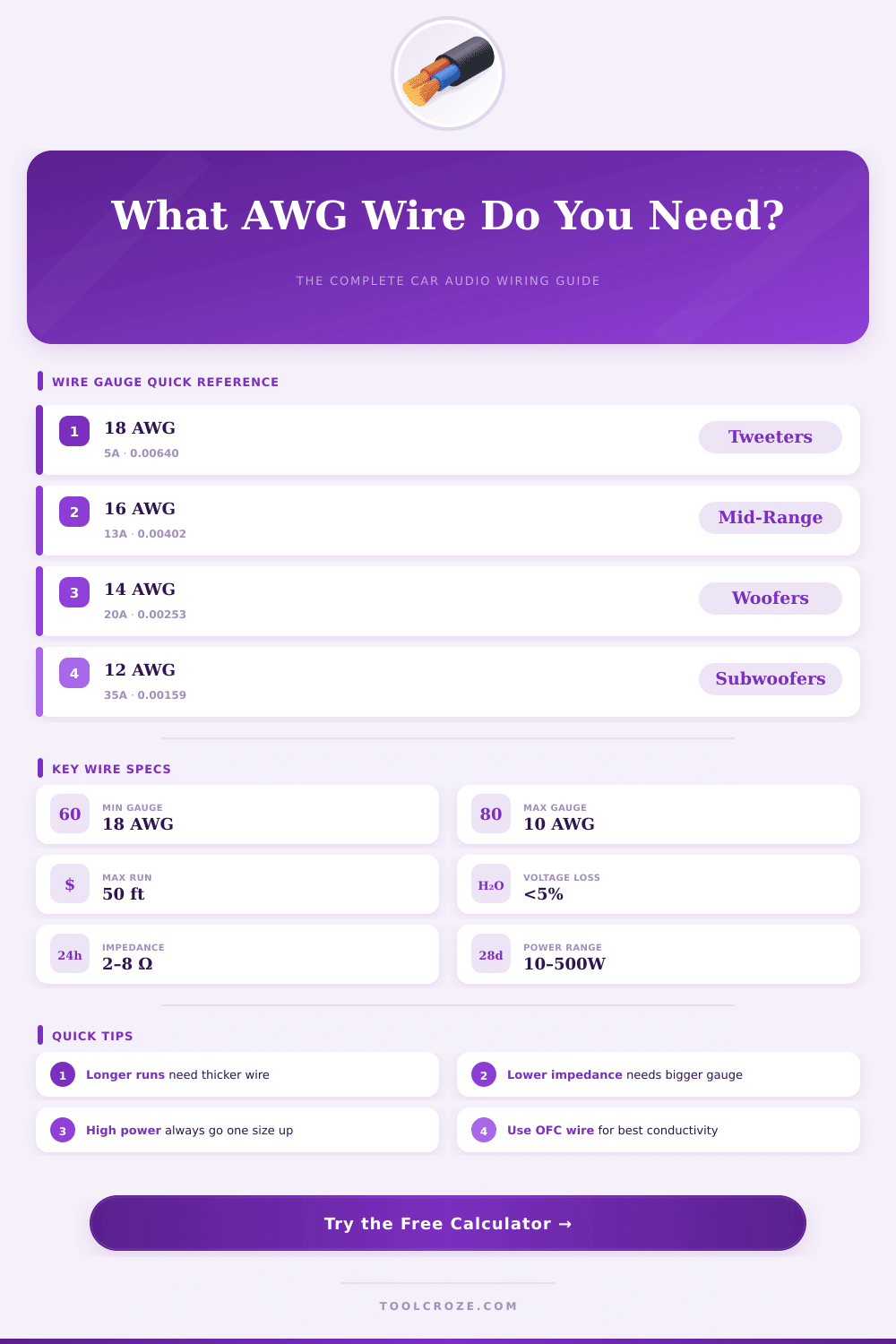
🔊 Car Speaker Wire Gauge Calculator
Find the correct AWG wire gauge for your car audio system — enter power, impedance, and run length for instant results
| AWG | Diameter (mm) | Resistance (Ω/ft OFC) | Max Current (A) | Max Wattage @4Ω | Max Wattage @2Ω | Best Use |
|---|---|---|---|---|---|---|
| 22 AWG | 0.64 | 0.01663 | 3 | 36W | 18W | Low-power tweeter only |
| 20 AWG | 0.81 | 0.01046 | 5 | 100W | 50W | Tweeters, up to 20 ft |
| 18 AWG | 1.02 | 0.00640 | 7 | 196W | 98W | Tweeters, short runs |
| 16 AWG | 1.29 | 0.00402 | 13 | 676W | 338W | Mid-range, coaxials |
| 14 AWG | 1.63 | 0.00253 | 20 | 1600W | 800W | Woofers, subwoofers |
| 12 AWG | 2.05 | 0.00159 | 35 | 4900W | 2450W | High-power subs |
| 10 AWG | 2.59 | 0.00100 | 55 | 12100W | 6050W | Competition builds |
| 8 AWG | 3.26 | 0.000628 | 80 | 25600W | 12800W | Extreme competition |
| Speaker Type | Typical Power | Impedance | Min AWG (<10 ft) | Min AWG (10–20 ft) | Min AWG (20–50 ft) |
|---|---|---|---|---|---|
| Tweeter | 10–50W RMS | 4–8Ω | 20 AWG | 18 AWG | 16 AWG |
| Mid-Range | 50–150W RMS | 4–8Ω | 18 AWG | 16 AWG | 14 AWG |
| Coaxial | 50–200W RMS | 4–8Ω | 16 AWG | 16 AWG | 14 AWG |
| Component | 75–300W RMS | 4Ω | 16 AWG | 14 AWG | 12 AWG |
| Full-Range | 30–100W RMS | 4–8Ω | 18 AWG | 16 AWG | 14 AWG |
| Subwoofer (low) | 150–400W RMS | 4Ω | 14 AWG | 14 AWG | 12 AWG |
| Subwoofer (high) | 400–1000W RMS | 2–4Ω | 12 AWG | 12 AWG | 10 AWG |
| Competition Sub | 1000W+ RMS | 1–2Ω | 10 AWG | 10 AWG | 8 AWG |
| Material | Conductivity vs Copper | Resistance Factor | Best For | Notes |
|---|---|---|---|---|
| OFC (Oxygen-Free Copper) | 100% | 1.0x | All applications | Best conductivity, premium choice |
| CCA (Copper-Clad Aluminum) | 61% | 1.64x | Budget builds | Go 2 AWG sizes larger than OFC |
| Tinned Copper (Marine) | 97% | 1.03x | Humid environments | Best corrosion resistance |
| Standard Copper (OCC) | 99% | 1.01x | General use | Good alternative to OFC |
Choosing the right rating of car speaker wire for car sound systems matters much more than many folks imagine. The rating of wire shows the thickness of the cable according to the American system of Wire Rating, or simply AWG. The less big the number, the fatter the cable.
Like this, 12-rated wire beats the thickness of 14-rated. Fat cable resists less against the flow of electricity, what helps for long runs, systems with high power and speakers of low resistance, for instance 4-ohm or 6-ohm types.
How to Choose the Right Car Speaker Wire
For most car sound setups, 16- or 14-rated car speaker wire works perfectly. Many cars operate best with cable between 16 AWG and 12 AWG. Copper without oxygen is chosen because of good performance and lasting quality.
Some use 12 AWG in their vehicles, what handles all usual situations without problems. Tweetres ja do not require nothing thicker than 18 AWG.
The distance of the wire run and the amount of energy, that passes through it, both decide what rating one takes. When an amplifier stands in the trunk and delivers around 100 watts to the front speakers, 14-rated car speaker wire works reliable. In cars however the runs stay short.
The difference in sound between 14 and 18 ratings only shows in around 40 to 50 feet of wire. Hence for short runs even 20 to 22 ratings can be quite reasonable according too charts of resistance and capacity.
In many cars the factory cables are close to 18 rating. For instance, the 2014 Subaru Forester arrived with 20-rated wire, and changing to 16 ratings gave clear difference here. Factory connection at the door set only to the right function with 18-rated cable, because the pin was too slim, and that setup worked well with 4-ohm speakers and a channel of 75 RMS amplifier.
People commonly write car speaker wire as 12-2 or 12/2. This means 12 ratings for two leads, that carry both the positive and negative signal in one single cable. For subwoofers fatter wire usually helps more.
One commonly runs 8-rated car speaker wire to a subwoofer. Because for mid speakers and tweeters 16 ratings do the task. If a subwoofer needs strong energy, as 1500 watts, then 12 ratings are worth the effort, even for a run of only 3 feet.
A practical rule says, that one chooses a bit thicker than needed. Use 14 ratings for all speakers in the car and 8 ratings to the subwoofer settles most cases. When cable is too slim, resistance grows and can cause warming, what maybe would burn it.
This happens rarely with car speaker wire, but it is good torecall it. The size of the cone does not decide the rating of wire truly. The expected amount of energy, that will flow through the cable, is what truly matters.