⚡ Blue Sea Wire Gauge Calculator
Calculate the correct AWG wire size for marine & automotive 12V/24V/48V DC circuits using ABYC E-11 standards
| AWG Size | Dia (in) | Area (mm²) | Max Amps (60°C) | Max Amps (75°C) | Resist. (Ω/1000ft) | Typical Use |
|---|---|---|---|---|---|---|
| #22 | 0.0253" | 0.33 | 3A | 3A | 16.14 | Low-current instruments |
| #20 | 0.0320" | 0.52 | 4A | 4A | 10.15 | Instruments, alarms |
| #18 | 0.0403" | 0.82 | 7A | 10A | 6.385 | Navigation lights |
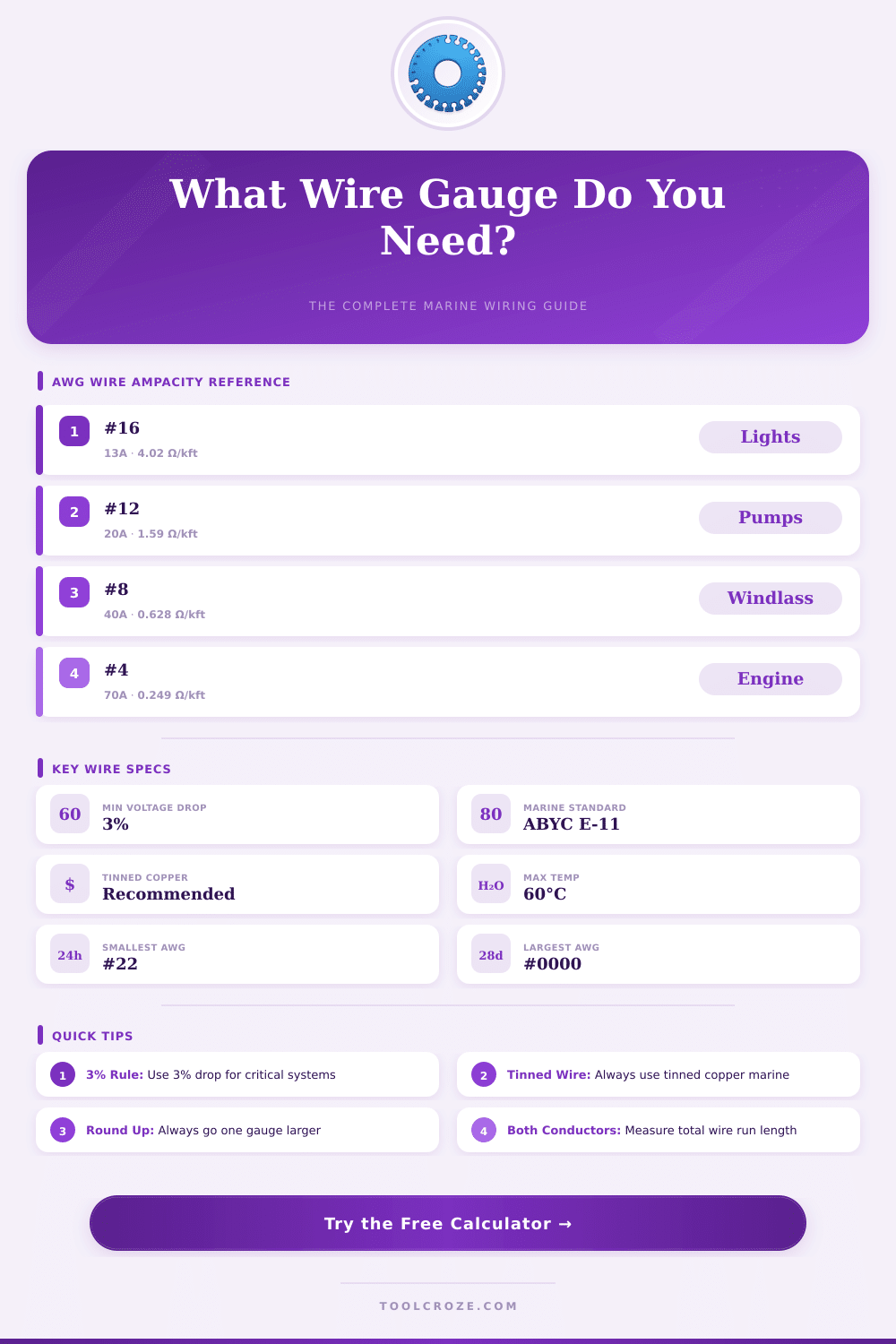
| #16 | 0.0508" | 1.31 | 13A | 15A | 4.016 | General lighting |
| #14 | 0.0641" | 2.08 | 17A | 20A | 2.525 | Small pumps |
| #12 | 0.0808" | 3.31 | 23A | 25A | 1.588 | Pumps, fans |
| #10 | 0.1019" | 5.26 | 30A | 35A | 0.999 | Windlass, large loads |
| #8 | 0.1285" | 8.37 | 40A | 50A | 0.628 | Windlass, thrusters |
| #6 | 0.1620" | 13.30 | 55A | 65A | 0.395 | Alternator output |
| #4 | 0.2043" | 21.15 | 70A | 85A | 0.249 | Engine starter |
| #2 | 0.2576" | 33.62 | 95A | 115A | 0.157 | Battery banks |
| #1 | 0.2893" | 42.41 | 110A | 130A | 0.124 | Battery cables |
| #1/0 | 0.3249" | 53.49 | 125A | 150A | 0.098 | Starter cables |
| #2/0 | 0.3648" | 67.43 | 145A | 175A | 0.078 | High-capacity runs |
| #3/0 | 0.4096" | 85.01 | 165A | 200A | 0.062 | Main distribution |
| #4/0 | 0.4600" | 107.2 | 190A | 230A | 0.049 | Heavy main cables |
| AWG | 5 Amps | 10 Amps | 20 Amps | 30 Amps | 40 Amps | 50 Amps |
|---|---|---|---|---|---|---|
| #18 | 0.64V | 1.28V | — | — | — | — |
| #16 | 0.40V | 0.80V | — | — | — | — |
| #14 | 0.25V | 0.51V | 1.01V | — | — | — |
| #12 | 0.16V | 0.32V | 0.64V | 0.95V | — | — |
| #10 | 0.10V | 0.20V | 0.40V | 0.60V | 0.80V | — |
| #8 | 0.06V | 0.13V | 0.25V | 0.38V | 0.50V | 0.63V |
| #6 | 0.04V | 0.08V | 0.16V | 0.24V | 0.32V | 0.40V |
| #4 | 0.02V | 0.05V | 0.10V | 0.15V | 0.20V | 0.25V |
| Device | Typical Draw | Rec. Wire (12V) | Max Run (3% drop) | Fuse Size |
|---|---|---|---|---|
| Navigation Lights | 3–5A | #18 AWG | 25 ft | 7.5A |
| VHF Radio | 6A TX / 1.5A RX | #16 AWG | 20 ft | 10A |
| Bilge Pump (small) | 3–8A | #16 AWG | 18 ft | 15A |
| Bilge Pump (large) | 10–20A | #12 AWG | 20 ft | 25A |
| Depth Finder / GPS | 0.5–2A | #20 AWG | 30 ft | 3A |
| Anchor Windlass | 60–100A | #4 AWG | 15 ft | 125A |
| Bow Thruster | 80–150A | #2 AWG | 12 ft | 175A |
| Trolling Motor (small) | 30–50A | #8 AWG | 10 ft | 60A |
| Battery Charger (20A) | 20A | #10 AWG | 18 ft | 30A |
| Solar Panel Charge | 10–30A | #10 AWG | 25 ft | 30A |
| Engine Starter | 150–300A | #1/0 AWG | 5 ft | No fuse |
Blue Sea Systems has resources and guides that help to find the right wire gauge of cables for circuits with direct electricity. The company offers a calculator for direct current circuits that allows to enter data about insulation of cable, temperature and various factors for better results. It is simple to use and works on any computer with internet.
After input of details like the rating of cold start amps of battery and if the circuit is main or branch, the calculator shows the suggested wire gauge of cable.
How to Choose the Right Wire Size for Direct Current Circuits
An important thing to recall is that any choice of wire gauge of cable or protection of circuit by means of that resource must be checked by an expert before the assembly. Blue Sea Systems clearly states that they do not answer for any usage of the calculator that leads to wrong wire gauge of cable or protection. So always check twice with someone that knows the relevant rules.
Blue Sea also has a practical guide that helps to estimate the wire gauge of cable for 12-volt direct electricity based on amps, distance and allowed drop of voltage. In a 24-volt system one simply takes half of the roudned distances to correct the upper rating. The sizing of cable must base on 3-percent or 10-percent voltage drop, based on the circumstances.
Here is a sample that shows the function. For a 24-volt system with 3-percent fall, 10-foot circuit and 100 amps you need cable of thickness 6. Different values give different results, so four that one uses the calculator or guides.
A bit of difference can happen between results of the calculator and other guides, that do not perfectly match. For instance, for 12 volts, 40 amps and 6 feet the calculator of Blue Sea suggests 10 AWG. Another guide suggests 8 AWG for 40 amps, and such difference can confuse.
About kinds of cables, SAE ratings are actually less thick than matching AWG of around 5 to 12 percent, and their ability for electricity is usually lower by about 7 percent. ISO ratings for metric cables are a bit lower than values from ABYC standards. So the kind of cable also matters.
For safety, choose tinned cables. The insulation must last 105 degrees Celsius, and that marking is printed directly on the cable itself. Using cable with an 8-percent rating gives space for growth of the system.
Blue Sea also sells items like the block with 6 circuits for fuse holders, negative bus and breaker. Their internal handles for fuses come pre-wired with 12 AWG cable. The company has a good name for reliable power distributionof direct current energy.
More info about choosing protection for circuits is on the website of Blue Sea.