⚙️ Belt Length Calculator
Calculate V-belt & flat belt length from pulley diameters and center distance — imperial & metric
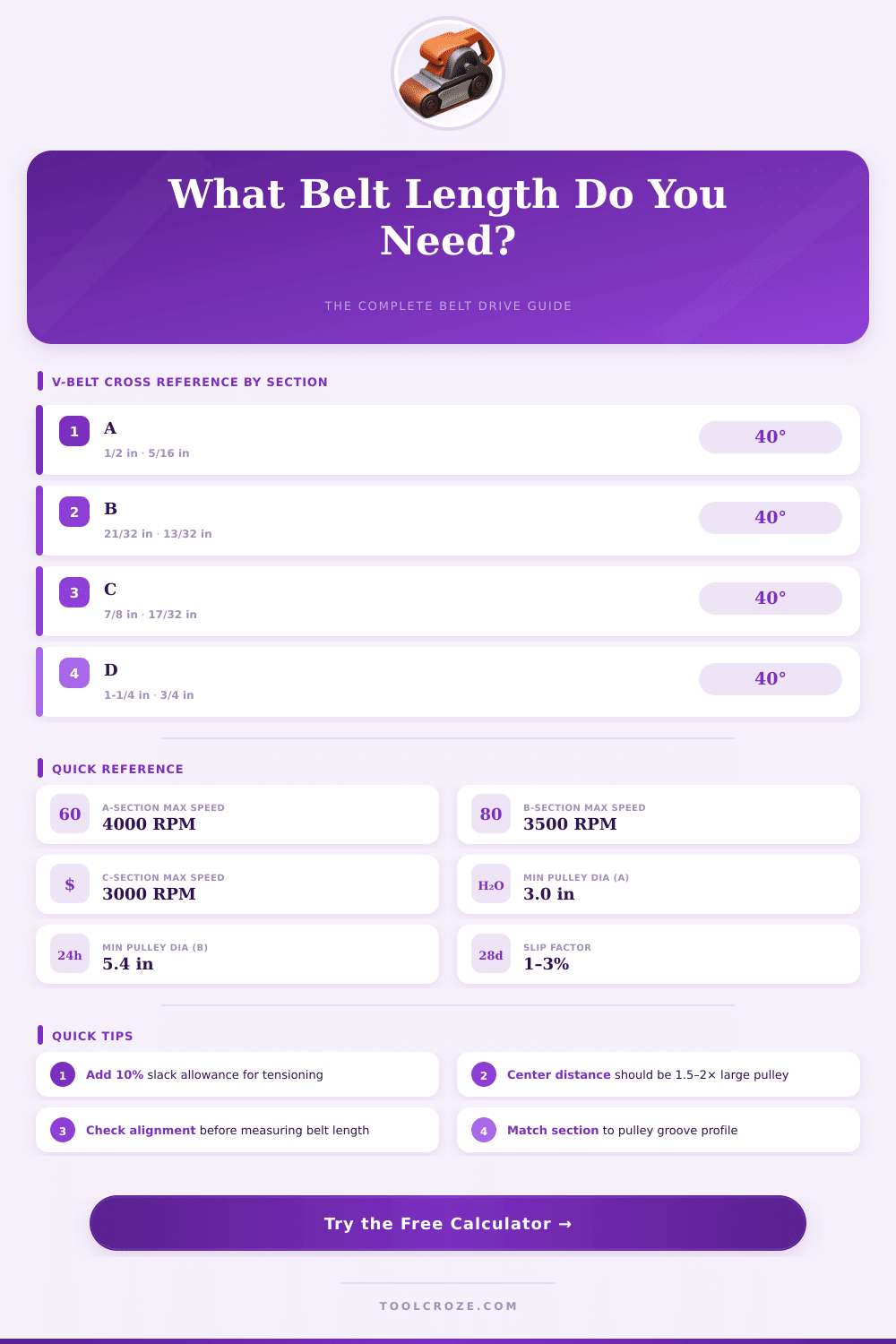
| Section | Top Width | Height | Angle | Min Pulley Dia | Max Speed (ft/min) | Typical Use |
|---|---|---|---|---|---|---|
| A | 1/2 in (13mm) | 5/16 in (8mm) | 40° | 3.0 in | 4,500 | Light machinery, drill press |
| B | 21/32 in (17mm) | 13/32 in (11mm) | 40° | 5.4 in | 4,500 | HVAC fans, table saws |
| C | 7/8 in (22mm) | 17/32 in (14mm) | 40° | 7.0 in | 4,500 | Compressors, industrial |
| D | 1-1/4 in (32mm) | 3/4 in (19mm) | 40° | 12.0 in | 4,000 | Heavy industrial drives |
| 3V | 3/8 in (10mm) | 5/16 in (8mm) | 40° | 2.65 in | 6,500 | High-speed light loads |
| 5V | 5/8 in (16mm) | 17/32 in (14mm) | 40° | 4.4 in | 6,500 | General industrial |
| 8V | 1 in (25mm) | 7/8 in (22mm) | 40° | 7.1 in | 6,000 | Heavy high-speed drives |
| Application | Ideal Belt Speed (ft/min) | Speed Ratio Range | Center Distance Rule | Recommended Section |
|---|---|---|---|---|
| Drill Press | 2,500–3,500 | 1:1 to 4:1 | 1.5–2× large dia | A or 3V |
| Table Saw | 3,000–4,500 | 1:1 to 3:1 | 1.5–2× large dia | A or B |
| Air Compressor | 2,000–3,500 | 2:1 to 5:1 | 2–3× large dia | B or C |
| Lathe | 2,500–4,000 | 1:1 to 6:1 | 1.5–2.5× large dia | A or flat |
| Conveyor (light) | 200–800 | 1:1 to 2:1 | Fixed by layout | Flat belt |
| HVAC Fan | 3,500–5,000 | 1:1 to 4:1 | 1.5–2× large dia | B |
| Industrial Pump | 2,000–4,500 | 1:1 to 5:1 | 2× large dia | C or D |
| Belt Designation | Section | Outside Length (in) | Pitch Length (in) | Outside Length (mm) |
|---|---|---|---|---|
| A30 | A | 32 | 31.3 | 813 |
| A36 | A | 38 | 37.3 | 965 |
| A42 | A | 44 | 43.3 | 1118 |
| A48 | A | 50 | 49.3 | 1270 |
| A54 | A | 56 | 55.3 | 1422 |
| A60 | A | 62 | 61.3 | 1575 |
| B40 | B | 43 | 42.2 | 1092 |
| B48 | B | 51 | 50.2 | 1295 |
| B56 | B | 59 | 58.2 | 1499 |
| B68 | B | 71 | 70.2 | 1803 |
| B80 | B | 83 | 82.2 | 2108 |
Election of the apt longo for zone can be hard. Many folks feel betrayed when deal about the size for order. The best start is made up of some basic guidelines that help.
The main rule is choose zone that matches your waist size in inches. For instance, if you wear jeans of size 34 then order zone of 34. Even so that no always works with every brand.
How to Choose the Right Belt Size
Sometimes a better method is add two inches to your waist. For pants of 32, so, zone of 34 probably will answer well. Some models need even more space.
Four inches above the waist is commonly suggested, although two is enough. It simply depends on the kind of zone and how you intend to use it.
Almost all zones store five holes. The ideal is set it in the third hole. Like this you have the option to tighten or loosen the zone according to your body changes.
It is useful also for range the clothes, for instance neetly tuck the shirt instead of leave it freely or switch between thin pants and heavy materials. The middle hole allows enough longo to nicely fold the finish. From the buckle until the third hole the distance should be won or two inches more than your waist or pants size.
Choose zone two sizes bigger is clear strategy. If you must use only the biggest holes, it looks weird. And in some weight gain, you need a whole new one.
For waist of 36, for instance, zone of 40 answers well, while 38 go with 42.
When you do not own zone for measure, take your favorite jeans and add two inches to its waist size. That gives a solid base for start. If you already have apt zone, simply measure it directly for best result.
Some brands point the longo until the middle hole, so that size 40 have it at 40 inches. Others relate to the nearest pants size. Also centimeters are used for zone sizes.
Waist of 28 until 29 inches matches around 80 cm zone, while 34 until 35 waists go with 90 cm. Zones have also general labels of small until twice extra big. Small answers for 28 until 33-inch waist with 39 inches total, while extrabig served 40 until 45 inches with 56 inches long.