💨 Air Compressor Tank Size Calculator
Calculate the ideal tank capacity (gallons/liters) based on your air tool CFM demand, duty cycle, and PSI requirements
| Tank Size | Typical Use | Recommended CFM | Duty Cycle | Portability |
|---|---|---|---|---|
| 1–6 gal (4–23 L) | Inflation, brad nailers, small touch-up | 0.5–2 CFM | 5–15% | Very portable |
| 6–20 gal (23–76 L) | Framing nailers, trim work, inflation | 2–5 CFM | 10–30% | Portable |
| 20–30 gal (76–114 L) | Impact wrench, spray gun, light grinding | 4–8 CFM | 25–50% | Semi-portable |
| 30–60 gal (114–227 L) | Sanding, painting, air hammers | 6–12 CFM | 40–60% | Stationary |
| 60–80 gal (227–302 L) | Auto body work, plasma cutting | 10–18 CFM | 50–70% | Shop stationary |
| 80–120 gal (302–454 L) | Sandblasting, multi-tool shops | 15–25 CFM | 60–80% | Industrial |
| 120+ gal (454+ L) | Production shops, continuous use | 25+ CFM | 70–100% | Industrial fixed |
| Compressor Type | Typical CFM | Max PSI | Best Tank Size | Typical HP |
|---|---|---|---|---|
| Pancake (single stage) | 0.5–2.5 CFM | 150 PSI | 1–6 gal | 0.5–1.5 HP |
| Hot Dog / Twin Stack | 2–5 CFM | 150 PSI | 4–6 gal | 1–2 HP |
| Vertical Single Stage | 4–8 CFM | 155 PSI | 20–30 gal | 1.5–3 HP |
| Horizontal Single Stage | 5–10 CFM | 155 PSI | 20–60 gal | 2–5 HP |
| Vertical Two Stage | 10–20 CFM | 175 PSI | 60–80 gal | 5–7.5 HP |
| Industrial Two Stage | 15–35 CFM | 200 PSI | 80–120 gal | 7.5–15 HP |
| Rotary Screw | 25–200+ CFM | 175 PSI | 120+ gal / receiver | 10–100 HP |
| Air Tool | CFM @ 90 PSI | Inlet Size | Duty Cycle | Min Tank Rec. |
|---|---|---|---|---|
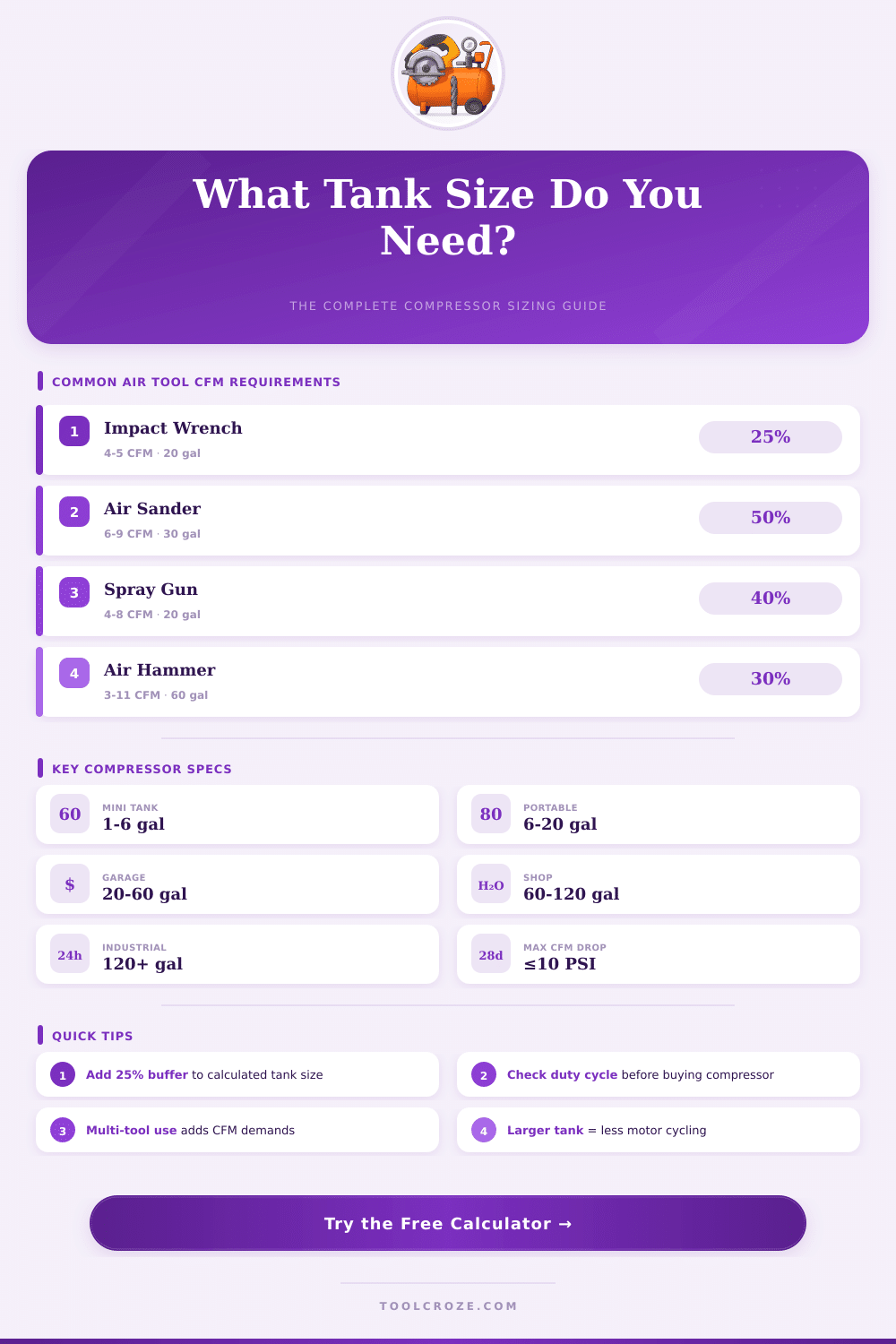
| Impact Wrench 1/2" | 4.0–5.0 CFM | 1/4" NPT | 25% | 20 gal |
| Impact Wrench 3/4" | 7.0–9.0 CFM | 3/8" NPT | 25% | 30 gal |
| Orbital Sander 5" | 6.0–9.0 CFM | 1/4" NPT | 50% | 30 gal |
| Spray Gun HVLP | 4.0–8.0 CFM | 1/4" NPT | 40% | 20 gal |
| Brad Nailer 18ga | 0.5–1.0 CFM | 1/4" NPT | 5% | 6 gal |
| Framing Nailer | 1.5–2.5 CFM | 1/4" NPT | 10% | 6 gal |
| Air Hammer / Chisel | 3.0–11.0 CFM | 1/4" NPT | 30% | 20 gal |
| Air Drill 3/8" | 5.0–8.0 CFM | 1/4" NPT | 40% | 20 gal |
| Die Grinder | 4.0–6.0 CFM | 1/4" NPT | 40% | 20 gal |
| Air Ratchet 3/8" | 3.5–4.5 CFM | 1/4" NPT | 30% | 20 gal |
| Tire Inflator | 1.5–3.0 CFM | 1/4" NPT | 15% | 6 gal |
| Plasma Cutter (air) | 12.0–18.0 CFM | 3/8" NPT | 60% | 60 gal |
| Sandblaster (light) | 15.0–20.0 CFM | 3/8" NPT | 70% | 60 gal |
| Sandblaster (heavy) | 20.0–25.0 CFM | 1/2" NPT | 80% | 80 gal |
Count the right size for an air compressor tank is not easy task, and for that confusion exists valid reason. Many folks do not mind, that the tank size simply points only the ability to store. And nothing else.
Truly important is the CFM, that means cubic feet each minute, because it measures the airflow from the compressor. Here the main point: big tank will not strengthen your airflow for every use. It simply helps you maintain the work more time, before the tank empties and requires new filling.
How to Choose the Right Air Compressor Tank Size
Yes, tank of 60 gallons stores double compared to one of 30 gallons, but if both deliver the same CFM, that extra storage only gives some moments more, before you must wait again.
For finding the size according to your need, I stripped various methods, that work according to your setup. The usual starting rule seems to be around 5 gallons for every CFM, that the compressor produces. One commonly mentions minimum of 2 gallons each CFM, although the most many folks, with that I talked, like to start with up to 4 gallons each CFM, possibly.
Systems for fast blending sit somehwere between 2 and 4 gallons each CFM. Some companies insist on even bigger amount, up to 10 gallons each CFM, together with formulas that depend on the pressure drop, that you accept.
The fastest way to set the tank size? Search your most demanding tool and measure its need of CFM at the needed PSI. Later, multiply that value by 1.25 or 1.5, and round to available tank size.
That does not entirely remove the pauses between fills, but it brings you quite a lot near too practical comfort.
Options for tanks cover whole range. You choose little; around 1 gallon, or truly big, in several thousands of gallons. The most portable models float between 1 and 8 gallons.
In industrial work, one rarely needs more than 20 gallons. For light task like inflating tires or blowing dust, 1 to 2 CFM work well. For nail-guns usually 1 to 3 CFM are ideal.
But for spray painting? Here you will want 20 gallons or more.
Do not skip the type of sheet. Tank of 6 gallons can output only 2 CFM, while other model of same size with more mighty engine reaches 4 CFM. One could assume, that tanks of same size have alike engines, but always exist differences in pressure and easy signs, that surprise.
Choose bigger tank eases the engine, because the unit does not switch always. That improves the energy efficiency and extends the life of your compressor. Add extra tank deserves attention.
Tie portable unit to your main system strengthens the storage when you need it. Place that extra tank according to the tool, that uses the most of air. Pass to broader tubes.
Three-quarter inch instead ofhalf, does clear difference. Extra storage also gives fresher and denser air, what truly helps during spray painting.