🔧 ACME Thread Pitch Diameter Calculator
Calculate major, minor, and pitch diameters for standard ACME threads — imperial & metric, all classes
| Size | TPI | Pitch (in) | Major Dia (in) | Pitch Dia (in) | Minor Dia Ext (in) | Minor Dia Int (in) |
|---|---|---|---|---|---|---|
| 1/4-16 | 16 | 0.0625 | 0.2500 | 0.2188 | 0.1875 | 0.1900 |
| 5/16-14 | 14 | 0.0714 | 0.3125 | 0.2768 | 0.2411 | 0.2440 |
| 3/8-12 | 12 | 0.0833 | 0.3750 | 0.3333 | 0.2917 | 0.2950 |
| 1/2-10 | 10 | 0.1000 | 0.5000 | 0.4500 | 0.4000 | 0.4040 |
| 5/8-8 | 8 | 0.1250 | 0.6250 | 0.5625 | 0.5000 | 0.5050 |
| 3/4-6 | 6 | 0.1667 | 0.7500 | 0.6667 | 0.5833 | 0.5900 |
| 7/8-6 | 6 | 0.1667 | 0.8750 | 0.7917 | 0.7083 | 0.7150 |
| 1-5 | 5 | 0.2000 | 1.0000 | 0.9000 | 0.8000 | 0.8080 |
| 1-1/4-5 | 5 | 0.2000 | 1.2500 | 1.1500 | 1.0500 | 1.0580 |
| 1-1/2-4 | 4 | 0.2500 | 1.5000 | 1.3750 | 1.2500 | 1.2590 |
| 2-4 | 4 | 0.2500 | 2.0000 | 1.8750 | 1.7500 | 1.7590 |
| 2-1/2-3 | 3 | 0.3333 | 2.5000 | 2.3333 | 2.1667 | 2.1790 |
| Class | Application | Pitch Dia Tol. (in) | Major Dia Tol. (in) | Minor Dia Tol. (in) | Allowance |
|---|---|---|---|---|---|
| 2G | General purpose, most common | ±0.0025 | +0.000/-0.005 | +0.010/-0.000 | Moderate |
| 3G | Precision fit, lower backlash | ±0.0018 | +0.000/-0.003 | +0.006/-0.000 | Low |
| 4G | High precision, minimum play | ±0.0012 | +0.000/-0.002 | +0.004/-0.000 | Minimal |
| Material | Brinell Hardness | Recommended SFM | Threading Speed | Notes |
|---|---|---|---|---|
| Mild Steel | 120–180 HB | 50–80 | Moderate | Use cutting oil |
| Stainless Steel | 160–220 HB | 20–40 | Slow | HSS recommended |
| Alloy Steel | 200–300 HB | 30–60 | Slow–Moderate | Rigid setup critical |
| Aluminum | 50–100 HB | 150–250 | Fast | Sharp tooling, flood coolant |
| Bronze / Brass | 60–100 HB | 100–200 | Fast | No coolant often needed |
| Cast Iron | 180–250 HB | 40–70 | Moderate | Dry cut, remove chips often |
| Engineering Plastic | N/A | 200–400 | Fast | Avoid heat buildup |
| Titanium | 300–370 HB | 15–30 | Very Slow | Carbide tooling, flood coolant |
| TPI | Pitch (in) | Best Wire Dia (in) | Wire Constant (in) | M = PD + constant |
|---|---|---|---|---|
| 16 | 0.0625 | 0.02317 | +0.01619 | PD + 0.01619 |
| 14 | 0.0714 | 0.02648 | +0.01851 | PD + 0.01851 |
| 12 | 0.0833 | 0.03089 | +0.02161 | PD + 0.02161 |
| 10 | 0.1000 | 0.03707 | +0.02593 | PD + 0.02593 |
| 8 | 0.1250 | 0.04634 | +0.03241 | PD + 0.03241 |
| 6 | 0.1667 | 0.06178 | +0.04322 | PD + 0.04322 |
| 5 | 0.2000 | 0.07414 | +0.05186 | PD + 0.05186 |
| 4 | 0.2500 | 0.09267 | +0.06482 | PD + 0.06482 |
| 3 | 0.3333 | 0.12356 | +0.08643 | PD + 0.08643 |
The diameter of the pitch ranks between the most important size when one works with Acme Thread type. For design Acme Thread, the main parts include the named size, the number of threads each inch or the pitch, the top diameter, the bottom diameter and especially the diameter of the pitch. Correct that sizes are this important because Acme Thread works entirely different than average threads.
Acme Thread uses a corner of 29 degrees included. Normal threads, like UNC or UNF, have 60-degree included corner, so the profile of Acme Thread shows much more flat. From that lower corner results, that even tiny change in the pitch diameter decides between well sitting fit and something that scratches almost.
Acme Thread Sizes, Pitch and Diameters
This differs strongly from the behavior of 60-degree threads.
One finds three classes of forms for Acme Thread: General Purpose, Centering and Stub Acme. General Purpose and Centering have depth of thread equal to half of the pitch, and they use 29-degree included corner. Stub forms use instead 40-degree included corner.
General Purpose Acme Thread appears in three classes of accuracy: 2G, 3G and 4G. Each of them ensures clear play at all usual sizes for free movement. One uses them in assemblies, where the internal thread stays flat set, while the outer thread moves along its axis, held by guides.
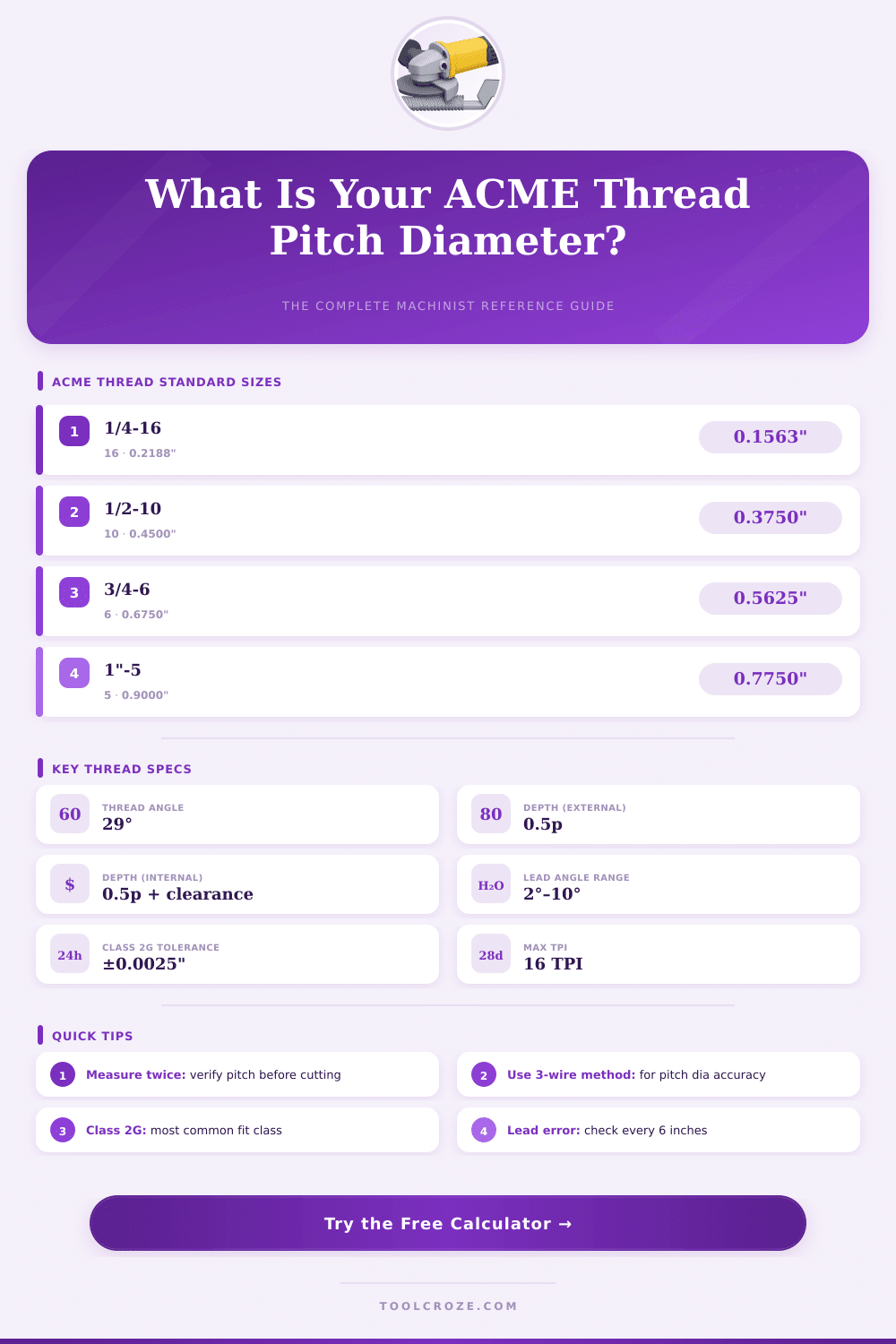
The formula for the basic pitch diameter is simple. It matches too the top diameter reduced by half of the pitch. The pitch itself is made up of one divided by the threads each inch.
The bottom basic diameter comes from the top diameter reduced by the whole pitch. For general purpose Acme Thread, the height of the thread is half of the pitch.
Diameters of Acme Thread range from one-quarter inch until five inches. One can also write them with decimal numbers. For instance, 0.250 for quarter inch or 0.4375 for seven-sixteenths.
All data about sizes follow the American national standard ASME/ANSI B1.5.
Here are real samples. Outer thread 3.5000-4-ACME-2G has top diameter maximum of 3.5000 and minimum of 3.4875. Maximum pitch diameter is 3.3600, minimum 3.3338.
Maximum bottom diameter is 3.2300. The basic height of thread is 0.1350, pitch 0.2500. The included corner is 29 degrees, and it has won start with lead angle of 1.354 degrees.
One designs Acme Thread for motion transfer. Commonly one uses them in vises and lead screw uses. They bear broad flat backs of thread, that allows smooth move.
The pitches one measures by threads each inch. Big pitch provides stronger skill, but hurts the force of thethread itself because of lower depth. One can settle this problem by extending the thread on the body.
For checking the pitch diameter, mostly works the method with one wire. Many Acme Thread parts end a bit oddly, what simply happens sometimes.