
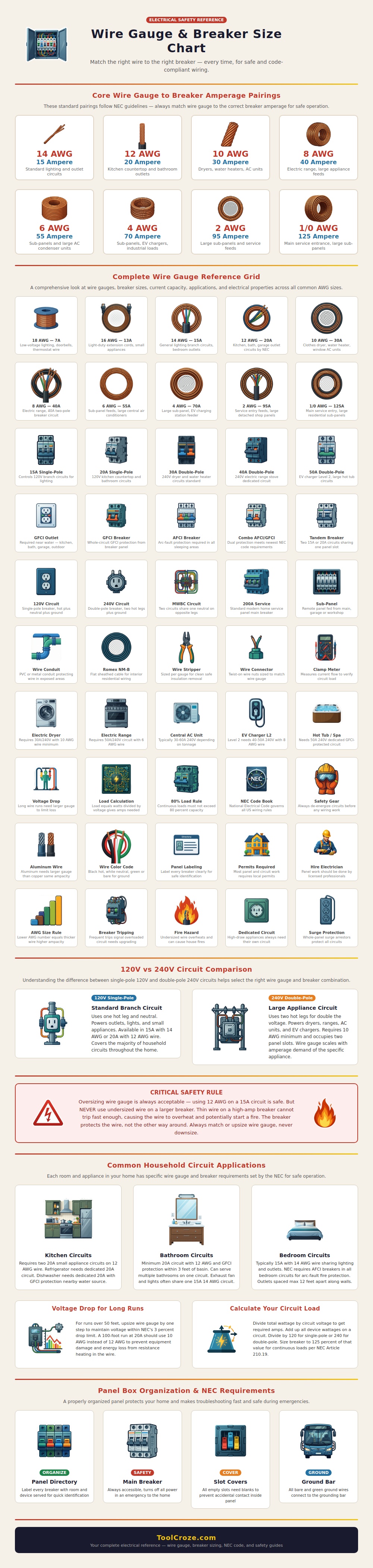
When you are choosing a wire and a breaker, you must ensure that the wire can handle the electrical load without overheating. The electrical load must not create too much heat within the wire. Excessive heat can cause the insulation of the wire to soften over time.
If the insulation of the wire softens, the wire can become a safety risk. A circuit breaker are a device that is designed to trip to protect the wire from overheating. The wire must be sized so that the breaker will trip before the wire overheats.
Choose the Right Wire and Breaker
Thus, the breaker exists to protect the wire. The wire must be thick enough to handle the electrical currents that the breaker allows through the circuit. Another important concept in electrical circuits is the relationship between the wire gauge and the amperage of the breaker.
The thicker the wire, the more current can pass through the wire without overheating. The thicker the wire, the more current that can be carried before overheating occur. Because a thicker wire can handle more current, a thicker wire will require a larger breaker.
If a thin wire is used with a large breaker amperage, the thin wire will overheat before the breaker prevent it. Thus, it is important to match the wire gauge with the breaker amperage to prevent overheating of the wire. Many homes have both 120 volt circuits and 240 volt circuits.
Single pole circuit breakers is used for 120 volt circuits. These types of circuits usually supply outlets and lights in an area. Double pole circuit breakers are used for 240 volt circuits.
These circuits supply heavy appliances to homes. The wire must be scaled to the voltages and amperages of these circuits. For instance, bedroom lights may use a 15 amp circuit with a specific gauge wire.
Kitchen appliances, however, may require a 20 amp breaker and a thicker wire to handle the increased amperage. Distance is another factor that you must consider when choosing the wire gauge for a circuit. The longer the distance between the breaker box and the appliances, the more resistance the wire will have.
The resistance will cause the voltage to drop along the circuit. For example, if the distance between the breaker and the appliances is more than fifty feet, a thicker gauge wire will be required to prevent the voltage from dropping to too low a voltage. Another factor to consider is the concept of continuous loads on a circuit.
A continuous load is one that will be running in three hour periods or more. For continuous loads, the eighty percent rule must be followed. This means that the electrical load on the circuit should be at or below eighty percent of the rating of the circuit breaker.
By keeping the electrical load at eighty percent of the circuit breaker amperage, the amount of heat that build up in the wire and the connections will be minimized. By minimizing the heat in the circuit, the wire and connections will not degrade over time. There are several types of protection devices that are placed into electrical circuits to protect against specific problems.
GFCI outlets and GFCI circuit breakers prevent ground fault in an electrical circuit. These types of outlets are often placed in locations near water. AFCI circuit breakers prevent electrical arcing in a circuit.
These types of circuit breakers is required in sleeping areas of a home. Some circuit breakers are combo units that provide both GFCI and AFCI protection in the circuit. These protection devices, along with the wires, outlets, and appliances in a home form a system of electrical safety.
Another factor is the material of the wire. The current that carries through an aluminum wire is different than a copper wire. Because the current carries through an aluminum wire is different, the gauge of the wire must be larger for aluminum than copper wire to carry the same amount of amperage.
If an aluminum wire is used instead of a copper wire, the aluminum wire should have a larger gauge. This prevents the development of loose connections in the wire. Copper wire is the electrical standard in most moddern new construction homes and circuits.
Many electrical contractors use copper wire instead of aluminum wire to avoid any potential issues with current carrying through aluminum wire. To review the information presented in this project, to select the proper wire for a circuit, the wire must be matched to the electrical load that will be placed into the circuit. Additionally, the breaker should be sized to protect the wire from overheating.
The wire must be thick enough for the number of amps that will pass through the wire, and the breaker should be sized according to the thickness of the wire. If you follow these principles, the wire will not overheat, the voltage will be stable throughout the circuit, and the circuit will be safe to use in the home. You should of matched the wire to teh load first.
Its important to recieve the right parts before you start. Youll want to make sure you got alot of supplies ready. One of the most common mistakes is using a wire that is too thin for the load, and that could cause problems.
Don’t forget that the rooms size doesnt matter for the wiring, but the distance does.
