Winch Line Speed Calculator
Estimate line speed from motor RPM, gear ratio, drum diameter, rope diameter, active cable layer, wraps per layer, load, and pull derating as the rope builds up on the drum.
⚙Winch presets
Start with a realistic ATV, UTV, recovery, trailer, or industrial winch setup, then replace the dimensions with your measured drum and rope data.
📏Drum, rope, motor, and load inputs
Duty changes the suggested pull margin and typical efficiency note.
Rope behavior adjusts packing and bend-ratio warnings.
Use loaded motor RPM if known; no-load RPM will overstate line speed.
Example: 216 means the motor turns 216 times for one drum turn.
Measure the core where the first rope layer touches.
Use the space between flanges, guides, or side plates.
Use measured loaded diameter, including coating or strand crown.
Layer 1 is the first wrap on the bare drum.
Enter your known wrap count or var presets estimate it from drum width.
Anchor wraps are held back from usable rope capacity.
Use the manufacturer's first-layer rating or your test value.
Include rolling resistance, slope, drag, snatch-block geometry, and rigging losses.
Accounts for heat, battery sag, hydraulic pressure drop, wear, and rigging inefficiency.
Lower values are better for uneven spooling or stiff cable.
Used to estimate how many layers are actually on the drum.
Line speed at the load is divided by the number of supporting parts.
A single sheave may lose several percent under load.
Winch speed and pull result
📊Rope, drum, and spec grid
📋Winch speed and pull reference tables
| Winch class | Common pull rating | Typical rope diameter | Common loaded line speed |
|---|---|---|---|
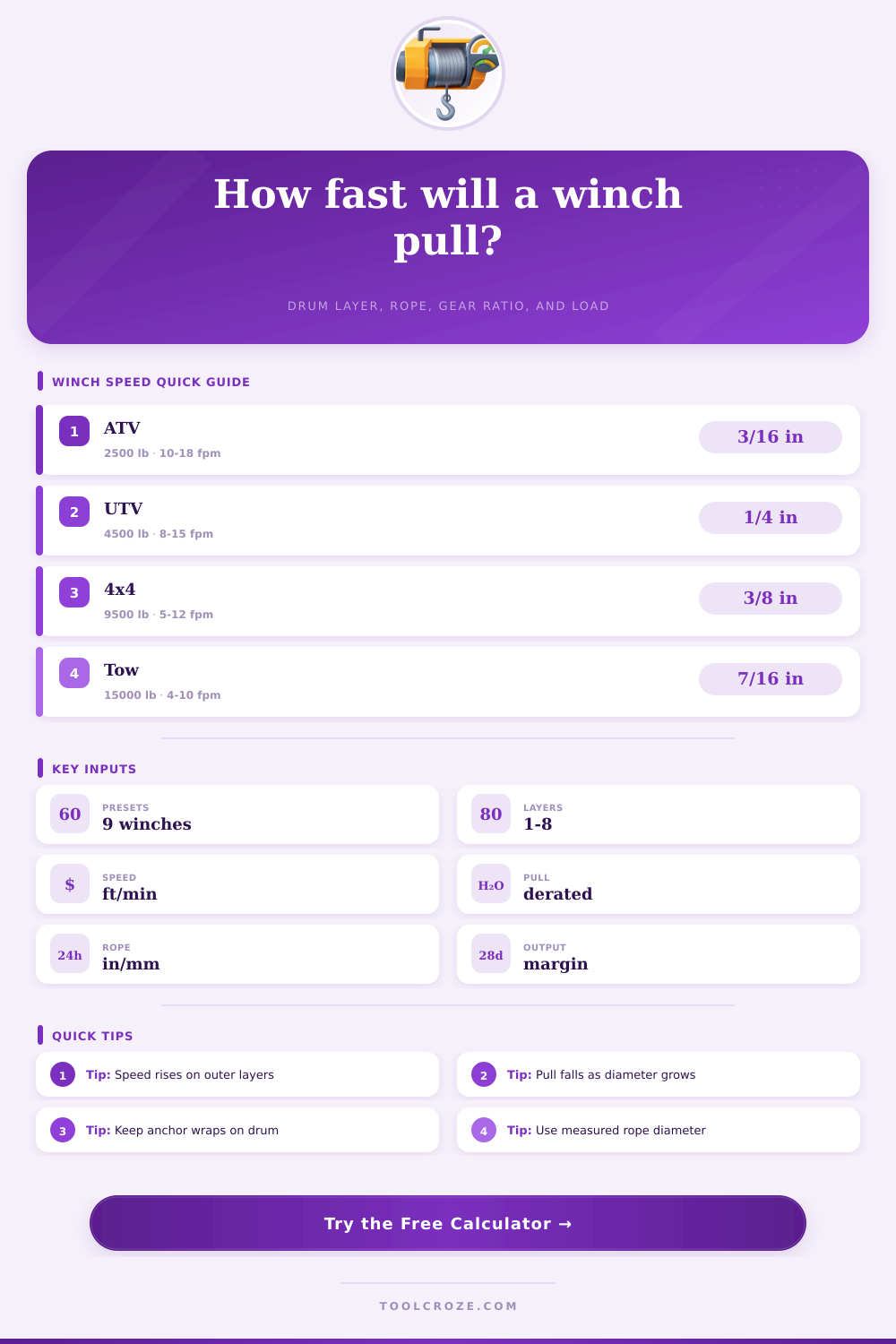
| ATV utility winch | 2000 to 3500 lb / 9 to 16 kN | 3/16 to 7/32 in / 5 to 6 mm | 10 to 18 ft/min when lightly loaded; slower near rated load. |
| UTV recovery winch | 4000 to 5500 lb / 18 to 24 kN | 1/4 in / 6 to 7 mm | 8 to 15 ft/min depending on battery voltage and layer. |
| 4x4 recovery winch | 8000 to 12000 lb / 36 to 53 kN | 5/16 to 3/8 in / 8 to 10 mm | 5 to 12 ft/min under moderate load on inner layers. |
| Trailer or utility winch | 3500 to 9000 lb / 16 to 40 kN | 1/4 to 3/8 in / 6 to 10 mm | 4 to 12 ft/min depending on gear ratio and load. |
| Tow or service winch | 12000 to 20000 lb / 53 to 89 kN | 7/16 to 1/2 in / 11 to 13 mm | 4 to 10 ft/min with hydraulic flow and pressure limits. |
| Layer check | Formula cue | What changes | Why it matters |
|---|---|---|---|
| Layer diameter | drum dia + rope dia x (2 x layer - 1) | Diameter grows each layer by about two rope diameters. | Larger diameter increases line speed because each drum turn reels more rope. |
| Drum RPM | motor RPM / gear ratio | Lower gear ratios spin the drum faster at the same motor speed. | High speed usually trades away torque and heat margin. |
| Line speed | drum RPM x pi x layer diameter | Outer layers are faster than the first layer. | Published speeds often depend on which layer and load are tested. |
| Layer pull | first-layer pull x first-layer dia / active dia | Pull falls as rope stacks farther from the drum center. | A full drum can have much less pull than the bare first layer rating. |
| Multi-part line | load speed / line parts | More line parts slow the hook but raise available load-side pull. | Snatch blocks can improve margin but add friction loss. |
| Rope diameter | Usual winch range | Wraps on 8 in width | Drum note |
|---|---|---|---|
| 3/16 in / 5 mm | 2000 to 3500 lb ATV winches | 35 to 40 wraps per layer with neat packing. | Small drums need careful bend-radius and fairlead alignment checks. |
| 1/4 in / 6 mm | 4000 to 5500 lb UTV and trailer winches | 27 to 31 wraps per layer on typical utility drums. | Synthetic rope packs tighter than old or kinked wire cable. |
| 5/16 in / 8 mm | 8000 to 9500 lb recovery winches | 21 to 24 wraps per layer when the drum is wide enough. | Outer layer speed rises quickly on compact 4x4 drums. |
| 3/8 in / 10 mm | 9500 to 12000 lb recovery winches | 17 to 21 wraps per layer depending on packing. | Common choice for truck recovery; capacity falls if spooling is loose. |
| 7/16 in / 11 mm | 12000 to 15000 lb service winches | 15 to 18 wraps per layer on an 8 inch drum width. | Requires more drum diameter for acceptable bend ratio. |
| 1/2 in / 13 mm | 15000 to 20000 lb industrial or tow winches | 13 to 16 wraps per layer with guided spooling. | Capacity and speed are strongly affected by drum width. |
| Input | Best measurement | Calculator effect | Recheck when |
|---|---|---|---|
| Bare drum diameter | Measure the steel drum core, not the flange. | Sets first-layer torque radius and first-layer speed. | The drum has sleeves, grooves, or welded rope anchors. |
| Rope diameter | Measure across the loaded rope or cable crown. | Controls layer diameter, wraps per layer, and capacity. | Rope is flattened, swollen, kinked, dirty, or new synthetic. |
| Motor speed | Use loaded RPM at the voltage, flow, or pressure being used. | Directly scales drum RPM and line speed. | Battery voltage sags, hydraulic flow changes, or duty cycle heats up. |
| Line pull derate | Choose a realistic reduction for heat, voltage, and rigging friction. | Reduces effective pull after layer geometry is applied. | The winch is hot, old, underpowered, or pulling through blocks. |
| Wraps per layer | Count actual wraps across the usable drum width. | Estimates rope capacity and layer location from installed rope length. | The fairlead lets rope pile up on one side. |
A winch employs a motor, gear ratios, and drum to move rope at a rate that is determined by how the rope is stacked upon the winch drum. The speed of the rope that is being pull by the winch will vary from the speed that is printed upon the motor itself; the rope create multiple layers upon the winch drum. As each layer of rope is added to the winch drum, the diameters of the winch drum increases.
As the diameter of the drum increases, the rope creates a longer distance for travel with each revolution of the winch drum. Consequently, as the rope creates a longer distance for travel with each revolution of the winch drum, the line speed of the rope increase. However, because the winch motor must work harder to move the increased diameter of the winch drum, the pulling power of the winch decreases.
How rope layers affect winch speed and pull
Thus, winches often feel as if they are moving quick when the drum is empty of rope, yet winches may feel slow when the rope is nearly full upon the winch drum. Each new wrap of rope sit upon the previous wrap of rope that is upon the winch drum. Thus, the first wrap of rope is upon the bare metal of the winch drum, but the second wrap of rope is upon the first wrap of that rope.
This second wrap of rope increases the diameter of the winch drum by the thickness of the rope multiplied by two. Each additional wrap of rope increase the diameter of that winch drum again by the same amount. As the diameter of a circle increases, the circumference of that circle increases.
Thus, the outer wraps of the rope will move a greater distance than the inner wraps of the rope with each revolution of the winch drum. These speeds can be calculated by entering the motor speed, gear ratio, bare drum size, and rope diameter into a winch speed calculator. Using such a calculator allows a person to avoid memorizing the mathematical formulas required to calculate these speeds.
The speed of the motor that is under the load of the winch is another figure that a person should understand. The motor speed under load will differ from the speed at which the motor freely runs without any load. Factors that can reduce the motor speed include voltage drop, heat creation, and hydraulic pressure loss.
Voltage drop can occur if the motor is drawing power from a vehicle battery. The gear ratio of the winch divides the loaded motor speed in order to calculate the speed of the winch drum. A high gear ratio will result in a winch with high pulling power (or torque) but at a low speed.
A low gear ratio will result in a winch with low pulling power (or torque) but with high speed. The calculator can help a person to understand how to balance these two factors without having to purchase new hardware for the winch. The diameter of the rope that the winch is to be use can also impact the winch’s performance.
Using a thicker rope will allow for fewer wraps of that rope to sit upon the winch drum. Additionally, the diameter of the rope will also impact the rate at which the diameter of the winch drum increases. The diameter of the rope also impacts the size of the winch drum required to minimize the chance of damaging the rope; synthetic rope can handle tighter bends than wire rope.
Thus, using synthetic rope may cause damage to the winch drum if the diameter of that winch drum is too small to accommodate the rope without creating damaging bends. Finally, the rope will not lie flat upon the winch drum; there will be tension upon the winch drum and the rope will create a certain “fleet angle” upon which it lies. Thus, the packing factor of the rope can be entered into a calculator to allow for the winch to be understood without guesswork as to the actual angle of the rope upon the winch drum.
Load and derate percentages can allow for a winch operator to better understand the measurement of their winch and the load that they wish to move. The rated first-layer pull of the winch is the pull that the winch will create when it is utilizing a bare winch drum and a new rope. As the winch begins to pull the rope and add more layers to the drum, the radius of the winch drum increases.
As the radius of the winch drum increases, the motor will create less line pull. Additionally, heat creation, battery condition, and rigging friction will also reduce the pulling power of the winch. The derate field of the winch calculator will allow a person to model these losses.
If the winch calculator calculates the margin as too low to handle the load that is to be moved, options may be considered to shorten the load, to use a snatch block, or to move the load to a lower layer of the winch drum. Calculations can help a person to understand the capacity of their winch; the capacity is the length of rope that can be cast to the load. The wraps of rope that are attached to the winch drum and that remain upon the winch by design are referred to as “anchor” wraps.
A winch calculator will account for the number of anchor wraps. A winch calculator will also estimate upon which layer of the winch the installed winch rope will be occupying. Thus, a winch calculator will prevent a person from making the common assumption that the winch drum is fully capable of being utilized for the winch operations.
If the length of the rope that is carried by the winch is shorter than the length of the rope that is required to reach the load, a warning will appear upon the display of the winch calculator. Many of the variables of winch operations are difficult to calculate. Yet, the winch calculator can help to provide a baseline understanding of the performance of a winch.
Thus, the calculator allows for a person to test the effects of changing the layer upon which the winch rope is operating or reducing the load by the winch by a certain percentage. The margin number that is displayed will indicate whether or not the change in load will increase the safety of the winch operation. Reference tables can be used to understand the numbers that are displayed by the winch calculator.
For instance, the reference tables can include typical line speeds of winches of each class, the sizes of the ropes for those winches, and other specifications. Yet, these tables are not guarantees as to the performance of a winch. For instance, reference tables may indicate that a winch with a 9500-pound recovery capability will travel at a line speed of between five and twelve feet per minute when operating on its second layer with a moderate load.
Thus, a person can use these reference tables to understand whether the winch calculator is providing an accurate calculation of the performance of the winch. Another factor to consider when choosing the diameter of the rope for the winch is the tradeoffs that will result from that choice. Using a smaller diameter rope will increase the capacity of the winch and the line speed of the rope.
Yet, the strength and durability of the rope will decrease if the diameter is reduced. Additionally, the strength of the rope will increase with an increased rope diameter; however, the number of wraps of rope that can be incorporated into each layer will decrease with an increase in that rope diameter. Furthermore, if the diameter of that rope is too great for the size of the winch drum, the bend ratio of the winch and rope will appear poorly.
Thus, tradeoffs between these factors must be considered when choosing the size of the rope for the winch. Another factor that will impact the performance of the winch are the components of a multi-part rigging. Adding a snatch block will increase the available pulling power of the winch; however, the number of parts of the block will divide the line speed and some friction losses will occur.
The block efficiency field of the calculator will allow for these losses in efficiency to be accounted for in the calculation of the performance of the winch. However, using snatch blocks will allow for more rope to be pulled; yet, if the efficiency of those components drops to eighty-five percent or below, the pulling margin that is gained by the addition of these blocks will decrease. Thus, many winch operators will opt to change their approach angle rather than add snatch blocks to their winch operations.
Another factor that will impact the performance of the winch are the manner in which the rope is spooled upon the winch drum. If the rope is spooled loose upon the winch drum, that winch drum will develop tension upon the rope and the wraps will not be even. These even wraps will impact the diameter and number of wraps of the rope upon each layer.
Thus, the packing factor field allows for a winch operator to account for these effects upon the performance of the winch. Many winch operators will choose to respool the winch rope under moderate tension after the first pull of the winch. Winches and winch operations involve a certain amount of risk; the calculator cannot provide an understanding of the risks that are to be taken with the winch operation.
For instance, no calculator will be able to detect a rope that is fray, a fairlead that is damaged, a battery that is low in charge, or any other risk that may arise when the operator attaches the winch to the load. Thus, the calculator is provided to assist in the understanding of the winch’s performance; yet, visual and manual inspections of the winch must be performed prior to the attachment of the winch’s hook to any load. The purpose of the winch calculator is to assist in the understanding the performance of the winch by an operator.
Thus, once a person understands the speed of each layer of the rope, the pulling power of the winch, and the margin of that winch, a decision can be made regarding the changes that should of be made to the rigging.