Air Compressor Duty Cycle Calculator
Check whether a compressor run/rest pattern can support your air demand, tank reserve, motor load, thermal class, and ambient temperature.
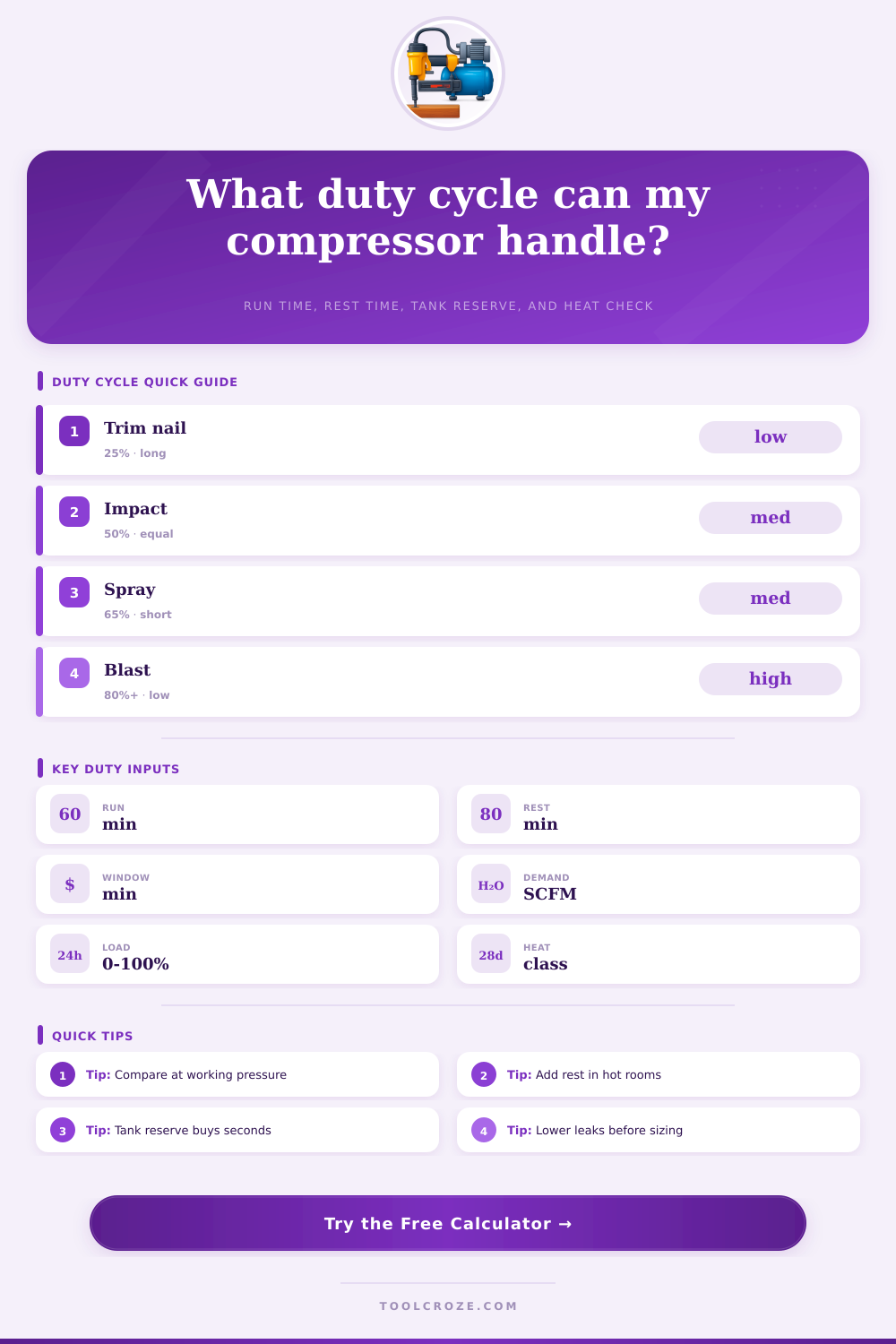
⚙Duty Cycle Presets
Choose a real shop scenario, then adjust the numbers to match the compressor rating at your working pressure.
📏Cycle Inputs
Use actual loaded pump time and stopped cooling time.
The work period you want to evaluate.
Use delivered air at the same PSI as your tool demand.
Average demand, including leaks and overlap.
Usable air between cut-out and the minimum working pressure.
Select the closest manual rating or pump style.
High amperage, pressure, or hot starts raise this value.
Use the temperature around the motor and pump, not outdoor shade.
🔧Compressor Duty Class Snapshot
📊Duty Cycle Reference Tables
| Thermal class | Typical duty limit | Good match | Watch closely |
|---|---|---|---|
| Light intermittent, oil-free portable | 20% to 35% | Inflation, brad nailers, short blow-off | Long sanding, spray work, hot garage use |
| Standard shop compressor | 45% to 60% | Impact bursts, framing nailers, general shop air | High overlap or high pressure operation |
| Heavy duty cast iron pump | 65% to 80% | Small production work, plasma, steady air tools | Restricted cooling or long peak-load runs |
| Continuous rated industrial unit | 90% to 100% | Process air, CNC, continuous tooling | Dirty coolers, overload amps, poor ventilation |
| Ambient condition | Temperature band | Rest adjustment | Practical note |
|---|---|---|---|
| Cool shop | Below 60°F / 16°C | No added rest | Still keep intake filters and motor fins clear. |
| Normal room | 60–85°F / 16–29°C | Use normal duty limit | Most nameplate duty ratings assume this range. |
| Hot garage | 86–100°F / 30–38°C | Add about 10% rest | Heat soak can delay pressure switch recovery. |
| Severe heat | Above 100°F / 38°C | Add 20% or more rest | Reduce demand or improve airflow before long runs. |
| Air use | Typical demand | Duty pattern | Reserve target |
|---|---|---|---|
| Brad or trim nailer | 0.5–2 SCFM | Short bursts | 15–30 seconds is usually enough. |
| Impact wrench | 4–8 SCFM | Burst then recovery | 30–60 seconds helps avoid slow torque. |
| HVLP spray gun | 8–15 SCFM | Long trigger pulls | 60 seconds or more protects finish consistency. |
| Blast cabinet | 10–25 SCFM | Heavy continuous | Tank reserve is brief; pump rating matters most. |
| Compressor style | Common spec range | Usable duty expectation | Best fit |
|---|---|---|---|
| 1 to 6 gallon oil-free portable | 0.5–2.6 SCFM at 90 PSI | 20% to 35% | Inflation, trim tools, punch-list work |
| 20 to 30 gallon single stage | 4–7 SCFM at 90 PSI | 40% to 60% | Impact bursts, framing, light shop air |
| 60 to 80 gallon two stage | 10–18 SCFM at 90 PSI | 60% to 80% | Spray, plasma, multiple light tools |
| Rotary screw or industrial piston | 20+ SCFM at work pressure | 90% to 100% | Continuous production and process air |
💡Duty Cycle Tips
A duty cycle is an measurement of the percentage of time that a compressor can run without causing the compressor to overheat or to trip its internal protections. Compressors with a fifty percent duty cycle, for instance, can run for half of the total cycle of the compressor, and then it must rest for the second half of the cycles. This specification assume that the compressor’s ambient temperature and working pressure are within normal ranges.
If the garage’s ambient temperature increases, or if the demand for air from the tools increase, the duty cycle shrinks. Most users dont understand how long the compressor’s motor is running and resting, so they have no idea what the true duty cycle are for the compressor. The calculator included with this article will allow you to compute the duty cycle of your compressor based off the number of minute that it is under load and at rest.
Calculate Your Air Compressor Duty Cycle
In order to calculate the duty cycle, you must enter the length of the work window for which you would like to calculate the duty cycle. Additionally, you must enter the output of the compressor at your working pressure, the demand of your tools, the load on the motor of the compressor, and the ambient temperature of the work area. The duty cycle is not a fixed number for each compressor.
The duty cycle change based upon the amount of heat created by the compressor, the load upon the motor, and the capacity of the tank. The calculator will provide you with the duty cycle percentage for the compressor, the amount of rest that it require, and whether your air supply can meet your demand. Additionally, there is a risk score for the compressor which factors in both the temperature and load upon the compressor.
The tank’s reserve for compressed air will buffer any situation in which the demand for air from your tools increases, or if the tank is idling between cycles of the compressor. The calculator will ask you for how many seconds of usable air exist in the tank between the cut-out of the compressor and the working pressure at which your tools will operate. For individuals with a small amount of reserve in their air tank, their pump will have to work harder to meet the demands of their tools.
For those with a larger reserve, their tool will not stutter during operation. The thermal class of the compressor is another importantly factor in the operation of the compressor. Compressors can be manufactured for a variety of different tasks.
Oil free, portable compressors are often constructed for short bursts of operation, but with regular periods of rest for the motor. Shop compressors often fall somewhere in the middle of these two extremes. Finally, there are heavy-duty compressor with large cast iron pumps that are constructed for continuous operation of the motor.
The calculator adjusts according to the chosen thermal class of the compressor, and adjusts again for increases in the ambient temperature in the shop. Heat is one of the variable that can alter a compressor’s performance. As the temperature of the air around the compressor increases beyond certain level, the rest period that the compressor requires increases.
A compressor that may be experiencing the correct amount of rest in the spring may begin to overheat and trip its motor in the summer. Leaks in the system, or the use of multiple tool that are connected to the same line that the air is released from the compressor can also impact the performance of a compressor. A small leak in the system will increase the demand upon the compressor to supply air to the tools while the leak is occurring.
If the same line supplies multiple tools, the demand may spike when certain tool is in operation. However, the demand in the calculator is the average demand of the tools. This means that the demand must be measured with a flow meter or by noting how often the compressor must cycle to power the tools.
The difference between the nameplate duty cycle of the compressor versus the actual duty cycle that it perform can be caused by a lack of understanding of how long the compressor motor is actually running versus the amount of time that the motor is at rest. The time that is measured should only be the time that the motor is actually compressing the air. By measuring only these period of operation, there will be no guesswork in determining the true duty cycle of the compressor.
When you are purchasing a compressor, the work that it will perform is one of the variables in determining the duty cycle of the compressor. A small pancake compressor may be appropriate for trim work and nailing boards because of the short bursts of operation that will be required. However, using the same type of compressor for tasks that require the air to be released continuously will cause the motor to overheat.
A larger compressor with a cast iron pump will allow for some of these demand to be met, but still requires that the motor to be well ventilated and cooled during operation. The calculator is not a replacement for the manual that comes with your compressor, but it is a tool that will help you to understand whether or not the work that you perform with the compressor is sustainable. By using the calculator, you will know the duty cycle of your motor, the rest that it require, and the risk of overheating based upon the temperature of your shop.
Using this information, you can make a decision about the work that you will perform with the compressor. For example, you may decide that you will need to increase the capacity of the tank, you can improve the airflow around the compressor, you can reduce leaks in the system, or you can simply change the way that you schedule your work session. By using this calculator and learning how to read the information that it displays, you can ensure that your compressor will continue to run efficient, and that you will not damage the compressor if it is not allowed to run beyond its set limits.