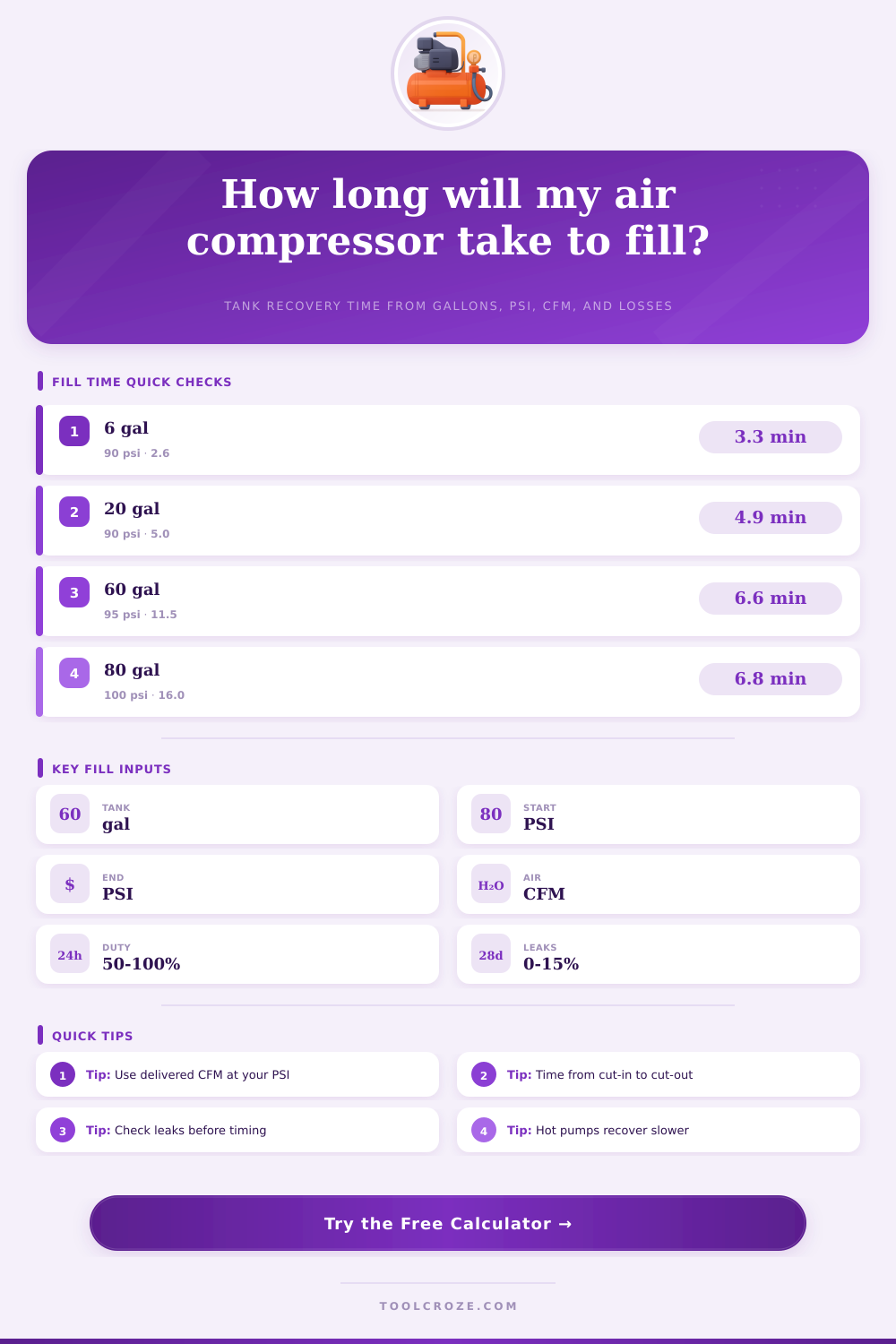
Air Compressor Fill Time Calculator
Estimate receiver fill and pump recovery time from tank gallons, pressure rise, delivered CFM, duty cycle, ambient derating, leak allowance, and pump condition.
Choose a common compressor and recovery scenario, then adjust the fields to match your pressure switch, rated CFM, and shop conditions.
Use the actual tank size stamped on the receiver.
Pressure where the pump starts recovering.
Pressure where the pressure switch stops the pump.
Use delivered or SCFM at the closest working pressure.
100% for continuous duty; 50% doubles elapsed recovery time.
Lower for hot rooms, high altitude, restricted intake, or low voltage.
Reserve output lost through couplers, drains, hoses, and fittings.
Use a lower value for a hot pump, worn rings, dirty filters, or belt slip.
Fill-Time Breakdown
| Receiver Size | Pressure Rise | Free Air Needed | Fill Time At 10 CFM |
|---|---|---|---|
| 6 gallon trim tank | 40 to 120 PSI | 4.4 cubic ft | 0.4 min pump run |
| 20 gallon garage tank | 90 to 135 PSI | 8.2 cubic ft | 0.8 min pump run |
| 60 gallon shop tank | 95 to 135 PSI | 21.8 cubic ft | 2.2 min pump run |
| 80 gallon two-stage tank | 100 to 175 PSI | 54.6 cubic ft | 5.5 min pump run |
| Ambient Or Pump Condition | Typical Correction | What It Represents | Fill-Time Effect |
|---|---|---|---|
| Cool shop, clean intake | 100% | Rated test-like conditions | Baseline fill time |
| Hot room or weak ventilation | 90% to 95% | Lower air density and hotter pump | 5% to 11% longer |
| High altitude or dirty filter | 80% to 90% | Reduced intake mass flow | 11% to 25% longer |
| Worn pump or belt slip | 70% to 85% | Mechanical recovery loss | 18% to 43% longer |
| Duty Cycle | Pump Run Allowed | Rest Added | Best Use Case |
|---|---|---|---|
| 100% | Continuous | 0 min per run min | Industrial continuous-duty motors |
| 75% | 45 min per hour | 0.33 min per run min | Quality shop compressors |
| 50% | 30 min per hour | 1 min per run min | Many portable oil-lube units |
| 25% | 15 min per hour | 3 min per run min | Small intermittent-duty units |
| Leak Allowance | System Condition | Lost Capacity | Practical Meaning |
|---|---|---|---|
| 0% to 2% | Tight receiver and hose | Very low | Fresh fittings, closed drains |
| 3% to 5% | Typical portable setup | Minor | Quick couplers and hose seepage |
| 6% to 10% | Aging shop plumbing | Noticeable | Longer recovery and more starts |
| 10% to 15%+ | Audible leaks present | Major | Repair before judging compressor size |
An air compressor is an machine that store pressurized air in a tank so that air tools can function. An air compressor is only useful if the air compressor is able to refill that tank with air at a fast enough rate to allow the air tools to continue to function. Air tools often experience a drop in pressure from the air compressor tank because the air tools use the air from the tank at a faster rate then the air compressor can refill the tank.
The size of the receiver tank into which the air compressor deliver air is one of the main factors that will affect how well the air compressor can perform. Smaller receiver tanks are often sufficient for air tools that use small amounts of air. However, small receiver tanks are often insufficient for tools that require a continuous flow of air.
How to Choose the Right Air Compressor
Tanks that is larger can hold more air than small tanks, and the air compressor motor does not have to turn on as often. However, larger receiver tanks take longer to refill than smaller tanks. Therefore, the smallest tank size that ensure that the air tools do not experience a drop in available air is the tank size that should be selected.
Another factor that is relate to the performance of an air compressor is the pressure band of the air compressor. The pressure band is the difference between the cut-in pressure and the cut-out pressure. Many air compressors has a pressure band of 40 psi.
A 40 psi pressure band is often selected because it prevents the motor from starting and stop too frequently. If the pressure band is made tighter, the motor will run more often. If the user makes the pressure band wider, the motor will run less often, but the minimum air pressure that is delivered to the tool will be lower.
A calculator can be used to determine the effect that changing the pressure band will have upon the amount of time the air compressor will run. Another factor that relates to the air compressor is the delivered CFM (cubic feet per minute) of the air compressor. The CFM that the air compressor delivers is not the same than the displacement of the air compressor motor.
The displacement of the motor is the amount of air that moves within the motor, but the air compressor does not deliver the same amount of those air. Factors like heat, altitude, and dirty filters reduce the delivered CFM. The lower reading of CFM should be used to calculate the needs of the air tools.
The motor can be adjusted for dirty filter or hot air tools, as the air that is used by the tools will often warm up in the air tools. Another factor related to the air compressor is the duty cycle of that air compressor. The duty cycle is the length of time that the air compressor will run during a specific time period.
For instance, a duty cycle of 50% mean that the air compressor will run for half of that time period, and the motor will need to rest for the other half of that time period. If the air compressor motor run for long periods of time, it will need to rest for the same length of time. The temperature of the shop where the air compressor is located will affect the duty cycle.
Warm air will heat the air compressor motor, causing it to need to rest more frequent. Leaks in the air system will also reduce the efficiency of the air compressor. For instance, if there is a leak at a coupler or at the drain valve, the air compressor will lose air pressure.
Because the air compressor loses air, it will have to run more often to replace that air. A leak allowance percentage can be entered into a calculator that is used to calculate how often the air compressor will need to run. If the leak allowance is increased in the calculator, and the calculated run time increases significantly, then the air compressor should be tightened to reduce the leaks.
The ambient conditions in which the air compressor is located, and the condition of the air compressor pump itself may also affect the performance of the air compressor. For instance, hot air contains fewer air molecule than cold air, so the pump will move fewer air molecules when the air is hot. Additionally, if the pump wears down components like the piston ring, it will also reduce the CFM of air that is delivered by the air compressor.
A recovery factor can be used to adjust the air compressor rating to account for these factor. Additionally, the air compressor will lose even more capacity if the pump is already hot. The loss of that capacity will make the air compressor take more time to reach its rated amount of air output during recovery time.
The goal is to match the air compressor to the air tools that will be used in the shop. The size of the receiver tank, the pressure switch settings, and the delivered CFM should be entered into a calculator. The duty cycle, the leak allowance, and the recovery factor can also be adjusted in the calculator to account for the condition in the shop.
For instance, if the calculated recovery time matches the time period during which air tools are observed to need to run in the shop, then the air compressor settings are accurate. If the calculated recovery time is shorter than the time period during which the air tools are observed to need to run in the shop, then the settings of the air compressor are likely too optimistic.