Air Compressor RPM Calculator
Calculate pump RPM from motor speed and pulley diameters, then check belt speed, estimated air delivery, sheave ratio, and pump overspeed margin.
Choose a common shop setup, then fine tune the pulley diameters, pump rating, displacement, efficiency, and belt slip for your actual compressor.
Used for comparison notes and practical speed bands.
Typical induction motors are near 1725, 1750, 3450, or 3600 RPM.
Use pitch diameter when known, not the outer rim diameter.
Driven sheave or flywheel diameter on the compressor pump.
Use the pump plate or manual limit. Lower is safer for old pumps.
Swept volume per crank revolution before efficiency losses.
Single stage often lands around 65-78%; two stage often 70-85%.
Use 1-3% for a good drive, 4-8% if belts are small or worn.
Calculation Breakdown
| Motor RPM | Motor Pulley | Pump Pulley | Approx Pump RPM | Drive Use |
|---|---|---|---|---|
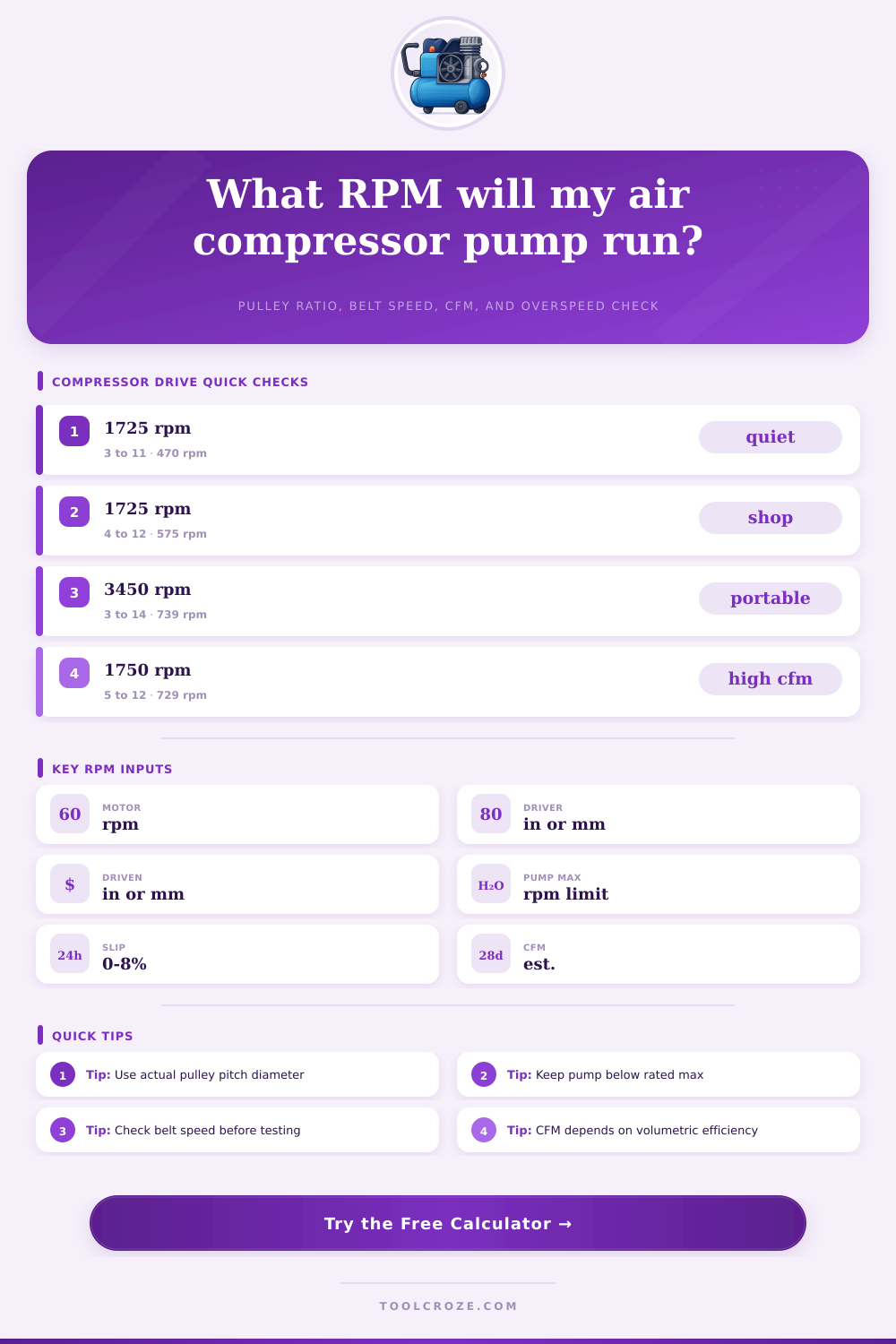
| 1725 | 3.0 in | 12.0 in | 431 RPM | Low noise, light CFM |
| 1725 | 3.5 in | 11.0 in | 549 RPM | Quiet 60 gallon shop unit |
| 1750 | 4.5 in | 12.0 in | 656 RPM | General two cylinder pump |
| 3450 | 3.0 in | 14.0 in | 739 RPM | High speed motor with reduction |
| 1750 | 5.0 in | 10.5 in | 833 RPM | High output single stage |
| Belt Type | Usual Small Pulley | Comfortable Belt Speed | Drive Note |
|---|---|---|---|
| A-section V-belt | 3.0-5.0 in | 2500-4500 ft/min | Small shop compressors |
| B-section V-belt | 4.0-7.0 in | 3000-5500 ft/min | Higher horsepower pumps |
| Dual V-belt | 4.0-8.0 in | 3000-6000 ft/min | Better grip and cooler belts |
| Poly-V belt | 2.5-5.0 in | 3500-6500 ft/min | Compact modern compressor drives |
| Jackshaft drive | varies | Match each belt span | Use stage ratios separately |
| Pump Style | Typical RPM | Volumetric Efficiency | RPM Caution |
|---|---|---|---|
| Small oil-lube single stage | 800-1200 | 62-74% | Watch heat and oil carryover |
| Cast iron single stage | 600-950 | 65-78% | Often happier below max RPM |
| Two stage shop pump | 500-900 | 70-85% | Confirm flywheel fan direction |
| Slow industrial pump | 350-700 | 72-86% | Do not size from motor HP alone |
| Compact portable pump | 900-1500 | 55-70% | Use the exact pump nameplate |
| Check Item | Preferred Reading | Warning Reading | Calculator Response |
|---|---|---|---|
| Pump RPM margin | 10%+ below max | Above rated RPM | Reduce driver or increase driven sheave |
| Belt speed | 2500-5000 ft/min | Under 1800 or over 6500 | Review sheave size and belt type |
| Driver diameter | At belt maker minimum | Too small for belt section | Use larger sheaves with same ratio |
| CFM estimate | Matches pump class | Unrealistically high | Check displacement and efficiency entry |
| Slip estimate | 1-3% | Over 8% | Inspect tension, wrap, and belt condition |
An air compressor can operate at different speed. The speed at which an air compressor operates will affect the way in which the air compressor functions. If an air compressor is set to operate at a speed that is too fast for the pump manufacturer rated speed, then the pump may overheat, the pump rings may wear out, and the pump may begin to throw oil past the seals that prevent that oil from escaping the pump.
If the air compressor is set to run too slowly for the air compressor pump, the motor will labor and the belts will slip, which will prevent the air compressor from providing an amount of air that is required by the individuals using that air compressor. The size of the pulleys that connect to the motor and air compressor pump, respectively, determines the speed of the air compressor pump. The sizes of those pulleys will determine the speed at which the air compressor pump will be running.
How to Find the Right Pulley Size and Pump Speed for an Air Compressor
Consequently, it is necessary for individuals to understand how to calculate the size of those pulleys in order to provide the amount of air that is required by the user of the air compressor. To calculate the correct ratio of the air compressor pump pulleys, there are several different parameter that must be entered into the calculator. One of the parameters that must be entered is the RPM of the motor, which can be found on the motor nameplate.
The diameters of the pulleys must be entered into the calculator, as these will allow the calculator to calculate the ratio of how many times the air compressor pump will turn relative to the motor. The displacement of the air compressor pump is another parameter that the operator must enter, as this will allow the calculator to determine how much air will exit the air compressor with each turn of the crank handle of the air compressor. Another parameter that must be entered is the volumetric efficiency of the air compressor unit, which account for the fact that the air compressor will lose some of its air due to heat and leaks in the system.
Finally, another parameter that must be entered is the slip of the air compressor’s belts, as slip will occur due to the heat that is created by the operation of the compressor. Once you enter these parameters into the calculator, the air compressor’s manufacturer will be able to determine the RPM of the air compressor pump after slip, the speed of the belts within the air compressor, the amount of air that the air compressor will deliver to the user, and the margin that exist between the air compressor’s current speed and the air compressor pump’s maximum rated speed. The margin that is established between the air compressor pump’s current speed and its maximum rated speed is another parameter that is important to set up the air compressor to provide the amount of air that is required by the users.
For many air compressor manufacturer, the maximum speed of the pump is not the target speed for that air compressor pump. By establishing a pump speed that is ten percent below the rated maximum speed of the pump, the air compressor will remain cooler than if it were running at its maximum speeds. Furthermore, at these slower RPMs, the fan that is attached to the air compressor pump will be able to effectively move air across the cylinders of the pump.
Air compressor manufacturers consider this margin in the calculations of the required size of the drive pulley for the air compressor. Another constraint on air compressor setup is the speed at which the V-belts that connect the motor to the air compressor pump should operate. Most V-belts function best at speeds between 2500 and 5000 feet per minute.
Below 2500 feet per minute, the V-belts may slip relative to the motor. Above 5000 feet per minute, the V-belts may overheat and may begin to wear chunks of rubber. The belt speed that the air compressor manufacturer calculates will allow the air compressor operator to ensure that the motor’s pulley is not too small for the size of the belts that are used in that air compressor unit.
Air compressor units come in a variety of different types. For instance, a 60 gallon quiet twin air compressor units may have motors that are rated at 1725 RPMs, and the pulleys may be sized to have a 3.5 inch driver pulley and an 11 inch flywheel. Air compressor units with this size of motor and pulleys may have air compressor pump speeds that are approximately 550 RPMs, which is a comfortable RPM for a cast iron single stage air compressor pump.
Another example of air compressor units are those that are portable, such as with a motor that is rated at 3450 RPMs. For those air compressor units, the driven pulley must be relatively large to ensure that the air compressor pump does not reach its maximum speed. Another example are air compressor units that have a two-stage air compressor pump with a 13 inch flywheel.
These pumps can run at slower RPMs than other air compressor pumps, which allows those air compressor units to provide their air pump with less wear and tear over time. A common mistake that individuals who purchase air compressor units make is focusing on one parameter that will impact the air compressor unit’s RPM, yet failing to consider the impact that changing that parameter will have upon the speed at which the V-belts travel. For instance, changing the size of the motor pulley will change the RPM of the air compressor pump, but those changes will also change the speed at which the air compressor’s V-belts travel.
Consequently, an individual is likely to decrease the RPM of the air compressor pump by making the motor pulley smaller; however, that same change will also affect the speed of the V-belts to potentially fall into the slipping zone. Air compressor manufacturers create the ratio calculator to allow individuals to understand the impact of changing the size of the motor pulley without having to purchase new sheaves for the air compressor unit. The displacement and the volumetric efficiency of an air compressor are also two parameters that interact with each other.
For instance, it is possible to create an air compressor unit that has a relatively large air compressor pump that runs at a relatively low RPM that will provide the same amount of air as a relatively small air compressor pump that is turned at high RPMs. The larger air compressor pump will, however, operate cooler and for longer periods of time before maintenance is required. Furthermore, the volumetric efficiency will decrease as the air compressor pump reaches higher temperatures.
Consequently, the theoretical amount of air that the air compressor can deliver is rarely the amount of air that is delivered to the users. This value can, however, be entered into the calculator in place of the estimated amount of air that is delivered by the air compressor unit. Furthermore, not all air compressor units are alike in their capabilities.
For instance, many of the air compressor units that were manufactured in the 1970s and 1980s are constructed with large flywheels and are limited to relatively low RPM ratings for those pumps. The pumps that are manufactured with aluminum are portable units, and those pumps can be rated at higher RPMs due to the understanding that these air compressor units will need to be replaced more quickly than those constructed with cast iron components. Consequently, if individuals are placing a new air compressor pump into an existing air compressor motor, they should use the RPM ratings of the new air compressor pump on its mounting plate, rather than the RPM at which the air compressor that is being replaced by the new pump used to operate.
Another parameter that may impact the air compressor unit is the tension of the V-belts. For instance, if the V-belts are hard or glazed, they may slip even if the air compressor pump is established at the correct RPM. The slip that is entered into the air compressor ratio calculator will allow the air compressor manufacturer to account for the potential slipping of the V-belts.
For instance, a slip of three percent is common for new, well-tensioned V-belts. An established slip of eight percent indicates that the V-belts may need to be replaced. There are also a variety of tables included within the article that provide the air compressor manufacturers recommendations for air compressor units with various motor speeds, driver pulley sizes, and driven pulley sizes.
These tables are not rules, but they do provide a starting point for those who are uncertain as to which sizes of air compressor pump pulleys to use. For instance, tables indicate that air compressor motors with 1725 RPM ratings and driver pulleys with 3 inch diameters and driven pulleys with 12 inch diameters will result in the air compressor pump achieving RPMs of near 430. Such RPMs will provide a relatively quiet air compressor unit that does little wear and tear on the air compressor pump.
Such an air compressor unit may, however, not provide enough air to power sandblasting tools or multiple air-powered tools at once. Finally, before operating the air compressor unit that has been constructed according to the specifications that are generated by the air compressor ratio calculator, the safety note at the bottom of the calculator should be read. The air compressor pump should not ever be allowed to exceed the maximum RPMs that are rated for that specific pump.
The speed of the V-belts should not ever exceed the maximum speed at which the V-belts are rated to function. Finally, the motor should not ever be allowed to work harder than the specifications that were provided for the motor by the motor’s manufacturer. For instance, if the motor has a specified full load amperage of 12, then the load on the motor should never be increased to a value that would require the motor to draw more than 12 amps of electricity.
Any change to the size of the motor’s pulley will change the load that is placed on the motor. Finally, an individual should not aim for the highest possible RPMs for their air compressor pump. Instead, an individual only desires to set up their air compressor such that the pump remains cool, the V-belts have a long time before needing to be replaced, and the air compressor motor does not need to work as hard as it is design to work.
Thus, while the calculator may provide the numbers that are associated with a particular setup of air compressor components, the individual must determine if those numbers will lead to an air compressor system that remains within its comfortable operational range.