Pressure Washer Hose Calculator
Estimate hose inside diameter, length, flow, pressure drop, usable nozzle pressure, and water velocity before choosing a pressure washer hose setup.
▣Job Presets
Load a pressure-washing scenario, then adjust hose size, length, GPM, PSI, nozzle number, fittings, and material.
⚙Hose And Nozzle Inputs
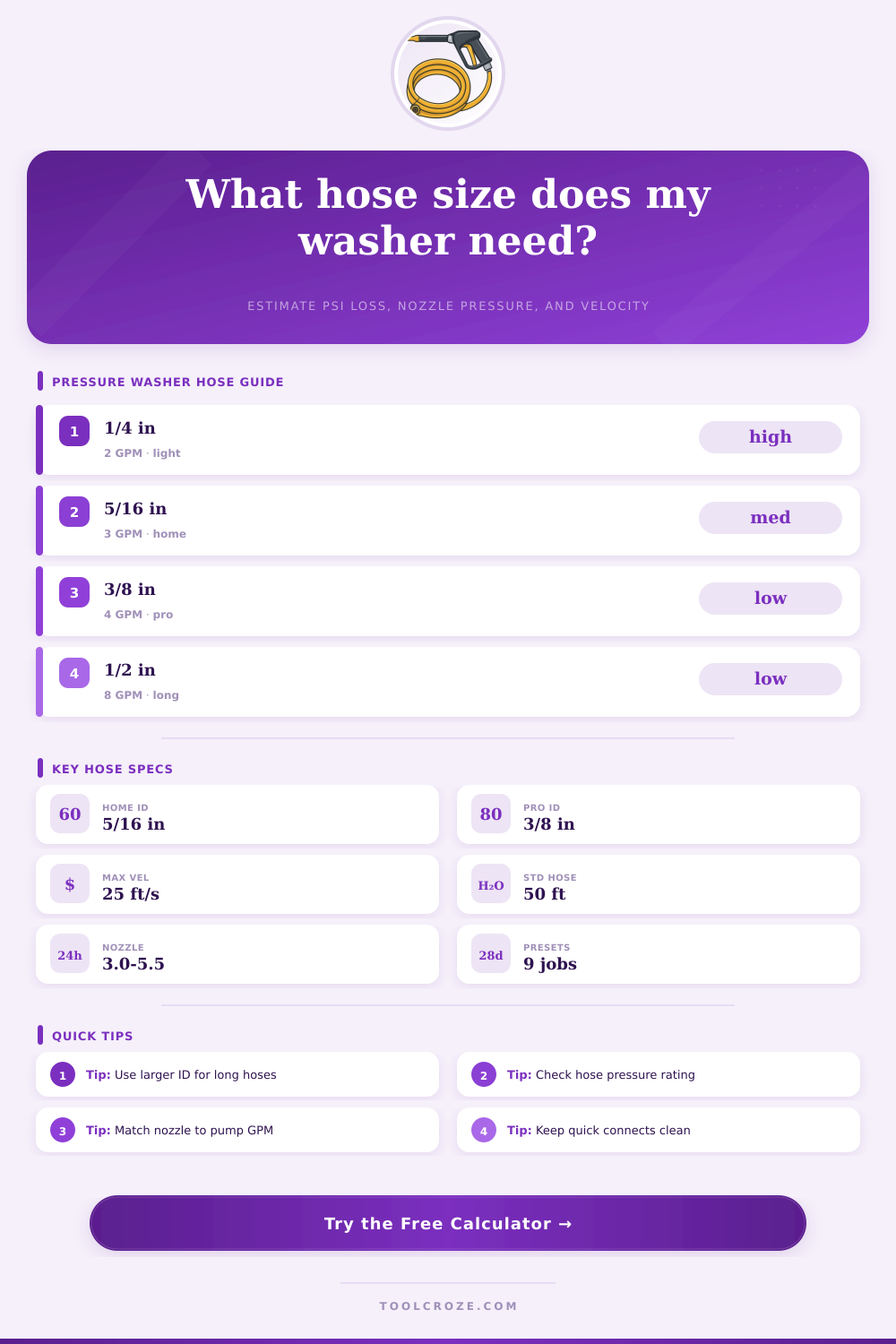
Common pressure washer IDs: 1/4, 5/16, 3/8, and 1/2 in.
Include reel hose, extension hose, and whip line length.
A 4.0 nozzle means size 4.0, not a 40 degree spray angle.
Pressure Washer Hose Results
▦Hose Material And Spec Comparison
📊Reference Tables
| Hose ID | Typical Flow Range | Best Use | Velocity At 4 GPM | Pressure Loss Pattern |
|---|---|---|---|---|
| 1/4 in | 1.2 to 2.5 GPM | Portable electric washers | 26.1 ft/s | High on long runs |
| 5/16 in | 2.0 to 3.5 GPM | Residential gas washers | 16.7 ft/s | Moderate |
| 3/8 in | 3.0 to 5.5 GPM | Most professional washers | 11.6 ft/s | Low to moderate |
| 1/2 in | 5.0 to 10.0 GPM | Long hose reels and high flow | 6.5 ft/s | Low |
| Material | Typical Rating | Roughness Factor | Temperature Use | Practical Note |
|---|---|---|---|---|
| Wire-braid rubber | 3000 to 6000 PSI | Moderate | Cold or hot water | Best general pro hose |
| Polyurethane jacket | 3000 to 4500 PSI | Smooth | Cold water mostly | Good for hose reels |
| PVC light-duty | 1600 to 3200 PSI | Higher | Cold water | Short residential runs |
| Thermoplastic | 3000 to 5000 PSI | Smooth | Cold or warm water | Light, compact, kink resistant |
| Jetter hose | 4000 to 6000 PSI | Smooth small bore | Cold or hot water | Pressure loss rises fast |
| Nozzle Size | 2.5 GPM Pressure | 4.0 GPM Pressure | 5.5 GPM Pressure | Common Pairing |
|---|---|---|---|---|
| 2.5 | 4000 PSI | Too small | Too small | Small gas unit |
| 3.0 | 2778 PSI | 7111 PSI | Too small | 2.5 to 3.0 GPM |
| 4.0 | 1563 PSI | 4000 PSI | 7563 PSI | 4 GPM at 4000 PSI |
| 5.5 | 826 PSI | 2116 PSI | 4000 PSI | 5.5 GPM pro pump |
| 8.0 | 391 PSI | 1000 PSI | 1891 PSI | Soft wash or rinse |
| Pressure Washer Setup | Hose Length | Suggested ID | Flow Range | Target Hose Velocity |
|---|---|---|---|---|
| Electric washer patio rinse | 25 to 35 ft | 1/4 in | 1.2 to 2.0 GPM | Under 18 ft/s |
| Residential driveway | 50 to 75 ft | 5/16 or 3/8 in | 2.5 to 3.5 GPM | Under 20 ft/s |
| Professional surface cleaner | 100 to 150 ft | 3/8 in | 4.0 to 5.5 GPM | Under 18 ft/s |
| Long roof or building line | 200 to 300 ft | 3/8 or 1/2 in | 4.0 to 8.0 GPM | Under 15 ft/s |
ℹPressure Washer Hose Notes
A pressure washer hose between the pressure washer and the surface can determine whether the water flows from the pressure washer remains reliable or whether the water flow becomes inconsistent. If a pressure washer hose are set to be too small or if the hose is too long for the flow that the pressure washer pump can produce, then the pressure will drop in the hose prior to the water reaching the nozzle of the pressure washer. If the hose is oversized for the electric pressure washer model, then the water flow will create kinks in the hose and add to the weight that the person have to bear who is operating the pressure washer without providing any benefit to the performance of the machine.
Each of these issues will lead to slower performance in comparison to what is expected from the machine, as well as cause the trigger gun on the pressure washer to feel more weak than it should feel when the machine is in operation. The inside diameter of the hose plays a major role in the amount of friction that the water experience as it moves through the hose. For example, a hose with a diameter of a quarter-inch may be sufficient for a light electric pressure washer model that only produce around two gallon of water per minute.
How to Choose the Right Pressure Washer Hose
However, the same hose will create resistance within the water flow if the length of the hose is fifty feet or more for a four gallon per minute commercial pressure washer model. The calculator that is available will mathematically calculate the expected results once the user enter the length of the hose, the flow of the water, and the pressure of the water from the pump of the pressure washer. By entering these variables, the individual removes the guesswork that many people use when purchasing or selecting a hose size that is too large for the pressure washer model that they own.
The calculator will reveal the amount of pressure that will reach the nozzle of the pressure washer once it exit the hose, as well as the speed at which the water will travel through the hose. The speed of the water travel is another factor that can impact the user in relation to the performance of the pressure washer hose. For instance, the rate at which the water leaves the hose and perform its job can have an impact upon the lifespan of the pressure washer hose and the fittings that attach the hose to the pressure washer model.
Should the velocity of the water increase to twenty feet per second or more, each of these component will begin to wear out at a faster rate. The calculator will display the velocity of the water that pass through the hose, as well as a status line that displays whether or not the diameter of the hose is acceptable or if the user should select a larger diameter to avoid excessive wear upon the components of the pressure washer. In addition to the factors related to water velocity, the material of the hose also impact the user of the pressure washer.
For example, rubber hoses that contain wire braids will remain flexible should the environment change temperatures, and will not balloon when exposed to high levels of pressure. The drawbacks to these hoses is that they are heavier than other types of hoses, and they cost more money. Polyurethane hoses are lighter in weight, and will slide more easily over pavement with the movement of the user, but will become stiff in cold weather climate.
Additionally, polyurethane hoses tend to have a lower pressure rating than rubber hoses. Both of these materials can be selected in the calculator to ensure that the friction calculations are based off the type of hose that the user own. The fittings that are used on the end of the pressure washer hose will also create a drop in the water pressure.
Each coupling or swivel will create a small drop in the pressure of the water, and numerous couplings or swivels will create an additional drop in the water pressure. These factors can be entered into the calculator, as well as the number of fittings will have an impact upon the water pressure that is calculate by the calculator. This factor is one of the significant variable that the user must consider with relation to the performance of their pressure washer hose.
The size of the nozzle that is used on the end of the pressure washer hose must match the flow rate of the water from the pressure washer pump at the specific pressure that is to be used. Should the nozzle be too small relative to the amount of gallons of water that is dispensed per minute from the pressure washer model, the nozzle will force the pump into bypass mode, or the nozzle will increase the pressure of the water to a level that is too great for the pressure rating of the hose. The calculator will calculate the water pressure at the nozzle that will result from the reduction of pressure from the pump to account for friction within the hose and the fittings, as well as the pressure that the nozzle will restrict to in order to provide a more accurate nozzles that will allow the water to function as desired by the user.
The type of job that is to be performed with the pressure washer can also have an impact upon the setting variables of the pressure washer model. For instance, jobs that involve siding and wood require lower levels of pressure to be placed onto the surface relative to jobs involving concrete or general surface cleaning. Thus, one variable in the calculator that can be modified is the working-pressure-reserve field, which allow the user to input the preference of the type of work that the pressure washer is to perform.
The jobs that are performed in the real world may not match the specifications that is provided for the pressure washer models. For instance, the water pressure from the model may change with alterations to the temperature of the water, the tension of the hose reel, or the kinks that form in the hose. Thus, the calculator acts as a planning tool, and once the pressure washer is placed into operation and the trigger gun is activated, the user can observe the performance of the water jet from the nozzle relative to the estimate that was made in the calculator.
Should the trigger gun feel weaker than that which the calculator estimated, then one or more of the fittings may need to be tightened, or one or more section of the hose may be experiencing a restriction in the flow of water relative to that which is allowed through its diameter. In addition to the factors related to performance of the pressure washer, there are also other factors related to the length of the pressure washer hose. For instance, while a pressure washer hose that is set to be one hundred feet in length can reach the majority of job site in a residential area, the length of the hose will also impact the pressure of the water.
Any length of hose will lose water pressure if placed upon any pump whose flow rate is above three gallons of water per minute. Thus, an understanding of how many gallon per minute the pressure washer can produce can allow the user to determine whether the convenience of a one hundred foot hose is worth the decrease in the water pressure at the nozzle. The velocity of the water that exit the nozzle of the pressure washer can also impact the life of the pressure washer model.
Should the velocity of the water increase to too great of a rate, the pump will experience an increase in the back pressure of the system. This increase in back pressure can lead to the shortening of the life of the seal of the pressure washer model, especially if those models are electric models, where the increased back pressure can also potentially set off the thermal relief valve of the model. Similar to the various factor related to the performance of the pressure washer, the correct size of the pressure washer hose also includes a consideration of a variety of variables.
For instance, the diameter of the hose will depend upon the flow of water from the pressure washer model, the length of the hose, the number of fittings, and the amount of pressure that should remain within the hose at any given time. Each of these variable can be entered into the calculator for the user to review. Should each of the calculated numbers provide an accurate and acceptable reading of the performance of the pressure washer and its components, then the hose may be of an acceptable size for use in the work site that the individual that owns the pressure washer model is to visit.
Should any calculations indicate that the variables are within the caution range, however, then alterations to those variables indicate that the user should purchase a hose of a larger diameter for the pressure washer, or that the length of the hose should be shortened. Each of these solutions will ensure that the water reaches the work site with the intended force with which it should be directed, while also avoiding the development of any issues with the pressure washer or the individual that is using the pressure washer model.