Fuel Hose Size Calculator
Estimate fuel flow, hose inside diameter, line velocity, pressure drop, and compatible hose material for gasoline, diesel, E85, methanol, and blended-fuel systems.
Pick a close setup, then adjust the inputs to match the actual pump path, hose run, and fuel blend.
Density and compatibility change the required volume flow.
Sets target velocity and acceptable hose pressure loss.
Use flywheel power for sizing margin.
Gas EFI often 0.45-0.65; E85 and methanol are higher.
Lower duty means more reserve pump flow.
Measure tank outlet to rail, regulator, or return point.
Each fitting is treated as equivalent added hose length.
Applies after power, BSFC, and duty-cycle correction.
Fuel hose sizing results
| Nominal size | Typical ID | Area | Best-use note |
|---|---|---|---|
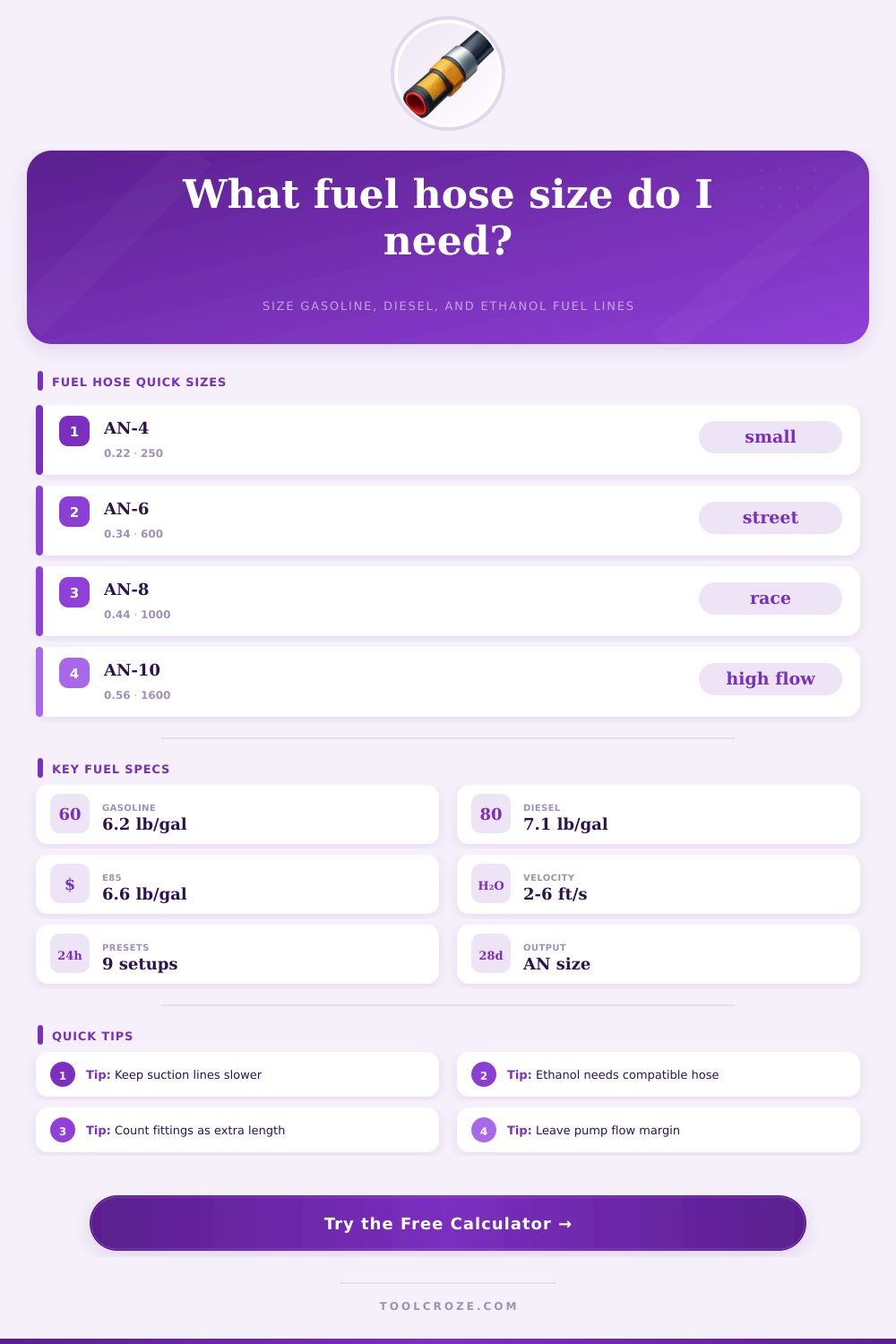
| 1/4 in / AN-4 | 0.219 in / 5.6 mm | 0.0377 sq in | Small engines, short return lines, motorcycles |
| 5/16 in | 0.312 in / 7.9 mm | 0.0765 sq in | Mild carburetor feeds and low-output EFI |
| 3/8 in / AN-6 | 0.344 in / 8.7 mm | 0.0930 sq in | Most street EFI and moderate diesel feeds |
| 1/2 in / AN-8 | 0.438 in / 11.1 mm | 0.1507 sq in | High-output EFI, E85, long runs, race feed |
| 5/8 in / AN-10 | 0.562 in / 14.3 mm | 0.2482 sq in | Very high-flow methanol, diesel transfer, surge systems |
| 3/4 in / AN-12 | 0.688 in / 17.5 mm | 0.3718 sq in | Large suction feeds or extreme flow plumbing |
| Fuel | Density used | Typical BSFC range | Hose compatibility focus |
|---|---|---|---|
| Pump gasoline / E10 | 6.2 lb/gal | 0.45 to 0.65 lb/hp/hr | 30R9 or PTFE for pressure injection |
| Diesel fuel | 7.1 lb/gal | 0.33 to 0.45 lb/hp/hr | Diesel-rated rubber, textile braid, or PTFE |
| E85 ethanol blend | 6.6 lb/gal | 0.65 to 0.95 lb/hp/hr | PTFE or hose explicitly rated for high alcohol |
| Methanol | 6.6 lb/gal | 1.10 to 1.80 lb/hp/hr | PTFE preferred because alcohol permeation is severe |
| Aviation gasoline | 6.0 lb/gal | 0.45 to 0.60 lb/hp/hr | Use approved aviation or motorsport hose specs |
| B20 biodiesel blend | 7.2 lb/gal | 0.34 to 0.48 lb/hp/hr | Check elastomer swell resistance and pressure rating |
| Fuel circuit | Target velocity | Drop limit used | Reason |
|---|---|---|---|
| EFI pressure feed | 2.0 to 6.0 ft/sec | 2.0 psi | Keeps rail pressure stable under pulse demand |
| EFI return line | 1.5 to 5.0 ft/sec | 1.5 psi | Reduces regulator backpressure and heating |
| Carburetor feed | 1.0 to 4.0 ft/sec | 0.5 psi | Low-pressure systems have little pressure margin |
| Diesel feed | 1.0 to 5.0 ft/sec | 1.0 psi | Supports lift-pump inlet and filter restriction margin |
| Suction line | 0.8 to 3.0 ft/sec | 0.3 psi | Helps prevent pump cavitation and vapor formation |
| Spec or material | Pressure role | Gasoline | Ethanol / methanol | Diesel |
|---|---|---|---|---|
| SAE 30R7 | Low pressure | Carb/vapor | Limited; verify rating | Low-pressure return |
| SAE 30R9 | EFI pressure | Good | Only if alcohol rated | Good if diesel rated |
| SAE 30R10 | Submersible | In-tank use | Only if listed | Check listing |
| PTFE lined | High pressure | Excellent | Excellent | Excellent |
| ISO 7840 marine | Marine fuel | Good | Check blend limit | Good |
Selecting the correct fuel hose size are a necessary step in the design of an internal combustion engine system. The size of the fuel hose affect how the engine receives the fuel that it require to function. If the fuel hose that is selected for an engine has a too-small diameter, the engine may experience hesitation during operation.
In addition to these performance issue, if you use a fuel hose that is too small for the engine, the fuel pump must work harder than is necessary to move the fuel through the fuel system, and the fuel that reaches the engine may be at a higher temperature than is desire. Many people do not notice these symptom until the engine begins to perform poorly. Issues related to fuel hose diameter, fuel hose length, and the type of fuel that the engine uses all has the potential to impact engine performance.
How to Choose the Right Fuel Hose Size
The fuel hose size calculator require that a few different measurements and values are entered in order to calculate the diameter that should be used for the fuel hose. You must enter the engine output into the calculator. You must also enter the fuel consumption rate for the engine, also known as Brake Specific Fuel Consumption (BSFC) into the calculator.
The duty cycle of the fuel pump must be entered. Finally, a safety factor must be entered into the calculator to allow for fuel issues such as hot fuel or voltage drop. Different type of fuel have different requirements for the fuel system, especially the fuel hose size.
For example, an engine that runs on E85 fuel will require a higher volume of fuel than an engine that use pump gas fuel. This is due to the higher BSFC number of E85 fuel. Similarly, methanol fuel has an even higher BSFC number than E85 fuel, which indicate that the engine that utilizes methanol fuel requires more fuel.
These fuel properties are accounted for in the fuel hose size calculator in order to provide an accurate estimate for fuel hose diameter. The velocity of the fuel in the fuel system, referred to as line velocity, can have an impact upon the engine performance. If the line velocity in the fuel hose is too fast for the engine, the fuel will increase in temperature due to the friction between the fuel and the fuel hose.
Additionally, high line velocity will make the fuel pump work against any turbulence in the system. If the line velocity is too slow, vapor pockets can form in the fuel hose. Each of these issues will impact engine performance.
The fuel hose size calculator utilize different targets for line velocity for suction lines and pressure feed line. The pressure drop that occurs in the fuel system can be caused by many factor. Each foot of fuel hose and each fitting in the system will contribute to a pressure drop.
Each fitting in the fuel system will decrease the flow of fuel through that component of the system. Similarly, a ninety-degree bend in the fuel hose will act like an additional length of fuel hose for the same reasons that the fuel cannot move easy through that turn. The fuel hose size calculator treats each fitting as if each of these components is lengthening the fuel system.
The calculator will help to determine the diameter of the fuel hose necessary to maintain the pressure drop within an acceptable range for the engine. The type of fuel that the engine will use will impact the type of fuel hose that should be used in the system. Fuel hoses that are made of rubber may not be appropriate for engines that use ethanol or methanol fuel.
The ethanol and methanol fuel will cause the rubber fuel hose to swell or leak. In these situations, you should use fuel hoses made of PTFE or alcohol-rated fuel hoses. Additionally, diesel fuel systems will require different types of fuel hoses than gasoline engine.
Similarly, fuel hoses used in marine engines should be fire resistant to meet safety requirements for those environment. There are a few mistakes that many people make when selecting the size for a fuel hose. One common mistake is to size the fuel hose for the peak power of the engine.
While this may be necessary for high performance, the engine may not reach these level of power very often. For instance, a drag car that reaches high speeds very briefly may have a smaller fuel hose than a street car that operate at lower speeds for longer periods of time. A second common mistake is to ignore the suction side of the fuel system.
Many people pay attention to the fuel pump and pressure feed hose, but neglect the suction side of the system. If the suction side of the fuel system is too small for the engine, the fuel pump will not receive the fuel that it require to operate. Thus, you must also size the suction side of the fuel system to ensure proper function of the fuel pump.
In addition to the fuel system calculations performed by the fuel hose size calculator, there are a few real world issue to consider. The heat that is created by the engine’s exhaust system will heat the fuel in the fuel system. The voltage supplied to the fuel pump may drop below the voltage required to maintain the strength of the fuel pump.
Additionally, the filters in the fuel system may become dirty and reduce the flow of fuel through the fuel system over time. These factor are accounted for by the safety factor for the fuel system. The reference tables on the fuel hose size calculator can help to provide additional context to the information calculated by the calculator.
These tables include information about the inside diameter of fuel lines of various AN sizes, the density of various type of fuel, and the targets for line velocity in the various systems of a fuel system. Each of these tables can help a person to determine whether the fuel hose diameter that the calculator calculates is within an acceptable range, or if an even larger diameter for the fuel hose is to be used. The ultimate goal in using a fuel hose size calculator is to ensure that the fuel pump is able to maintain pressure in the fuel system.
This goal can be accomplished by ensuring that the fuel hose diameter is sized to allow the fuel to reach the engine but not to become too hot in the process, as well as to ensure that the fuel hose material are compatible with the type of fuel that will be used in the engine. Thus, the fuel hose size calculator makes it easier for a person to focus upon the different factor related to fuel system design, while the calculations help the person to understand these different factor and relationship. Thus, using the fuel hose size calculator will help a person to understand the different factor related to fuel hose size in general, which will assist that same person in making future fuel system design decisions.