Kegerator Hose Length Calculator
Balance a kegerator draft line from serving pressure, beer temperature, vertical faucet lift, tower cooling, faucet restriction, line ID, and target pour behavior.
⚙Kegerator setup presets
Load a realistic single-keg or tower setup, then adjust the pressure, temperature, lift, line restriction, and faucet resistance for your draft path.
📏Draft pressure, lift, tower, and line inputs
Use actual liquid temperature near the keg, not the room thermostat.
Positive lift means the faucet is above the keg centerline.
Kegerator beer line result
🧪Line material and restriction comparison
📊Kegerator reference tables
| Beer line spec | Typical restriction | Best kegerator use | Practical note |
|---|---|---|---|
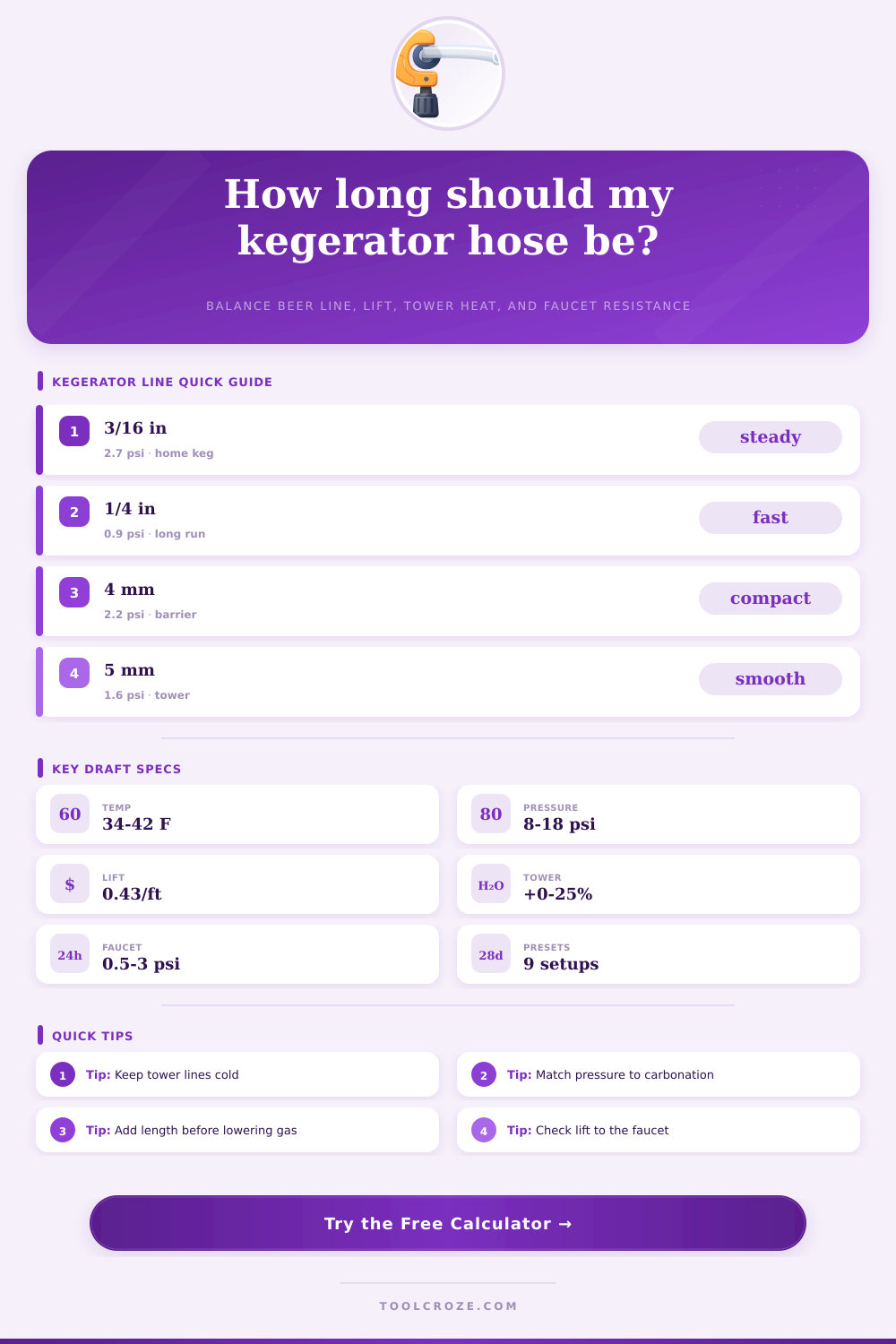
| 3/16 inch vinyl beer line | 2.2 to 3.0 psi per foot | Short home kegerator runs | Most common choice for five to ten foot home lines. |
| 1/4 inch vinyl beer line | 0.7 to 1.0 psi per foot | Longer refrigerated routes | Needs much more length to create the same pressure drop. |
| 4 mm EVA barrier line | 1.9 to 2.4 psi per foot | Compact towers and tight bends | Good oxygen barrier and predictable restriction in small spaces. |
| 5 mm EVA barrier line | 1.4 to 1.8 psi per foot | Moderate tower runs | Useful when 3/16 inch vinyl pours too slowly at the needed length. |
| 3/8 inch barrier trunk line | 0.15 to 0.30 psi per foot | Remote cooled runs | Requires coils, choker line, or other restriction near the faucet. |
| Beer type | CO2 volumes | Typical 38°F pressure | Kegerator balance note |
|---|---|---|---|
| Pub ale or bitter | 2.0 to 2.3 | 7 to 10 psi | Often needs shorter line or lower restriction than lager service. |
| Standard ale or IPA | 2.3 to 2.6 | 10 to 13 psi | Works well with typical 3/16 inch home kegerator line. |
| Lager or pilsner | 2.5 to 2.7 | 12 to 15 psi | Higher pressure usually means more line length for smooth pours. |
| Wheat beer | 2.7 to 3.0 | 15 to 19 psi | Needs more restriction and a cold tower to keep foam controlled. |
| Dry stout on blend gas | 1.6 to 2.0 | 25 to 35 psi blend | Stout faucets add major restriction, so hose length is not comparable. |
| Tower condition | Warmup allowance | Foam risk | Calculator treatment |
|---|---|---|---|
| No tower, collar faucet | 0% | Low when the shank is cold | No extra hose length is added for tower heat gain. |
| Fan cooled tower | 5% | Low to moderate first-pour risk | Adds a small length allowance for the vertical tower path. |
| Passive tower | 12% | Moderate first-pour risk | Adds more restriction so the first ounce is less violent. |
| Warm tower or shank | 20% | High foamy first pour risk | Adds length but still flags cooling as the main correction. |
| Tall bridge tower | 25% | High unless actively cooled | Adds the largest allowance because lift and heat both matter. |
| Faucet or hardware | Restriction used | Best fit | Line length effect |
|---|---|---|---|
| Standard rear-seal faucet and short shank | About 1.0 psi | Most home kegerators | Leaves most pressure drop to the beer hose. |
| Forward seal faucet | About 0.8 psi | Cleaner low-stick operation | Slightly increases hose length compared with standard faucets. |
| Flow control faucet half-open | About 2.5 psi | Mixed beers on one pressure | Can shorten the line, but do not use it to hide warm beer. |
| Stout restrictor faucet | About 8.0 psi | Nitro stout and beer gas | Consumes enough pressure that hose length may be modest. |
| Picnic faucet | About 0.5 psi | Temporary keg box service | Usually needs more hose than the short party tap line supplied. |
💡Draft balancing notes
Determining the correct lengths for the tubing that connect from the kegerator to the dispensing tap is a necesary task. The length of the tubing will affect the way that the beer pours from the keg. If the length of the tubing is incorrect, the beer can either pour too quickly like water or it can foam excessively from the tap.
The beer must move through the keg through the system of gravity, friction within the tubing, and the resistance that is create at the faucet. Each of these three element must be balanced for the beer to properly pour from the keg. Many individuals will purchase a kegerator and choose the initial length of the tubing by guess at the correct length.
Choosing the Right Tubing Length for Your Kegerator
Eventually, however, these individuals will spend a long period of time adding or removing section of tubing to find the length that works best for their kegerator. Before beginning to cut the tubing for the kegerator, it is first important to determine the pressure that is require for the beer that is to be dispensed from the keg at its serving temperature. The beer requires the pressure that is related to the carbonation level of that particular type of beer.
For instance, the carbonation level of a pale ale is typically different than that of a wheat beer. The temperature of the beer will also impact the pressure of the beer. If the temperature of the beer is increased, the pressure will increase as well.
This increased pressure can lead to foam that exit the faucet without regard to the length of the tubing. The vertical lift of the beer from the keg to the dispensing tap will also have an impact upon the system pressure. For instance, if the dispensing tap is mounted on a chest freezer, the vertical lift of the beer is going to be low.
In contrast, a tower that is many feet in height will create a high vertical lift for the beer. This high vertical lift will reduce the system pressure before the beer even enter the tubing. Thus, higher vertical lifts requires more system pressure to overcome the effects of that vertical lift.
Another factor that will impact the pressure in the system is the diameter of the tubing. If the tubing is narrow, there will be increased friction within the system which can lead to a drop in the pressure of the beer before it even reaches the dispensing tap. If the tubing is wide, the beer will travel faster through the system so a longer length of tubing is required to provide the same restriction in a narrow tube.
For instance, 3/16 inch tubing is often used in small setups while 1/4 inch or 3/8 inch tubing is often used in commercial setups in which the distance between the keg and the dispensing tap are longer. Finally, the material of the tubing can have different levels of restriction to the flow of the beer. For instance, EVA barrier tubing will have different restriction levels than vinyl tubing.
Thus, the user should choose the diameter of the tubing according to how much space is available for the tubing within the dispensing area. Additionally, the type of faucet that is used to dispense the beer and the shank that connects the faucet to the kegerator will create resistance to the flow of the beer. For instance, a standard rear-seal faucet will create approximately one psi of back pressure.
Flow control faucets creates more resistance. Stout beers have faucets that create significant resistance to the flow of the beer. If this resistance is not accounted for, the length of the tubing may be chosen too long for the system.
The presence of foam can be indicative of too long of a hose, but the foam can also be created by a warm faucet shank. The temperature of the tower upon which the keg is placed will impact the first pour of the beer. For instance, if a fan is used to cool the keg, the temperature of the tower shank will be the same as the temperature of the beer in the keg.
However, if the tower is warm, heat will enter the dispensing system and create foam during the first pour of the beer. An increase in hose length can be used to slow the initial pour of the beer, but the extra length of tubing will not allow for the cooling of the beer as it exits the keg. Thus, the only way to fix a warm tower is to increase the airflow to the tower.
Many individuals tend to make mistakes when attempting to set up a kegerator. For instance, if an individual chooses to lower the regulator pressure to fight against the foam that exits the dispensing tap, the beer may become under-carbonated. Alternatively, if the tubing is trimmed to speed up the rate at which beer is poured from the keg, the beer will go flat quickly.
Each of these variables is connect to the others so that adjusting one will impact the others. Thus, an individual must consider the regulator pressure, the temperature of the dispensed beer, the vertical lift, the tubing diameter, and the resistance created at the faucet to properly set up a kegerator. Reference tables can tell an individual the appropriate length of tubing for various brands and types of beer.
These tables can provide the starting point for the tubing length for a kegerator installation. However, the length of tubing should still be measured on the kegerator itself. Once the proper length has been established, small adjustments can be made.
For instance, if the beer pours too quickly, six inch of tubing can be added to the system to even out the pressure. However, if the first pour of the beer creates foam but the remainder of the keg dispenses well, the temperature of the faucet is the problem, not the length of the tubing. Thus, while the length of the tubing can control the rate at which the beer is dispensed and the amount of pressure within the system, it cant cool the dispensing hardware.