Soaker Hose Flow Rate Calculator
Estimate total hose flow, gallons per minute, application depth, watering runtime, and pressure-adjusted output for beds, rows, shrubs, and raised gardens.
Choose a starting setup, then adjust the hose length, pressure, spacing, and target watering depth for your own layout.
Nominal flow is adjusted with pressure using a square-root emitter relationship.
Used to flag whether the calculated application rate is likely to run off.
Most soaker hoses work best around 6 to 15 psi.
Allowance lengthens runtime to cover uneven seepage, mulch interception, or small pressure variation.
Calculation Breakdown
GPH per 100 ft porous rubber at 10 psi
GPH per 100 ft flat weep tape at 8 psi
GPH per 100 ft inline dripline at 15 psi
GPH per 100 ft heavy wall hose at 12 psi
| Hose Type | Typical Pressure | Nominal Flow | Best Fit |
|---|---|---|---|
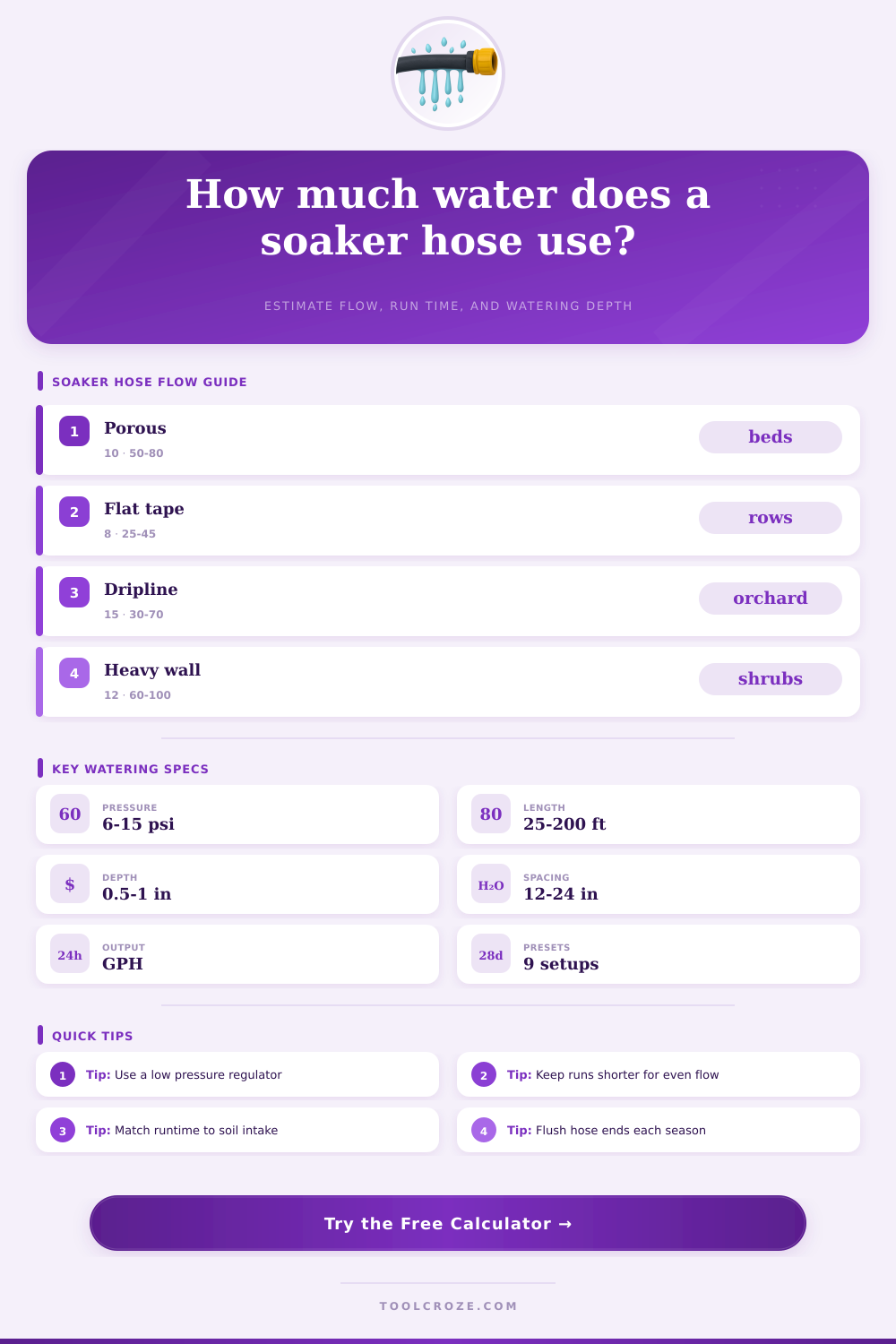
| Porous rubber soaker hose | 10 psi | 65 GPH per 100 ft | Vegetable beds, flower borders, shrubs |
| Flat weep tape | 8 psi | 35 GPH per 100 ft | Long straight rows and seasonal beds |
| Inline dripline style hose | 15 psi | 50 GPH per 100 ft | Evenly spaced plantings and tree rows |
| Heavy wall garden soaker | 12 psi | 80 GPH per 100 ft | Shrub lines and larger foundation beds |
| Soil Type | Approx Intake | Suggested Target | Calculator Use |
|---|---|---|---|
| Sandy soil | 1.00 in/hr | 0.50 to 0.75 in per event | Shorter, more frequent runs |
| Loam soil | 0.50 in/hr | 0.75 to 1.00 in per event | Balanced runtime and absorption |
| Clay soil | 0.25 in/hr | 0.40 to 0.70 in per event | Use split cycles to prevent runoff |
| Mulched bed | 0.60 in/hr | 0.75 to 1.00 in per event | Allowance helps cover mulch interception |
| Layout | Common Spacing | Typical Length | Planning Note |
|---|---|---|---|
| Raised vegetable bed | 12 to 18 in | 25 to 75 ft | Use two or three parallel lines for wide beds |
| Tomato or pepper row | 18 to 24 in | 50 to 150 ft | Keep row ends flushed to remove sediment |
| Shrub foundation bed | 18 to 30 in | 50 to 200 ft | Loops improve coverage around deep root zones |
| Tree ring | 18 to 36 in | 20 to 80 ft | Place water near the drip line, not the trunk |
| Pressure At Hose | Flow Multiplier | Uniformity Risk | Practical Reading |
|---|---|---|---|
| 5 psi | 0.71 at 10 psi reference | Low at far end | Works for short runs with level beds |
| 10 psi | 1.00 at 10 psi reference | Moderate | Common target for porous rubber hoses |
| 15 psi | 1.22 at 10 psi reference | Higher near inlet | Use a regulator and check seepage pattern |
| 20 psi | 1.41 at 10 psi reference | High | Often above comfortable soaker hose range |
Soaker hoses is used to provide water to plant. The soaker hoses have to be provided with the correct amount of water to the plants to ensure that the plants remains healthy. If the soaker hoses provides too little water to the plants, the plants will experience stress due to not receiving the water that they requires.
However, if the soaker hoses provide too much water to the plants, then the water will be wasted, and the roots of those plant may develop disease due to the excess moisture around there roots. Thus, the success of the soaker hoses depend upon the amount of water that the hoses distribute, and how fast the soil can absorb that water. The water pressure that is distributed along the end of the soaker hose will help to determine the flow rate of the water that exits the hose.
How to Use a Soaker Hose Calculator
Additionally, changes in the water pressure will change the amount of water that the soaker hose distributes. Thus, one day the soaker hoses may provide alot of water to the plants, but on another day the same hoses may provide a much more smaller amount of water to those plants. The type of soil also plays a crucial role in the amount of water that is absorbed by the plants.
Soils that have sandy soil will absorb water rapid, but soils that contain clay will hold the water near the plants’ roots. Thus, if the water from the soaker hoses exits the hose at a faster rate then the soil can absorb the water, the water will either pool upon the soil’s surface or it will run off of the surface of the soil, and the plants’ roots will not recieve the water that they need. The calculator allow for the user to input specific data regarding the drip hoses, the slope of the garden, and various other parameters associated with watering the plants.
This information allow for the calculator to perform the math that is necessary to calculate the amount of time that the soaker hoses will take to distribute the amount of water that is required to reach the target depth. In addition, the calculator will provide an estimate of the amount of time that the user should water the plants by calculating the amount of minutes; twenty minutes may be the proper time for one garden bed, but it may be too short for another garden bed. The spacing between the rows of the soaker hoses will determine how much of the garden bed will be watered.
If the rows are closer together, then the amount of water that is distributed will be increased. However, if the rows are too wide apart from one another, then part of the garden bed will remain dry. These variables can be entered into the calculator so that the plan for watering the garden math matches the physical layout of the garden.
The slope of the garden will impact the movement of the water from one end of the soaker hose to the other. The water will move downhill, and it will reach the end of the hose with less force than when it entered the hose. Thus, the calculator apply a penalty for the slope in its calculations.
However, any layout of the garden along the slope may result in patches of dryness at the ends of the hose. Thus, seepage along the hose should be checked after a few watering sessions to find these issues before they develop into habit. The condition of the soaker hoses may impact the amount of water that is distributed to the roots of the plants.
Mineral buildup within the walls of the soaker hoses will reduce the amount of water that is distributed to the roots; this may not be visible from the outside of the hoses. Thus, the amount of time that the hoses are exposed to the water will impact the amount of water that exit the hoses. Thus, a field is provided within the calculator to account for the condition of the hoses.
The application depth field will determine how deep into the soil that the water should go. Half an inch of water may be deep enough for most vegetable when the soil is loam soil. However, clay soil will require less water to be distributed with each watering of the soaker hoses.
Thus, if the amount of water calculated exceed the amount of water that can be absorbed by the soil, the watering time should of been divided into two session with a break in the watering of the plants. The volume per event will help to determine how many gallon of water each soaker hose will distribute during each watering session. Once the watering sessions are established each week with the calculator, these numbers will become helpful in comparing different brand of soaker hoses.
Additionally, the volume will help to make a decision of whether the loss of water pressure during a longer watering session is worth the extra water that will be distributed. Furthermore, the volume of water will make it easy to abide by the water rules of the district in which the garden is established. The uniformity field will determine if the amount of water that reaches the plants at the end of the soaker hose is similar to the amount of water that reaches the plants at the beginning of the hose.
If the uniformity score is low, the issue can be fixed by using shorter length of soaker hoses, or by utilizing a second soaker hose that is placed from the opposite direction of the plants, rather than purchasing a new soaker hose system. Many mistake are made by gardeners with a variety of reasons. For instance, some individuals will set a timer for the soaker hoses to water the plants, but they will never change that timer.
Additionally, some individuals will purchase a soaker hose for their garden based off its price, but they will not test the amount of water that the hose distributes. Finally, some individuals may be unaware of the water pressure in their area and the direction in which the plants are located relative to that water pressure. These error may be avoided by the calculator.
The value of the calculator can be seen after a few growing season. For instance, gardeners will be able to determine which part of the garden require longer watering sessions than others, and which parts of the garden will finish watering sessions with the soaker hoses sooner than others. Additionally, the gardener will notice if the amount of water that the soaker hoses distribute is decreasing over time due to the mineral buildup within the hoses.
Finally, the gardener will also be able to adjust the spacing between the soaker hoses to ensure that all of the plants within the garden receive the same amount of water. These principle can be applied to a single row of tomato plants, but they can also be applied to the entire foundation planting areas within a garden. Thus, the gardener should measure the layout of the entire garden.
Additionally, the gardener should run the numbers within the calculator that determines the water pressure and soil type within the garden. Thus, the gardener should also observe the moisture level within the garden. The soaker hoses will indicate whether the math utilized within the calculator is correct.