Fire Hose GPM Calculator
Estimate nozzle flow, fire hose friction loss, pump discharge pressure, stream velocity, and nozzle reaction from nozzle diameter, nozzle pressure, coefficient, hose size, line length, and stream type.
Choose a common attack, supply, or master stream setup. Each preset fills nozzle diameter, nozzle pressure, coefficient, hose size, friction model, pump pressure inputs, and stream type.
Total Nozzle Flow
0
GPM across all flowing lines
Pump Discharge Pressure
0
psi including line loss
Friction Loss Per Line
0
psi through hose
Nozzle Reaction
0
lb reaction per nozzle
Calculation Breakdown
| Preset | Stream type | Nozzle pressure | Typical hose | Planning use |
|---|---|---|---|---|
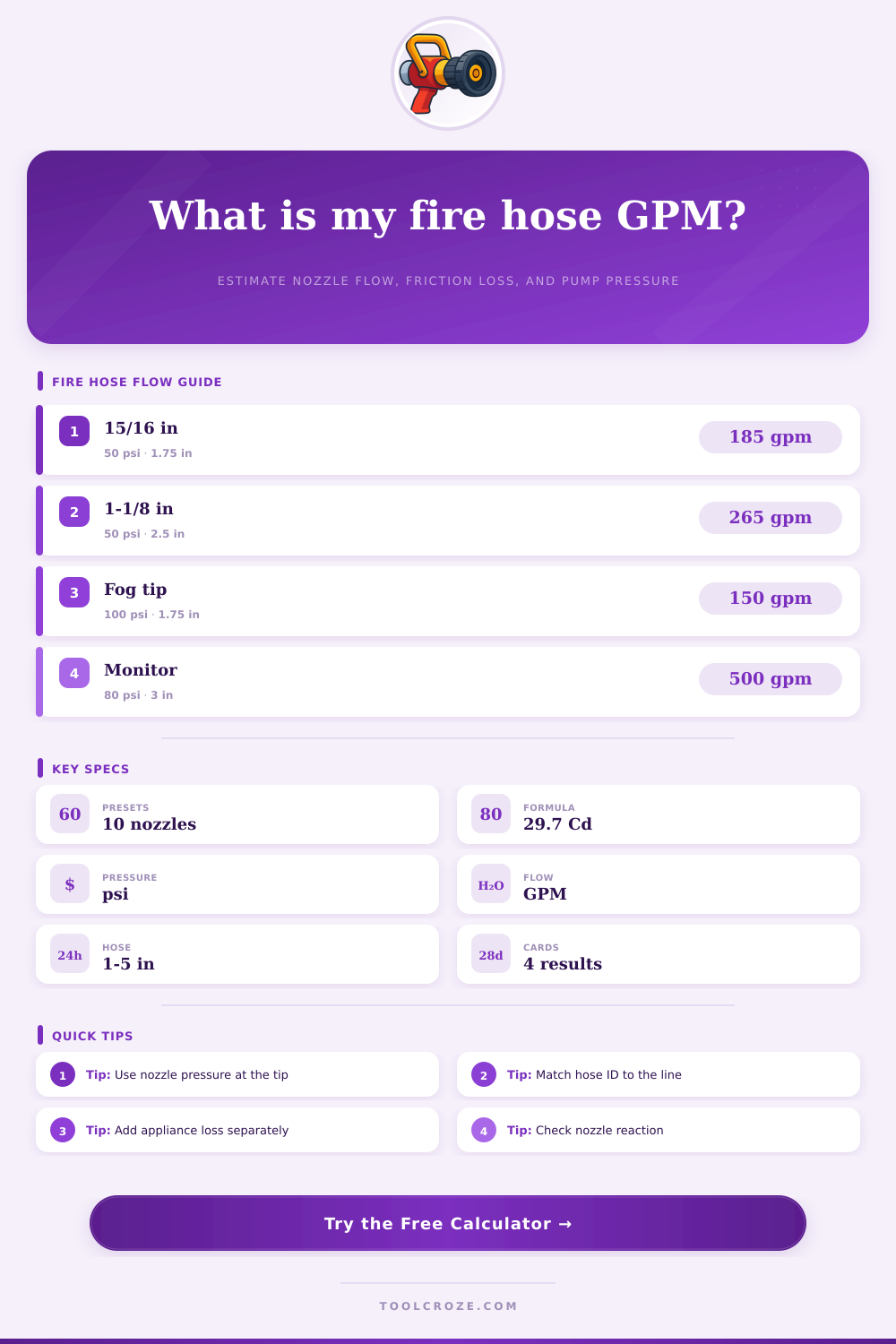
| 15/16 in smooth bore | Solid stream | 50 psi | 1-3/4 in | Interior handline flow with moderate reaction. |
| 1-1/8 in smooth bore | Solid stream | 50 psi | 2-1/2 in | Heavy handline or exposure line with lower friction per GPM. |
| 150 GPM fog | Combination | 100 psi | 1-3/4 in | Fixed gallonage or selectable fog nozzle estimate. |
| 500 GPM monitor | Monitor | 80 psi | 3 in or manifold | Portable appliance flow where appliance loss must be added. |
| 1000 GPM deck gun | Master stream | 80 psi | 4 in or 5 in | Large exterior stream with high pump-flow demand. |
| Hose size | Coefficient C | Formula use | Common flow range | Practical note |
|---|---|---|---|---|
| 1 in booster | 150 | C x Q2 x L | 30 to 80 GPM | High friction; keep lengths and flows modest. |
| 1-1/2 in attack | 24 | C x Q2 x L | 60 to 125 GPM | Useful for compact lines with limited flow. |
| 1-3/4 in attack | 15.5 | C x Q2 x L | 125 to 200 GPM | Common attack size; friction rises quickly above 180 GPM. |
| 2 in attack | 8 | C x Q2 x L | 175 to 250 GPM | Lower loss option for higher handline flows. |
| 2-1/2 in hose | 2 | C x Q2 x L | 200 to 325 GPM | Good heavy stream and supply line size. |
| 3 in supply | 0.8 | C x Q2 x L | 300 to 600 GPM | Often used feeding monitors or standpipe packs. |
| 4 in LDH | 0.20 | C x Q2 x L | 600 to 1000 GPM | Supply work where lower friction is needed. |
| 5 in LDH | 0.08 | C x Q2 x L | 800 to 1500 GPM | Large supply line; appliance and hydrant limits still matter. |
| Stream type | Typical pressure | Coefficient range | Reaction model | Use in calculator |
|---|---|---|---|---|
| Smooth bore | 50 psi | 0.97 to 1.00 | 1.57 x d2 x NP | Best when the physical tip diameter is known. |
| Combination fog | 75 to 100 psi | 0.75 to 0.95 | 0.0505 x Q x sqrt NP | Use rated flow override for fixed-gallonage nozzles. |
| Straight fog stream | 75 to 100 psi | 0.85 to 0.98 | 0.0505 x Q x sqrt NP | Useful for equivalent-orifice estimates. |
| Foam stream | 75 to 100 psi | 0.70 to 0.90 | 0.0505 x Q x sqrt NP | Add proportioner, eductor, or appliance loss separately. |
| Monitor or master | 80 psi | 0.90 to 1.00 | Stream dependent | Include appliance loss and supply hose size carefully. |
Firefighting crews must calculate the pressures and the water flow through the fire hose. The water that exits the nozzle of the fire hose must have the appropriate amount of pressures and volume to reach the fire. If the water dont have the proper amount of pressure and volume, the water will not be able to reach the fire efficient.
The water may overwhelm the firefighters who are holding the nozzle of the fire hose if the water has too much pressure and volume. Firefighters have to find a balance between the water flow and the control of the fire hose to ensure that they can control the fire hose efficient. The amount of water that flow out of the nozzle of the fire hose depends on two factors.
How to Calculate Fire Hose Water Flow and Pressure
The first factor is the size of the nozzle opening. The second factor is the pressure at the nozzle tip. The amount of water that exits the nozzle also depend on the discharge coefficient for that nozzle.
The discharge coefficient is a number that represents the efficiency of the nozzle in which the water exits. Smooth bore nozzles are very efficient at ejecting water compared to fog nozzles and foam nozzles, which creates turbulence in the water. The turbulence results in a lower discharge coefficient for those types of nozzle.
Once a person determines the flow of the water in the nozzle, the person has to calculate the pressure that the fire hose pump must produce. Friction loss in the fire hose reduce the pressure of the water that exits the nozzle. The friction loss depends on the flow of the water, the length of the fire hose, and the diameter of the hose.
One can calculate the friction loss by multiplying three factor: a constant that is specific to the type of fire hose used, the square of the water flow in gallons per minute, and the length of the fire hose in hundreds of feet. Friction loss increases rapid with increased water flow. A slight increase in the flow of the water will require a much more greater increase in the hose pump pressure.
For example, a 2-inch diameter fire hose will allow the water to flow differently than a 1-3/4 inch fire hose. Elevation above the fire hose pump will also affect the water pressure. For every foot that the nozzle is above the pump, the water pressure will decrease by 0.4 psi.
In a high-rise building, the elevation of the fire nozzles will create a significant loss in water pressure. That loss must be accounted for when calculating the fire hose pressure requirements. A calculator will make the calculations for elevation loss if the individual type in the elevation in feet into the calculator.
Nozzle reaction is another calculation that firefighters must perform. Nozzle reaction is the force that pushes back against the firefighters as the fire hose water exits the nozzle. The force of the nozzle reaction is related to the pressure and the volume of the water.
There are different types of formula that can be used to calculate nozzle reaction, depending on whether the nozzle is a smooth bore nozzle or a fog nozzle. A fire hose may be easy to hold for firefighters in station, but it may be difficult when they begin to move it from one part of the structure to another. Calculating the nozzle reaction in pounds will help firefighters have a reality check on the fire hose prior to move it to fight the fire.
The diameter of the fire hose is another choice that a firefighter can make. Using large supply line will reduce the friction loss of the water. On the other hand, large supply lines will add more weight to the firefighters load and make it difficult to move the fire hose.
A 5-inch fire hose has the benefit of moving a great amount of water with its monitor, but a 5-inch fire hose is too heavy for interior attacks on fires. There are tables of coefficients for various fire hose diameters. The table will help a firefighter select the correct diameter for the fire.
When performing fire hose calculations, an allowance percentage must be included. As the water travels through the fire hose system, there will be kinks and other things that will reduce the water pressure. There will also be losses due to gated wyes, the age of the fire hose, and the appliances from which the water emerge.
An allowance percentage accounts for these losses so that the pump operator knows that the pressure readings from the fire hose will be less than the calculated number. There are many mistake that occur when calculating fire hose pressure. One of the most common is treating the nozzle pressure as the pump pressure.
These two values are not the same. Another error is the assumption that the actual water flow from the nozzle is the same than the rated flow. A fire hose calculator will allow an individual to see the difference between these two values.
The type of stream that the nozzle creates will change the pressure and the friction loss requirements for the fire hose. A smooth bore nozzle at 50 psi will have a different nozzle reaction than a fog nozzle at 100 psi. Even with the same gallons per minute flow rate, the smooth bore nozzle will behave different from a fog nozzle.
A stream selector on a fire hose calculator will allow an individual to compare the two nozzle types while setting the psi to the same value so that the comparison are accurate. Calculating fire hose pressure and flow rates will be useful for pre-incident planning for fire departments. By knowing the fire hose layouts for a building, fire departments can plan the water flow and the maximum hose length that each firefighter should have to control the fire.
A fire hose calculator will assist in fire department planning. Finally, an individual must remember that hose calculations are estimates only. There will be differences in the age of the fire hose and the manufacturing of the fire hose.
A fire hose calculator provides a starting point for firefighters when fighting fires. However, they are still in charge of the fire hose and must monitor the nozzle and the gauge on the fire pump for correct function of the fire hose.