Hydraulic Hose Life Calculator
Estimate remaining hydraulic hose service life from working pressure, hose impulse rating, oil temperature, bend radius ratio, abrasion exposure, daily pressure cycles, and inspection safety factor.
Choose a typical hydraulic hose service. Each preset fills pressure, impulse rating, temperature, bend radius ratio, cover exposure, cycles per day, age, and safety factor.
Calculation Breakdown
| Hose class | Typical service | Common impulse rating | Life sensitivity |
|---|---|---|---|
| SAE 100R1 / 100R2 | General hydraulic lines | 150k to 1M cycles | Good baseline when routed above minimum bend radius. |
| Compact high impulse | Mobile equipment and tight routing | 500k to 1M cycles | Handles flexing better, but still needs abrasion control. |
| Four-spiral high pressure | Boom, hammer, lift, and winch circuits | 500k to 1M cycles | Pressure spikes dominate fatigue life. |
| Thermoplastic hose | Lift trucks, steering, test lines | 100k to 500k cycles | Temperature and bend radius are major checks. |
| Return or suction hose | Tank return and inlet plumbing | Often not impulse rated | Use conservative inputs when pressure pulses exist. |
| Condition | Input range | Calculator treatment | Practical interpretation |
|---|---|---|---|
| Pressure below 70% | 0.70 or less of rating | Large fatigue reserve | Often long life if heat, bend, and abrasion are controlled. |
| Pressure above rating | More than 100% | Immediate warning | Do not use the estimate as permission to operate. |
| Hot oil | Above 180°F | Temperature multiplier rises | Cover, tube, and reinforcement adhesion age faster. |
| Tight bend | Below 1.00 ratio | Bend multiplier rises sharply | Re-route or change fittings before relying on cycle life. |
| Visible abrasion | Moderate or severe | Abrasion multiplier rises | Protective sleeve is not a cure for exposed reinforcement. |
| Preset | Typical pressure | Cycle pattern | Watch point |
|---|---|---|---|
| Loader lift cylinder hose | 2500 psi class | Hundreds to thousands per day | Boom articulation and cover rub at clamps. |
| Excavator boom flex line | 4000 psi class | High impulse with shock | Pressure spikes and tight bends at pivot points. |
| Forklift mast hose chain | 3000 psi class | Frequent lift cycles | Chain tracking, bend repeatability, and guide wear. |
| Hydraulic press return line | Low pressure return | High count but low pressure | Heat and fluid compatibility may matter more than pressure. |
| Skid steer auxiliary hose | 3500 psi class | Attachment dependent | Abrasion, twist, and quick-coupler pressure traps. |
Hydraulic hoses dont usually fail because of a single overload to the hoses. Additionally, the hoses do not usually fail in the way that people might expect the hoses to fail. The hoses slowly accumulate damage from the various factors that contribute to the hose life.
Due to the fact that hoses slowly accumulate damage from these factors, it is necessary to estimate the life of the hoses. A hose life estimate will allow you to create a schedule to replace the hoses so as to avoid hose failure. One of the factors that impact the life of a hydraulic hose is the pressure ratio of the hoses.
How Long Will a Hydraulic Hose Last
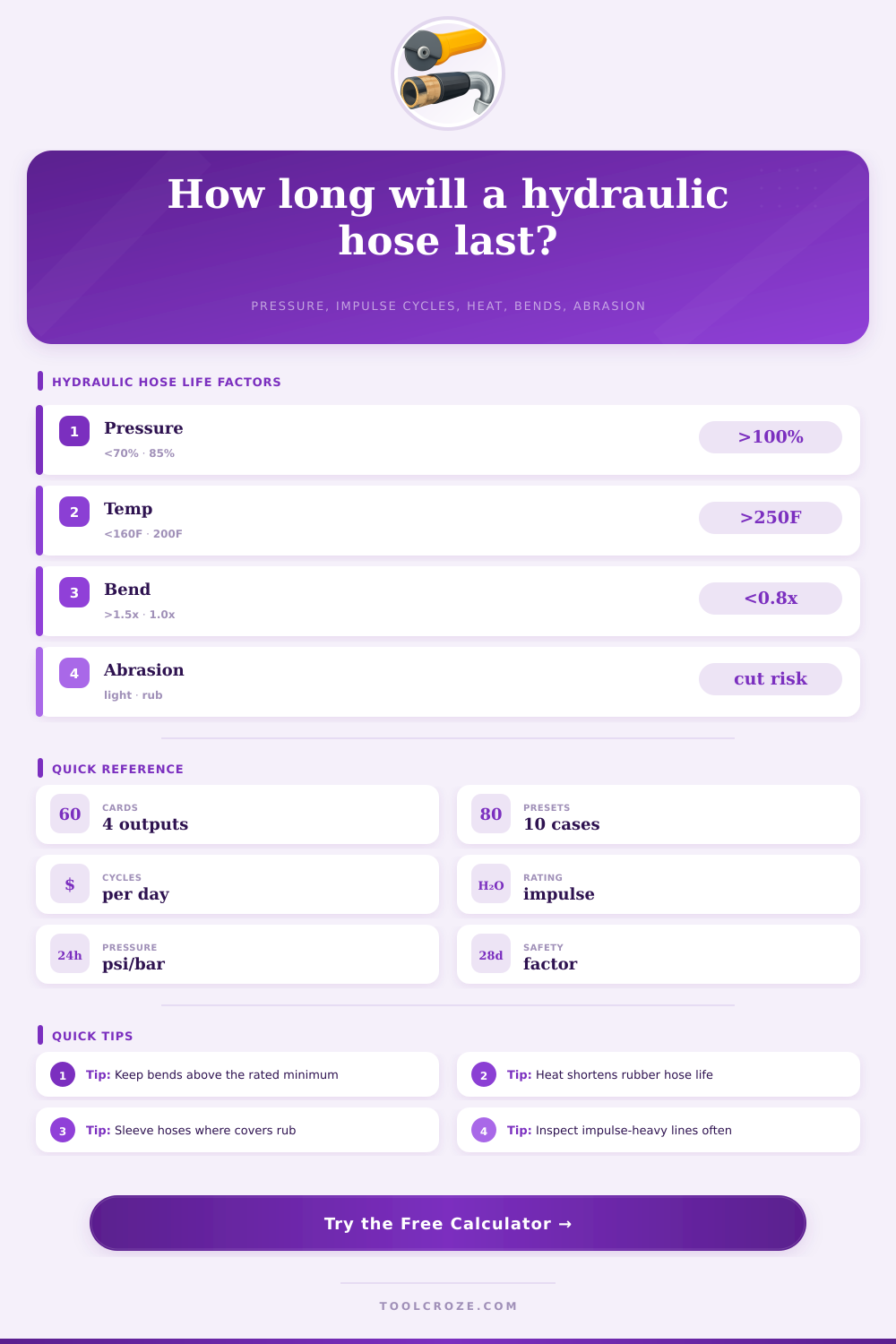
The pressure ratio is the measurement of the daily operating pressure of the hose divided by the working pressure of the hose manufacturer. If a hydraulic hose operates at seventy percent of its working pressure, it has a large degree of fatigue reserve prior to hose failure. However, if the hose operate at ninety-five percent of its working pressure, the hose fatigue reserve is significantly smaller than if it was operating at seventy percent of its rated working pressure.
A hydraulic hose life calculator will use the pressure numbers of the hydraulic hose and the construction of the hose to calculate the life of that hose. Each type of reinforcement structure for the hose allows for different math calculations within the calculator to determine the life of that hose. Another factor that impacts the life of a hose is the effect that temperature has upon the rubber compounds in the hose.
If the oil that is contained within the hose reaches a temperature of one hundred eighty degrees, the rubber compounds in the hoses begin to oxidize and lose the flexibility that they require in order to effectively move the fluids within the hoses. The higher that the temperature of the oil in the hoses reaches towards the maximum rated temperature for the hoses, the more damage that is done to those hoses. The life of the hoses is calculated with a temperature multiplier that can significantly shorten the life of the hoses.
The third factor that can significantly impact the life of a hose is the bend radius of the hose. The hoses are designed with a minimum bend radius that indicates the position in which the hose rests when it is not in use. However, hoses experience many cycles of flexing from the movement of the machine in which the hoses are installed.
If the bend radius of the hose is set to a radius that is smaller than the minimum bend radius of the hose, the internal reinforcement layers of the hoses will rub against each other. Such rub can significantly shorten the life of that hose. The life calculator calculates a bend factor for hoses with a radius that is smaller than the hoses minimum bend radius.
An abrasion factor is another that can lead to damage to the hoses. If the abrasion factor is strong, the cover of the hoses may wear thin over time. Such thinning of the cover can expose the internal reinforcement to rubbing.
An abrasion factor is set into the calculation of the life of the hose. If the abrasion is moderate, the factor increases the damage to the hose. If the abrasion is severe and the wire internal reinforcement is exposed from abrasion, the hoses will indicate that the hoses require immediate replacement.
An additional factor related to the life of the hoses is the number of cycles that the hoses are subjected to each day. The more cycles that the hydraulic machine that employs those hoses performs, the less life the hoses will have left to operate effectively. A hose life calculator may calculate the number of cycles performed daily by the machine to determine the annual damage percentage for that hose.
The annual damage percentage will allow the maintenance worker to understand how many years of the total life of the hose are used each year. Thus, the worker will be able to decide whether the hoses should be routinely replaced or whether they may experience emergency downtime. The age of the hoses is another factor that impacts their life, even if they are not in use by a machine.
Over time, the hoses are exposed to ozone and UV radiation that ages the rubber compounds within them. These years of the hose can be subtracted from the total life of the hoses within the calculator. By subtracting the age of the hoses from the total life, the life estimate will be accurate even if the hoses were installed in stages and some of those hoses had been sitting idle for several years.
A safety factor is incorporated into the life calculation of the hoses to prepare a more conservative estimate for maintenance planners. A safety factor of one-point-five is used for hoses for mobile equipment. Higher safety factors are used for overhead lifts and hoses near workers.
The life calculator will apply the safety factor to the fatigue life of the hoses prior to calculating the life of the hoses. A common mistake among those who read the specifications of the hoses is to treat the published impulse rating as a guarantee of the life of that hose. Impulse ratings are determined under laboratory conditions to which hoses are subjected to single pressures and temperatures.
The machines to which the hoses are attached may not experience the same conditions. The hydraulic hose life calculator helps to bridge the gap between impulse ratings and the life of the hoses under actual use. It is also important to physically check the hoses for their bend radius while the machine is in motion.
It is possible for the hose to bend to a tighter radius than when the machine is stationary. Additionally, it is also important to physically inspect the hoses for abrasion while the machine is in motion. The hoses may only touch a metal bracket while the cylinder of the machine is extended.
The reference tables included with the life calculator assist in understanding the numbers to be entered into the calculator. The tables include information about the different ways that hose constructions behave based off the number of cycles per day, for instance. Additionally, the tables indicate the different classifications of low, watch, or severe conditions for the hoses.
These tables may assist in the entry of realistic numbers in to the calculator. Factors that are external to the calculator that can impact the life of the hoses include the compatibility of the fluid with the rubber compounds of the hoses, the way in which the hoses are assembled (such as the crimp diameter), and the quality of the hoses during assembly. If the hoses are assembled with the wrong size crimp to secure the fittings to the hoses, for example, the hoses may fail prematurely.
Thus, the life calculator is only an estimate of the life of the hoses and not a warranty for that life. Should the life calculator indicate that a hose has a short life, it is important to review the factors that contributed to the short life of that hose. For instance, if the pressure ratio for the hoses is high, it may be necessary to use hoses with a higher pressure rating.
High bend radius factors may indicate the need for a different fitting or a longer hose. If the abrasion for those hoses is determined to be severe, protective sleeving may be needed or the hoses may need to be rerouted around the bracket that is causing the abrasion. Such inspection will help to fix these issues with the hoses.
The goal of calculating the life of a hydraulic hose is to transition hoses from being replaced reactively to hoses being replaced on a schedule. A schedule can reduce the number of downtimes that occur due to hose failure, and it can also reduce the risk that a hose will fail during an operation. Each of the factors that impact the life of the hoses are accounted for in the life calculator.
Additionally, the calculation of the life of the hoses also accounts for the age of the hoses and the safety factor. Thus, the calculator will provide an estimate of the hoses remaining life.