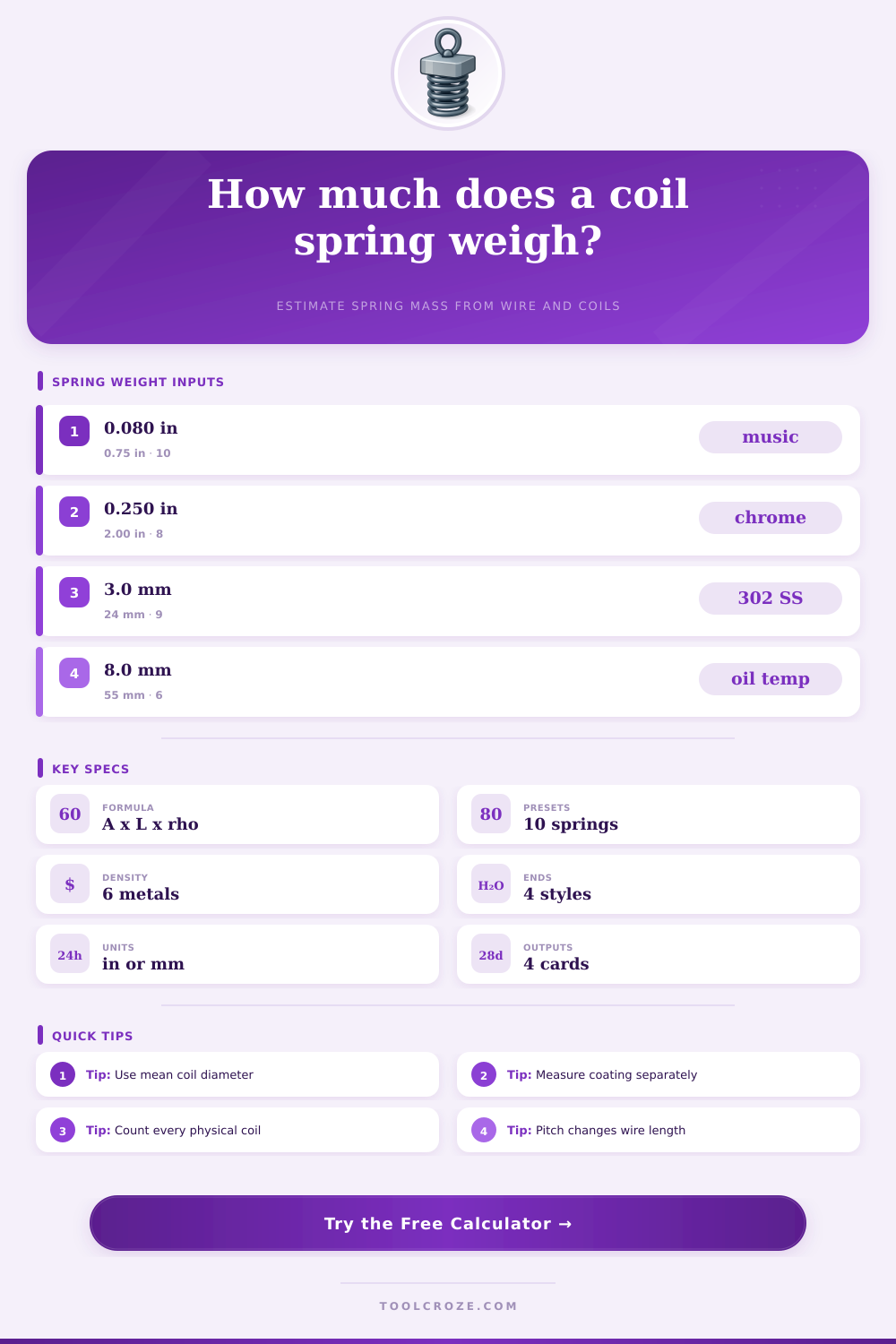
Coil Spring Weight Calculator
Estimate the finished weight of compression, extension, valve, die, and suspension coil springs from wire diameter, mean coil diameter, pitch, total coils, density, end style, and coating allowance.
Load a named spring geometry, then adjust the measured dimensions for your actual part.
Calculation breakdown
| Material | Density lb/in³ | Density g/cm³ | Typical use |
|---|---|---|---|
| Music wire ASTM A228 | 0.283 | 7.83 | General compression and extension springs |
| Oil-tempered spring steel | 0.283 | 7.83 | Automotive, agricultural, heavy equipment springs |
| Chrome silicon spring steel | 0.283 | 7.83 | Valve, die, and high-stress cyclic springs |
| 302 stainless spring wire | 0.286 | 7.92 | Corrosion-resistant instrument and food-zone springs |
| Phosphor bronze | 0.319 | 8.83 | Conductive and marine hardware springs |
| Titanium beta alloy | 0.166 | 4.60 | Lightweight corrosion-resistant springs |
| End type | Allowance model | Weight effect | Use when |
|---|---|---|---|
| Plain open ends | No added circumference | Lowest | Ends are left as wound |
| Closed and squared ends | +0.50 mean turn | Small increase | End coils are closed for seating |
| Squared and ground ends | +0.75 mean turn | Moderate increase | Flat bearing faces are ground |
| Looped or hook ends | +1.25 mean turns | Largest increase | Extension spring hooks or loops remain attached |
| Spring family | Wire diameter | Mean diameter | Coil count |
|---|---|---|---|
| Small instrument compression | 0.010-0.050 in / 0.25-1.3 mm | 0.080-0.500 in / 2-13 mm | 5-20 total coils |
| Workshop fixture compression | 0.063-0.187 in / 1.6-4.8 mm | 0.50-1.50 in / 13-38 mm | 6-14 total coils |
| Valve or die spring | 0.125-0.375 in / 3.2-9.5 mm | 0.75-2.50 in / 19-64 mm | 5-10 total coils |
| Suspension coilover | 0.375-0.750 in / 9.5-19 mm | 3.0-5.5 in / 76-140 mm | 6-12 total coils |
| Check | Formula or rule | Why it matters | Calculator output |
|---|---|---|---|
| Wire area | π × d² / 4 | Weight scales with diameter squared | Shown in breakdown |
| Helix length | sqrt((πD)² + pitch²) × coils | Pitch adds length beyond a flat circle | Wire length card |
| Material mass | volume × density | Stainless, bronze, and titanium vary widely | Finished weight card |
| Coating allowance | raw weight × allowance % | Accounts for plating, paint, oil, or margin | Batch weight card |
Coil spring are components that are used in a wide variety of machine. The weight of the coil spring is one of the measurements of that component that is important to calculate. Coil springs can be used in machine components like engine valve train and suspension system for vehicles.
The weight of the coil spring will impact the functioning of the machine in which it is used. Should the weight of the spring be more then the weight that was calculated for the component in which it is to be used, that extra weight can impact the balance of that assembly, as well as the cost of moving and shipping the spring. Each of these variable impacts the weight of the spring, thus the weight is not a fixed value for that component.
How to Calculate the Weight of a Coil Spring
The weight of the spring will change with changes to the diameter of the spring’s wire, the mean coil diameter of the spring, the number of coil of the spring, the pitch of the spring, the end style of the spring, the material of the spring, or the coating of the spring. The diameter of the spring’s wire will have the greatest impact upon the weight of the spring. The heavier the diameter of the spring wire, the more weight that spring will contribute.
The weight of a spring’s wire is proportional to the square of the diameter of that wire. Thus, a spring that utilizes 0.080-inch music wire will be relatively light in weight in comparison to a spring that utilizes 0.250-inch wire. The mean coil diameter of the spring is another variable that will impact the weight of that spring.
The user should use the mean coil diameter in the calculation of that spring’s weight instead of the spring’s outside diameter. The outside diameter of the spring would add an additional thickness of the spring wire to each turn of the spring. Thus, if the outside diameter is used in place of the mean diameter, the calculated weight of the spring will be higher than the actual weight of the spring.
The pitch of the spring is another variable that will impact the weight of the spring. The pitch of the spring is the distance between each coil of the spring. A spring with a tight pitch will have less wire within each turn of the spring compared to a spring with a relatively wide pitch.
Because each turn of a spring has a length to it, the longer the spring’s helical path, the more weight that the spring will have. Thus, a spring with a wide pitch will have more weight than a spring with a tight pitch. Despite having the same free length, two springs can have different weights if the pitch of those spring is different from one another.
The end style of the spring will also impact the total weight of the spring. Springs that have open ends will have less weight associated with those ends than springs with closed ends. If the spring has closed ends, then there will be an extra half turn of wire for each end of the spring.
If the ends are squared and ground, then there will be three-quarters of a turn of additional wire at each end of the spring. Finally, if the spring is an extension spring with looped or hooked ends, there will be more than a full turn of additional wire at each end. While the extra weight of this wire may be small if the spring itself is small in size, the extra weight of this wire is one of the factors that can contribute to the relatively high weight of long springs.
The material of the spring will also impact its weight. Springs that use carbon steel have a density of 0.283 pounds per cubic inch. Springs that utilize stainless steel have a higher density, while those made of titanium have a lower density.
For instance, replacing music wire with 302 stainless steel will increase the weight of the spring by a few percent. Replacing music wire with a titanium beta alloy will decrease the weight of that spring by 40%. Spring designers can reference these densities for different spring materials in a table to help understand how different materials have different densities and how that can impact the weight of the spring.
Finally, one last variable is the weight of any coating that may be applied to the spring. Thin coatings of oil or zinc plate will add only a small amount of weight to the spring, but thicker coatings of powder coat or paint will add five to ten percent to the weight of the spring. The user should enter the percentage of the weight of the coating into the calculator for the spring’s total weight to be accurately calculated.
Coatings will have a greater effect upon the total weight of a larger spring compared to a thin spring. The calculator adds this weight to the bare spring to determine the total weight of the spring. There are many reasons to calculate the spring’s weight.
The weight of the spring will impact the total cost of any large order of those springs. Additionally, the weight of all of the springs within a design will impact the spring assembly’s center of gravity. Finally, if a spring is to be replaced for an existing component, the weight of that spring must match that of the current spring.
Despite the variety of reasons that the weight of a spring can be calculated, there are some mistake that many people make when calculating the weight of a spring. For instance, people may consider the spring to be a simple cylinder, but the spring is actually helical in shape. Additionally, using the outside diameter of the spring instead of the mean spring diameter will result in a calculated spring weight that is too high.
Finally, a third mistake is to not consider that the percentage of the weight of the coating refers to the weight of the spring without that coating. These mistake will result in the spring’s weight being incorrectly calculated. The calculator can provide an estimate of the weight of the spring.
However, that weight will not be a certified measurement of that spring. There may be slight variations in the weight of the spring due to the diameter of the spring wire varying slightly from spring to spring, or due to the wire being stretched during the forming of the spring. However, the calculator will provide an accurate estimate of that spring’s weight.
After determining the spring weight, it is possible to decide whether or not that weight is within the requirement for that spring’s function.