Dual Rate Spring Calculator
Calculate primary and secondary spring behavior, crossover position, preload force, ride sag, wheel rate, and the combined rate curve for coilover suspension tuning.
Load a realistic dual-rate baseline, then adjust the spring rates, crossover travel, preload, corner weight, motion ratio, and available travel.
Sets the screening note for sag, crossover timing, and progression.
Rate after the secondary spring reaches the crossover stop.
Initial spring acting in series with the main spring before crossover.
Spring-axis travel available before the tender closes or the slider hits.
Collar preload applied to the spring stack at full droop.
Bump travel remaining before bump stop, tire contact, or mechanical bind.
Scale weight on one tire at ride height with the expected driver and fuel.
Wheel, tire, brake, hub, and part of the links or axle.
Measure spring-axis movement divided by vertical wheel movement.
Angle reduces effective wheel rate by cosine squared.
Used to screen whether preload and sag leave the spring seated.
Applies to wheel-rate screening, not to the entered physical springs.
This curve starts at ride height and steps through the entered bump travel, showing whether the stack is still in the combined zone or on the main spring.
| Wheel travel | Spring compression | Active zone | Spring force | Wheel rate |
|---|---|---|---|---|
| 0% | -- | -- | -- | -- |
| Preset baseline | Main rate | Tender rate | Crossover travel | Typical use |
|---|---|---|---|---|
| Light autocross car | 450-650 lb/in | 200-300 lb/in | 0.8-1.5 in | Ride support with early platform. |
| Track day rear | 600-850 lb/in | 250-400 lb/in | 0.6-1.2 in | Sharper transition and less roll. |
| Trail crawler | 200-350 lb/in | 80-150 lb/in | 1.5-3.5 in | Droop compliance and traction. |
| Desert truck | 600-900 lb/in | 200-350 lb/in | 2.0-4.0 in | Initial compliance before big hits. |
| Rally gravel | 350-550 lb/in | 150-250 lb/in | 1.0-2.0 in | Compliance over loose surfaces. |
| Crossover timing | What it feels like | Rate curve effect | Setup caution |
|---|---|---|---|
| Closed at preload | Acts like a single main spring | No soft initial zone | Tender may only be a helper spring. |
| Early in sag | Firm platform at ride height | Short dual-rate section | Can lose small-bump compliance. |
| Near ride height | Balanced ride and support | Transition happens under light bump | Measure after settling the car. |
| Deep in bump | Soft initial travel | Main rate arrives late | May use too much travel before support. |
| Motion ratio | Wheel-rate multiplier | Spring rate needed | Common location |
|---|---|---|---|
| 1.00 | 1.00× | Same as target wheel rate | Near-vertical strut |
| 0.90 | 0.81× | About 1.23× higher spring | MacPherson style front |
| 0.75 | 0.56× | About 1.78× higher spring | Multilink or arm mount |
| 0.60 | 0.36× | About 2.78× higher spring | Truck arm or inboard mount |
| Check | Useful target | Calculator output | Why it matters |
|---|---|---|---|
| Preload | Enough to seat springs | Preload force and closed status | Too much preload moves crossover too early. |
| Sag | 20-35% of total travel | Ride sag estimate | Shows if springs suit the corner weight. |
| Crossover | Before hard bump support | Wheel travel to crossover | Controls where the rate curve steps up. |
| Bump force | Within shock and mount limits | Curve force at full travel | High force can overload hardware. |
Dual rate springs exist for the fact that the vehicle will experience small bump or loads the majority of the time but will also hit a few large bump. A single spring rate will be too stiff for the majority of driving but too soft when the car is loaded up. Dual rate springs is comprised of two springs stacked in series with each other.
Each system provides a softer spring rate initially but then provides a firmer spring rate once the softer spring either closes or a crossover collar stops the movement of that spring. You must know where the change in spring rates occur in the car’s movement and if that particular change in rate happen in the same way as the car’s movement. The calculator allow you to enter the spring rates, the crossover travel, the preload, the corner weight, the motion ratio, and the spring angle.
Dual Rate Springs: How They Work and How to Adjust Them
Each of these rates and parameters will allow you to know exactly where the change in spring rates occur in relation to the height of the vehicles springs. Furthermore, each of these variables will allow you to ensure that you do not run out of travel before the car can reach the support that you want from the system. If the crossover point is set too early you will create a harsh ride for the car.
However, if you set the crossover too late you will use up all of you available travel before the car can reach the rate that you want. Motion ratio is one of the more challenging variable to calculate. As the spring is positioned at an angle to the vehicle, it does not move the same distance as the wheel.
Thus, the effective spring rate of the system will be lower then the spring rate of the spring itself. Furthermore, squaring the motion ratio will allow for any error in the measurement of that ratio to become more apparent. Spring angle can also impact spring rate as different angles to the spring will create different forces within the spring.
An eight or ten degree angle to the spring will reduce the vertical component of the spring force thus the cosine squared correction is applied to the rate. Preload can be used to adjust for the fact that many people either set their preload by feel or by counting turn of the collar. However, if the preload is set such that the tender spring is fully compress at full droop, it will no longer be a dual rate spring system.
It is important to understand the relationship between preload and tender spring crossover travel to ensure that you do not unintentinally convert your dual rate system into a single rate system. Ride sag will tell you if your spring rates is appropriate for the corner weight of the car. For most car, the target ride sag will be between 20 and 35% of the total spring travel.
The exact value of the ride sag will depend upon the performance of the car. For autocross cars, less ride sag is desire as the car will need to maintain better adhesion to the road during turns. For desert trucks and trail cars, more ride sag is desired as the tires need to remain in contact with the ground.
The combined rate curve will allow you to see where the spring rate change occur along the bump travel of the suspension system. If the tender spring rate crossover occur deep in the bump travel the car will remain soft over bumps but then suddenly feel firm. It is possible to use this setup for cars that perform high speed whoops but the tender spring will be doing the majority of the work over road surfaces.
If the crossover occurs right after the preload travel, the tender spring is essentially doing no work so it might as well not be part of the suspension system at all. One of the issues with dual rate systems is tender spring bind. It is possible that the tender spring will bind to the main spring when compress to its maximum droop travel.
Furthermore, if the droop travel is too much for the spring the tender spring will completely unload from the vehicle. This change in the suspension system will alter the way that the suspension work while the car is in extension travel. Some of the mistakes that can be made when setting up a dual rate system are ignoring the fact that many people simply copy the spring rates from another car.
Furthermore, spring rates are listed in most cars as the spring rate at the wheel but the spring rate listed is for the spring itself. Finally, most people do not consider the fact that the unsprung weight will not compress the spring at the same rate as the sprung weight. The tables can be used to provide examples of spring rates for different type of vehicles.
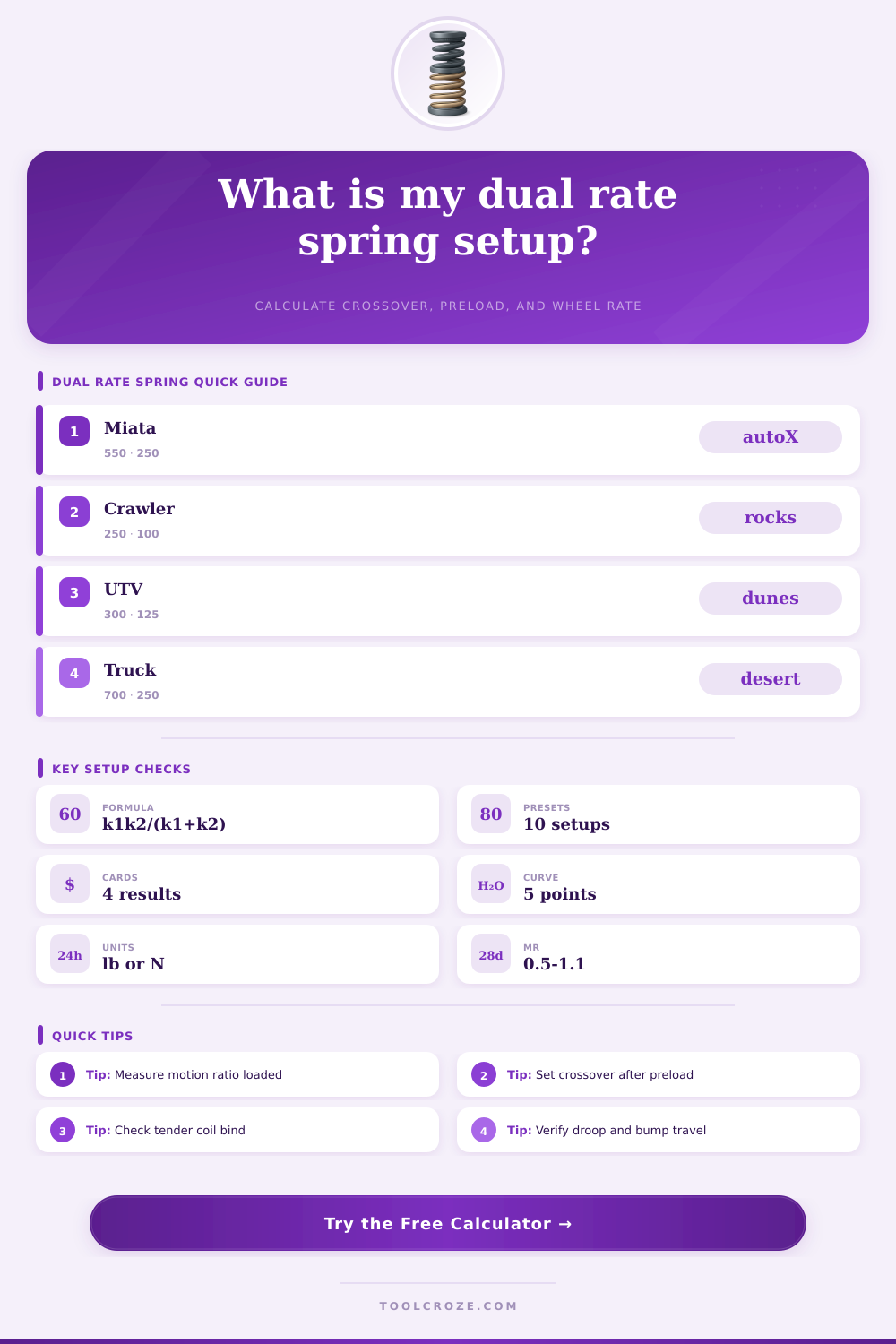
For instance, Miata cars that compete in autocross events will have a short crossover point travel. The reason for this is that a short crossover will allow the car to better transition between turns. For desert trucks and trail vehicles the crossover travel will be established before the majority of the suspension travel so that the spring system will not have to work as hard to push the vehicle forward.
Once you have all of the number calculated you can begin to make adjustment to the cars suspension system. Small changes to the crossover travel and the preload will have a greater impact on the feel of the car than changing the spring rates. Furthermore, the calculator allows you to determine these changes prior to making any adjustment to the collars of the car suspension system.