Dirt Bike Spring Rate Calculator
Estimate rear shock and front fork spring rates from rider weight, wet bike weight, rear sag, motion ratio, linkage factor, riding style, and front/rear load split.
⚙Named dirt bike presets
Load a baseline motocross, enduro, desert, trail, mini, or dual-sport setup, then tune the measured values for your bike and riding position.
📏Rider, bike, sag, and linkage inputs
Applies a practical firmness factor to the calculated front and rear targets.
Include helmet, boots, hydration pack, tools, and typical cargo.
Use ready-to-ride weight with fuel and fluids.
Common full-size targets are about 95-110 mm.
Used to report sag percentage and travel balance.
Fork sag target is usually lower than rear rider sag.
Used to check the front sag percentage.
Shock shaft travel divided by rear wheel travel at ride height.
Use above 1.00 for rising-rate linkage support near sag.
Static bike-only front load share; rear share is the remainder.
Standing and rearward body position increase this number.
Typical shock springs are sold in 0.2 or 0.3 kg/mm steps.
Fork springs are commonly listed per leg in 0.01-0.02 kg/mm steps.
📊Suspension spec grid
📐Reference tables
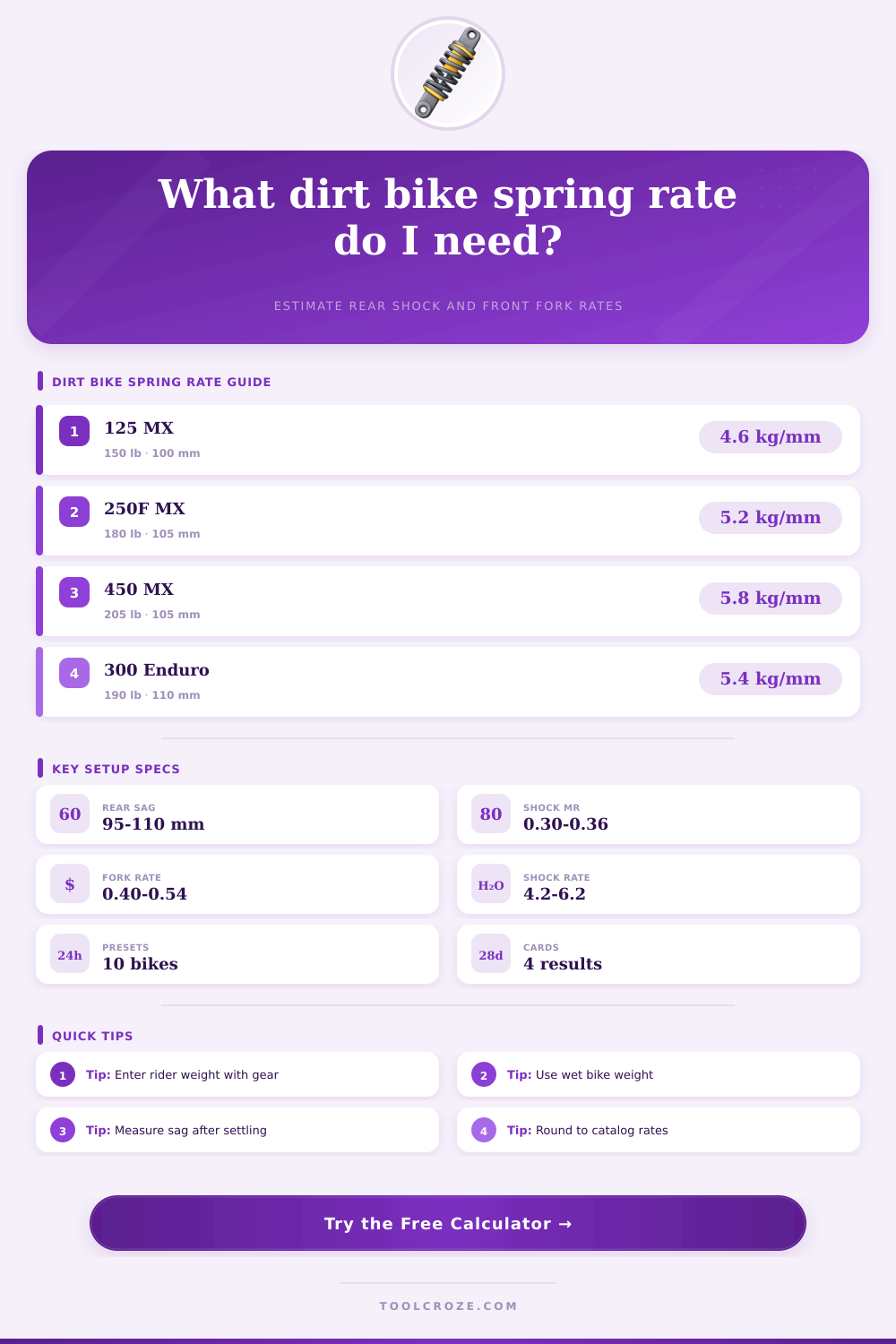
Use the tables as setup context after the calculator gives a front/rear target rate. Final rates should be checked with measured sag and track feel.
| Bike class | Rider with gear | Rear sag target | Typical shock rate |
|---|---|---|---|
| 85cc mini racer | 85-120 lb | 75-90 mm | 3.8-4.6 kg/mm |
| 125cc two-stroke MX | 135-170 lb | 95-105 mm | 4.4-5.0 kg/mm |
| 250F motocross | 160-200 lb | 100-108 mm | 4.8-5.6 kg/mm |
| 450 motocross | 185-230 lb | 100-108 mm | 5.4-6.2 kg/mm |
| 300 enduro | 170-220 lb | 105-115 mm | 5.0-5.8 kg/mm |
| Riding style | Rate factor | Sag feel | Setup note |
|---|---|---|---|
| Trail comfort | 0.94× | Plusher | Useful for slower roots, rocks, and all-day comfort. |
| Woods enduro | 0.98× | Neutral | Keeps traction without diving too far into travel. |
| Motocross | 1.06× | Firmer | Supports jump faces, landings, braking bumps, and berm load. |
| Sand / whoops | 1.10× | Firmer | Adds chassis hold-up for deep load and repeated hits. |
| Hard enduro | 0.92× | Plush | Prioritizes grip and low-speed compliance over big-hit support. |
| Rear motion ratio | Spring multiplier | Meaning | Common check |
|---|---|---|---|
| 0.30 | 11.11× | Large leverage at shock | Measure shaft and axle travel together. |
| 0.33 | 9.18× | Typical linkage zone | Good default for many full-size bikes. |
| 0.36 | 7.72× | Less leverage | Needs less spring for the same wheel rate. |
| 0.40 | 6.25× | High shock movement | Use only if measured on the actual bike. |
| Spring location | Catalog unit | Common step | Rounding advice |
|---|---|---|---|
| Rear shock spring | kg/mm | 0.2-0.3 | Round to nearest available rate, then verify rider sag. |
| Fork springs | kg/mm each | 0.01-0.02 | Use matching left and right rates unless tuning specially. |
| Mixed fork rates | average | 0.005+ | A 0.46 and 0.48 pair averages 0.47 kg/mm. |
| Loaded dual-sport | kg/mm | varies | Calculate with the normal luggage and fuel load included. |
ℹSetup tips and safety
Adjusting teh dirt bike suspension requires selecting the correct spring rates. Spring rates are important because they affect the dirt bike’s performance on the trails regarding how well it handles corners, jumps, and rocks. Dirt bike suspensions with spring rates that is too soft will make the dirt bike wallow or bottom out when the dirt bike applies the brakes.
Dirt bikes with too firm spring rates will make the dirt bike skim the ground. When the spring rates of a dirt bike are correct for the combined weight of the dirt bike and the rider, the dirt bike will feel well planted. However, if the spring rates do not match the weight of the dirt bike and it’s rider, the dirt bike will feel difficult to control.
How to Choose the Right Springs for Your Dirt Bike
The spring rate is the amount of force required to compress the spring a specific distance. The spring rate is a critical factor in dirt biking as the front and rear end shocks of a dirt bike work together as one suspension system. Several factors influences the spring rate of a dirt bike, including the weight of the dirt bike rider and gear, the weight of the dirt bike and fluids, the target sag for the dirt bike, the motion ratio, and the linkage system of the dirt bike’s suspension.
If any of these factors are changed, the target spring rate will change accordingly. The calculator helps perform the mathematics for determining the correct spring rate for the dirt bike without purchasing the wrong spring rates for the dirt bike suspension. Sag is the measurement of how much the dirt bike’s suspension compresses when the dirt bike is loaded with its rider.
Rear sag is the distance the rear end of the dirt bike settles when the dirt bike rider is seated in the normal riding position. Front sag is the distance the front end of the dirt bike settles when the dirt bike rider is seated. The front sag will be lower than the rear sag because the front forks of a dirt bike do not carry as much of the dirt bike’s weight as the rear end.
To determine whether the springs on a dirt bike are working correctly, you must measure the sag percentages. If the rear sag is only 25% of the total travel the suspension can move, then the spring rate for the rear end of the dirt bike is too stiff. However, if the rear sag percentage is more than 38% of the total travel, then the rider will lose steering feel when riding the dirt bike.
The motion ratio indicates the distance the dirt bike’s shock shaft moves in comparison to the rear wheel’s movement. Dirt bikes has a motion ratio of approximately one-third so that the shock travels one-third of the distance that the rear wheel travels. Dirt bikes’ linkages will change the motion ratio so that the spring rate of the suspension system works during full compression of the suspension system.
You should understand the motion ratio because the motion ratio will affect how the spring behaves when the dirt bike is moving through terrain. The riding style you use will affect the spring rate. Motocross bikes require more support from the spring when taking jumps and braking bumps.
Hard enduro requires the suspension to be more compliant with the terrain to ensure the tires can grip onto rocks and roots. The calculator can be used to adjust for the different types of riding styles. Another factor to consider is the distribution of the weight of the dirt bike.
Dirt bikes do not always have the same weight distributed equal on the front and rear of the bike. The calculator allows for adjustment for the percentage of the weight distributed to each portion of the dirt bike. The calculator will calculate the spring rates for the dirt bike.
Once the rider calculates these spring rates they must be rounded to the closest available spring rates for the dirt bike. After the rider has purchased and installed the spring rates it is important to check the sag of the dirt bike once more. The preload and oil height can be adjusted once the rider has installed the correct spring rates but they wont be able to compensate for a spring rate that is incorrect.
Many people make mistakes when calculating the spring rates for their dirt bikes. One of the most common mistakes is using the dry weight of the dirt bike instead of the wet weight of the bike. Other mistakes include failing to wear riding gear when measuring the sag of the dirt bike.
People also tend to ignore the motion ratio when calculating the spring rates. Additionally, many people treat the front and rear spring rates as separate issue when they should be adjusted together to even out the weight of the dirt bike. The balance indicator on the calculator will alert the rider if the front or rear spring rates are too high or too low.
After purchasing and installing the new springs it is important to actualy ride the dirt bike. Many factors will affect the feel of the springs. Some of these factors include terrain, tire pressure, damping and fuel load.
The feel of the springs on hardpack terrain may not be the same as the feel of the springs on sand terrain. Therefore, using the spring rate calculator is just that, a calculator. The rider should adjust the spring rates according to how well the dirt bike handles during riding time.
The entire point of adjusting the spring rates on a dirt bike is so that the dirt bike will use up all of its travel while maintaining the dirt bike’s balance and responding appropriately to the dirt bike rider’s desired riding style. You should of checked your sag more than once.