Valve Spring Rate Calculator
Calculate valve spring rate from seat pressure, open pressure, installed height, open height, coil bind clearance, retainer mass factor, cam type, and operating RPM.
Load a common engine spring setup, then adjust the measured pressures, heights, bind clearance, and valvetrain mass factor for the parts on the bench.
Valve spring result
Calculation breakdown
| Preset | Seat pressure | Open pressure | Installed / open height | Typical use |
|---|---|---|---|---|
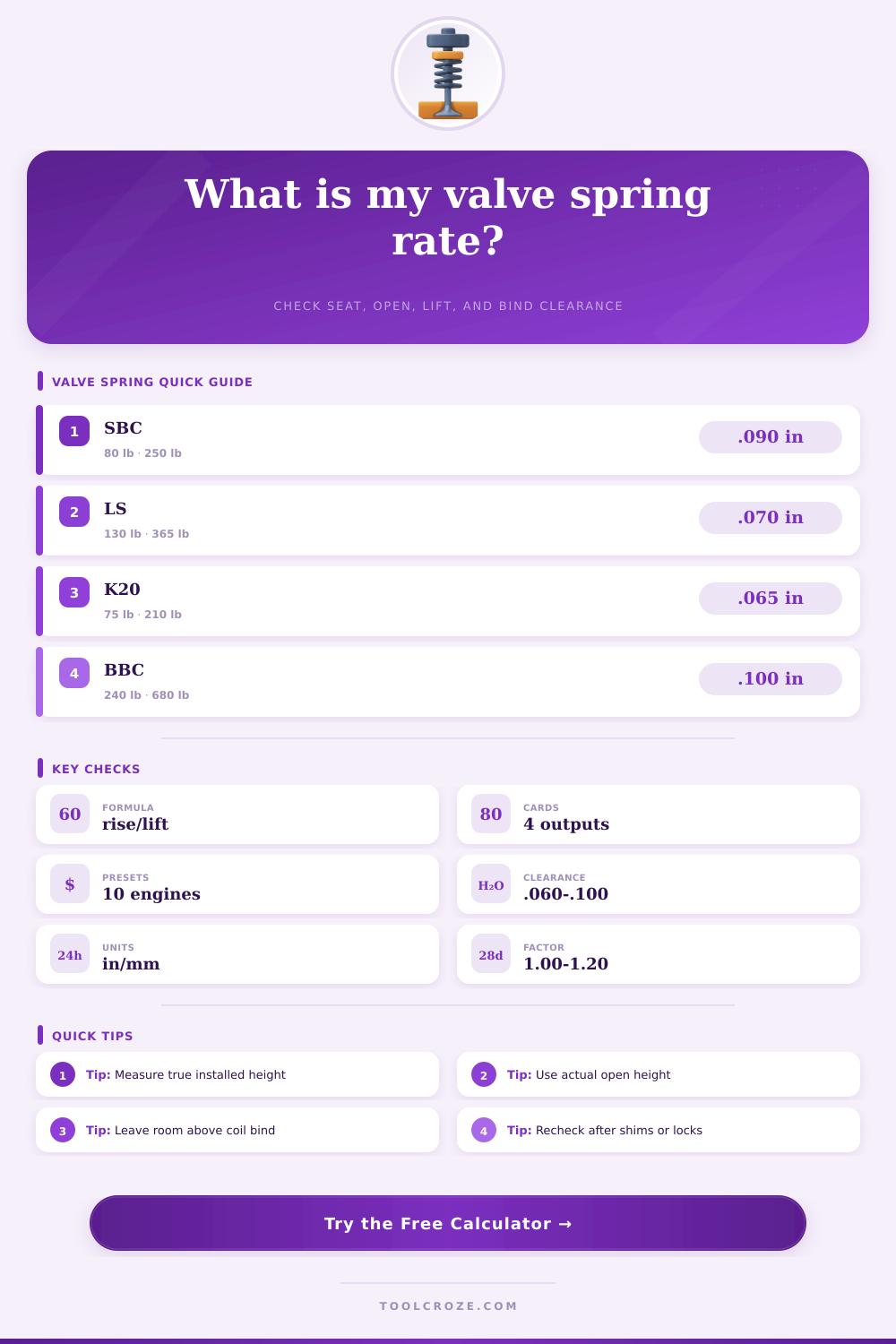
| Stock SBC hydraulic flat tappet | 80 lbf | 250 lbf | 1.700 / 1.230 in | Mild street cam, modest RPM |
| LS street hydraulic roller | 130 lbf | 365 lbf | 1.800 / 1.250 in | Street roller with stable lifters |
| Big Block Chevy solid roller | 240 lbf | 680 lbf | 2.000 / 1.200 in | High lift race profile |
| Honda K20 VTEC dual spring | 75 lbf | 210 lbf | 1.520 / 1.060 in | DOHC finger follower setup |
| Cam family | Common seat range | Common open range | Minimum bind clearance | Screening note |
|---|---|---|---|---|
| Hydraulic flat tappet | 80 to 125 lbf | 220 to 330 lbf | 0.060 in | Too much pressure can hurt lifter and lobe life. |
| Hydraulic roller | 120 to 170 lbf | 320 to 430 lbf | 0.060 in | Check lifter control and manufacturer limits. |
| Solid flat tappet | 110 to 160 lbf | 300 to 420 lbf | 0.070 in | Break-in and oiling are critical. |
| Solid roller | 180 to 300 lbf | 550 to 850 lbf | 0.080 in | High spring loads need strong parts and inspection. |
| DOHC bucket or finger follower | 55 to 110 lbf | 160 to 300 lbf | 0.055 in | Light valvetrain mass changes the spring demand. |
| Change | Seat pressure effect | Open pressure effect | Bind clearance effect | Use carefully when |
|---|---|---|---|---|
| Add 0.015 in shim | Adds rate x 0.015 | Adds rate x 0.015 | Reduces by 0.015 in | Clearance is already tight |
| Add 0.030 in shim | Adds rate x 0.030 | Adds rate x 0.030 | Reduces by 0.030 in | Near coil bind or retainer to seal |
| Use +0.050 in locks | Lowers seat load | Lowers open load | Adds about 0.050 in | Need more installed height |
| Increase valve lift | No seat change | Adds rate x lift gain | Reduces by lift gain | Cam or rocker ratio changes |
Valve springs is components that find themselves in the center of an engine build. The valve spring rate is a value that will determine whether a valvetrain will remain under control or if it begins to bounce. Many people knows the spring rate of a spring when they purchase it from the spring catalog, but the spring rate change once the spring is installed and the spring height is set.
This calculator will take the measurement of a spring and provide a spring rate that you can use to understand how the spring will perform once installed. Rather than guessing the spring rate of your spring based off spring catalog information and wire diameter information, you should always use the spring rate provide by the spring manufacturer. That information will always be more accurate than any guesswork that you can do yourself.
How to Use the Valve Spring Calculator
The two most important measurements to enter into the calculator are the two pressure and the two heights. The seat pressure is the amount of pressure that is required to keep the valve closed at the base circle of the cam lobe. The open pressure is the amount of pressure that exists once the valve has reached its full lift.
From these two pressures, you must subtract the two height to find the lift at the spring. Once you have the lift at the spring, you can divide the difference in the cam lobe pressure by the lift at the spring to determine the spring rate of the spring. Spring rate is the amount of extra force that the spring adds for every additional thousandth of an inch that the valve move.
The calculator performs this calculation once you enter the numbers; however, the spring rate is only useful if your measurement are accurate. A spring that measures 130 pounds of force at 1.800 inches may measure a different rate when sitting on it’s seat with a retainer. The other most important function of the calculator is to determine the coil bind clearance of the spring.
Spring rate alone will not protect you from having a spring that is crushed within the valve. By subtracting the open spring height from the bind height, the calculator can provide you with the clearance of the spring. Most cam manufacturer will provide a minimum clearance of their cam lobes.
If you go below that minimum clearance, you may introduce coil clash into your valvetrain, which can lead to broken valve springs or bent pushrods. These reference provide clearance information for both hydraulic flat tappet engines and solid roller big blocks. Higher lift camshafts and higher rpm engines will require a greater clearance to allow for proper valvetrain movement.
Beyond the measurement of the spring itself, the dynamic screen also account for the mass of the retainer that is placed onto each valve. The calculator will account for the weight of the valve, the locks that secure the retainer to the valve, and the retainer itself. The calculator will also account for how aggressive the cam is in opening the valve; a light retainer on a hydraulic roller will have different multiplier than a heavy steel retainer on a solid roller spinning at 7800 rpm.
This screening number is not the fatigue life of the spring. Rather, it is a means of ensuring that the spring will remain under control when the engine is running. The service margin selector allow you to add a buffer to the spring rate; this is useful in revealing how the spring will change with the addition of shims or other components that will affect the spring height.
Shimming and changing the locks on the valves will change every other value of the spring calculation. Adding a shim to the spring will add to the amount of force that is required to maintain the seat pressure and open pressure of the spring; both pressure will increase by the same amount that the shim is added. The bind clearance will decrease by the same amount, however.
Changing the locks will have the opposite effect. Using longer locks will reduce the amount of force required to maintain seat pressure; the spring will sit further from the valve. Additionally, longer locks will increase the bind clearance of the spring.
Both of these value are indicated within the breakdown of the spring calculations so that you can determine the effect that each change will have upon the spring. One of the most common mistake with springs is to use the spring rate listed in the catalog for the spring without considering the effect that each component change will have upon the springs rate. Many springs may be listed at 250 pounds of open pressure, but that measurement may have been taken at a different height than the spring will reach with the cam and the rocker arm setup.
Additionally, changing head gaskets, milling the block, or changing retainers will alter the spring height at which the spring must function; the calculator cannot account for these alteration. Another of the most common mistake is to not account for the effect that the rocker arm ratio will have upon the calculations. For instance, a rocker arm ratio of 1.6 will result in a different amount of lift at the spring compared to a rocker ratio of 1.5.
Because there is a difference in the amount of lift at the spring, there will be a difference in the open height and the rise in the spring load. Spring rate will change. The calculator does not have knowledge of the rocker arm ratio for the engine; therefore, you must manually account for the open height that results from the rocker ratio.
The reference tables that are provided for the spring calculator will help to reveal typical seat and open spring pressure value for each cam family. Additionally, these table will provide you with the minimum bind clearances for each cam family. If your spring combination is near the limits for those specs, the dynamic screen will indicate the tension of the spring.
This warning box will alert you of the potential for problem in your valvetrain. Thus, the calculator can help you to surface the tradeoffs that each component will have upon the others in the valvetrain. Beyond the measurements of the spring itself, the free height of the spring can be estimated with this calculator.
The free height is the height that the spring will sit at if there were no load on the spring. Additionally, the load that the spring will exert for each thousandth of an inch of lift can be accounted for. This figure is helpful in determining whether a 0.015-inch shim will be worth the effort to adjust the spring rate.
The single most important task is to measure the components that you have in your engine rather than those described for the spring catalogs. Once you have entered these numbers into the calculator, you can determine if the spring is within an acceptable range based off your engine’s specification. For example, is the clearance adequate for your engine’s target rpm?
Does the dynamic screen indicate that the spring will be able to control the mass of the valvetrain at engine running speeds? Will adding a shim to the spring help one component but hurt another component of the valvetrain? These type of questions will not have answers that are universal for every engine and valvetrain; however, they are the types of questions that a spring calculator will help to answer.
Beyond understanding the spring rates, clearances, and the valvetrain components, the calculator can assist in answering other important questions. For instance, will the spring work at 5500 rpm but not at 7500 rpm? Springs can have different rate according to the rpm at which the engine will be running.
Additionally, will the spring require any changes to the other components of the valvetrain? These are the types of questions that a spring calculator is designed to answer prior to firing up the engine. Thus, the calculator will help to ensure reliability in your engine and avoid the need for constant engine attention.