Torsion Spring Garage Door Calculator
Estimate standard-lift garage door torque, turns, required IPPT, spring rate, wire size match, active coils, stress, and cycle outlook from measured door and torsion spring data.
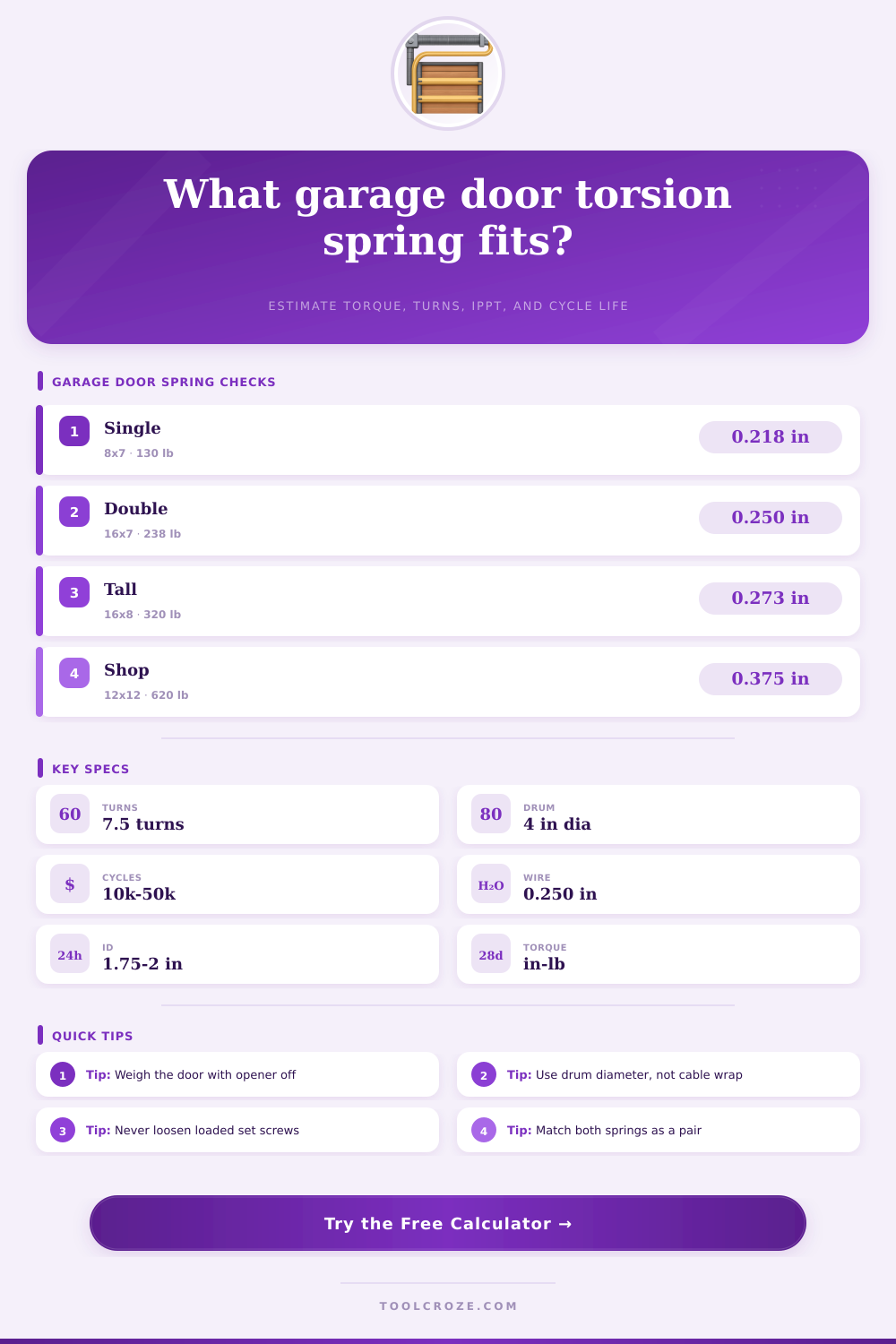
⚙Named garage door presets
Load a realistic starting point, then replace every value with measured door weight, drum diameter, turns, wire size, inside diameter, and spring length.
📏Door, drum, and torsion spring inputs
Garage door torsion spring result
📊Spring and door snapshot
🚪Common garage door presets reference
| Preset | Door size | Door weight | Starting spring pair |
|---|---|---|---|
| Single Steel 8x7 | 8 ft x 7 ft | 130 lb | 1 spring, 0.218 in wire, 1.75 in ID |
| Insulated One-Car 9x7 | 9 ft x 7 ft | 160 lb | 1 spring, 0.225 in wire, 1.75 in ID |
| Double Steel 16x7 | 16 ft x 7 ft | 238 lb | 2 springs, 0.250 in wire, 2 in ID |
| Insulated Double 16x8 | 16 ft x 8 ft | 320 lb | 2 springs, 0.273 in wire, 2 in ID |
| Commercial 12x12 | 12 ft x 12 ft | 620 lb | 2 springs, 0.375 in wire, 3.75 in ID |
🧰Wire size and spring ID guide
| Wire size | Common ID | Typical door range | Check before use |
|---|---|---|---|
| 0.192 to 0.218 in | 1.75 in or 2 in | Light single residential doors | Often one-spring systems; verify lift balance |
| 0.225 to 0.250 in | 1.75 in or 2 in | Single heavy or double steel doors | Measure 20 coils to avoid wire-size mistakes |
| 0.262 to 0.295 in | 2 in | Insulated and carriage-house doors | Longer springs may be used for higher cycle life |
| 0.312 to 0.375 in | 2.625 in to 3.75 in | Large residential or commercial doors | Confirm shaft, drum, headroom, and cone compatibility |
| Metric 5 to 9.5 mm | 44 to 95 mm | Metric replacement specifications | Convert all door and drum dimensions consistently |
↻Drum diameter, turns, and lift reference
| Door height | 4 in drum starting turns | 5.5 in drum starting turns | Important note |
|---|---|---|---|
| 7 ft standard lift | About 7.5 turns | About 5.9 turns | Final turns depend on drum groove and cable wrap |
| 8 ft standard lift | About 8.5 turns | About 6.6 turns | Tall doors need more cable travel |
| 10 ft standard lift | About 10.5 turns | About 8.0 turns | Check max turns and spring stress carefully |
| High-lift door | Door-specific | Door-specific | Requires high-lift drum data and professional setup |
| Vertical-lift door | Door-specific | Door-specific | Use engineered spring and drum tables |
⏱Cycle rating comparison table
| Cycle target | What usually changes | Calculator signal | Field check |
|---|---|---|---|
| 10,000 cycles | Baseline residential spring | Stress near standard limit | Door should balance at mid travel |
| 15,000 to 25,000 cycles | Longer spring or adjusted wire size | Lower stress and more active coils | Check spring length fits the shaft space |
| 50,000 cycles | Much longer spring pair | Lower IPPT per inch of spring length | Verify cones, shaft, and center bracket spacing |
| 100,000 cycles | Engineered high-cycle setup | Large active coil count and low stress | Use supplier engineering data |
📐Formula reference
| Output | Formula used | Inputs | Meaning |
|---|---|---|---|
| Total door torque | Door weight x drum radius | Weight, drum diameter | Torque needed at the torsion shaft |
| Required IPPT | Torque per spring / turns | Spring count, turns | Inch-pounds per turn each spring must provide |
| Mean diameter | Inside diameter + wire size | Spring ID, wire size | Diameter used in spring-rate math |
| Estimated active coils | Length / wire size - inactive coils | Spring length, wire, dead coils | Coils that twist under load |
| Spring rate | d^4 x G / (10.8 x D x N) | Wire, mean diameter, active coils | Estimated IPPT for one torsion spring |
| Stress screen | 32 x torque x D / (pi x d^3) | Torque, mean diameter, wire | Rough wire stress used for cycle comparison |
💡Measurement tips and safety
Torsion springs is located above a garage door, and torsion springs provide the force nessecary to move the garage door. Torsion garage door springs store energy when the garage door is in a closed position. When the garage door is opened, the torsion spring release the stored energy to open the garage door.
A correctly sized torsion spring will make a heavy garage door feel lightly. Every garage door has a specific weight, height, and drum diameter. Because every garage door has different dimension, the torsion spring that works well for one garage door might be too stiff for another garage door or too weak for anothers garage door.
How to Measure and Size Garage Door Torsion Springs
A torsion spring that is not the correct size for the garage door will cause the garage door to sag or slam shut when the garage door opener operates the door. To size a torsion spring for the garage door, determine the weight of the garage door. Find the actual weight of the garage door.
The weight of the garage door can change due to the different number of contents in the garage, the number of windows, and the hardware in the garage door. Measure the diameter of the drum that turns the torsion spring. One uses the drum diameter to calculate the amount of torque that the torsion spring must generate to open the door.
Knowing the weight of the garage door and the diameter of the drum allows for the calculation of the amount of torque required by the torsion spring. The product of the weight of the garage door and the drum diameter calculates the required torque for the torsion spring. After calculating the required torque for the garage door, calculate the spring rate of the torsion spring.
The spring rate is the amount of force required to turn the torsion spring through a specific number of turns. To calculate the spring rate, determine the number of torsion springs on the garage door, the number of turns that the torsion spring must move the garage door through when it is opened, and the spring rate of the torsion spring that will be used. The wire size of the torsion spring is a critical measurement for the torsion spring.
The spring rate formula requires that the formula places the wire size of the torsion spring to the fourth power. A small change in the wire size will have a large impact on the spring rate of the torsion spring. For this reason, measure the twenty coils of the torsion spring rather than relying on the number stamped on the end cone of the torsion spring.
The inside diameter of the torsion spring is another critical measurement of the torsion spring. Although the torsion springs may appear to be the same model and size, the inside diameter could be different. A torsion spring with a larger inside diameter will have a different behavior than a torsion spring with a smaller inside diameter.
The length of the torsion spring is another critical measurement of the torsion spring. You must subtract the number of inactive coils on each end of the torsion spring from the total number of coils on the torsion spring to determine how many active coils the torsion spring has. The active coils are the only coils that contribute to the spring rate of the torsion spring.
Longer torsion springs have lower stress per turn due to the increased number of active coils. Consequently, lowering the stress per turn will lead to an increase in the cycle life of the torsion spring. The use of a torsion spring that has a longer torsion spring setup is common in high-cycle torsion spring setups instead of those with thick torsion spring wires.
Using a longer torsion spring will distribute the required torque for the counterweight of the garage door over more coils, which reduces the stress placed upon the torsion spring. The cycle life rating of a torsion spring is an estimate of the number of times that the torsion spring will cycle in operation. The cycle life of a torsion spring is not a guarantee of the actual cycle life of that spring.
The type of material used in the construction of the torsion spring will affect both the modulus value that is used in the spring rate equation as well as the stress limit that is used to calculate the cycle life of that spring. While oil-tempered wire is a common material for residential garage door torsion springs, the use of high-cycle wire or a different alloy will alter the value of each of these variables in the equations for both spring rate and cycle life. A torsion spring cycle life calculator will perform the required calculations if the user enters the spring dimensions, the target cycle life, and the spring material.
Many people mistakenly use rules of thumb instead of measuring the dimensions of the garage door hardware. For instance, many people may think that any garage door whose length is seven feet will require torsion springs with seven and a half turns. This calculation is only true, however, if the diameter of the torsion spring drum is four inches in diameter and if it is a spring with standard lift characteristic.
If either the lift specification is changed or the diameter of the drum is changed, the required number of turns for a torsion spring will change. Additionally, many people dont realize that the two torsion springs on a two-spring garage door are not necessarily the same. If one torsion spring was replaced while the other was not, each torsion spring will not be the same.
Consequently, the torsion spring that is stronger will cause the garage door shaft to load unevenly, which will lead to a short life of that weaker torsion spring. Safety is of the primary concern in the operation of garage door torsion springs. Torsion springs contain a great deal of energy and can cause injury if not operated correctly.
The use of proper winding bars is required to adjust the tension of the torsion spring, and you must fully support the garage door when adjusting the torsion springs. A torsion spring calculator is a helpful tool, but it isnt the tool that should be used to adjust the torsion springs of a garage door that is in use. If the torque that is required to open and close the garage door does not equal the estimated torque of the torsion springs, then it is recommended to re-measure the dimensions of the garage door.
The most important numbers are the measurements of the garage door. The weight of the garage door, the diameter of the torsion spring drum, the size of the torsion spring wire, the inside diameter of the torsion spring drum, and the length of the torsion spring when relaxed are all measurements that should of been obtained. With these measurements, it is possible to determine both the spring rate that is required for that garage door as well as the length of torsion spring that is required.
The quality of the measurements of the garage door will have a direct impact on the results that the torsion spring calculator provides. Consequently, if the measurements are accurate, the torsion spring will both balance the garage door and last for a long time.