Gas Spring Calculator
Size a gas spring for a hatch, lid, tool chest, bed platform, guard, or cabinet door using lid weight, center of gravity, hinge geometry, opening angle, stroke, spring count, and force curve.
Calculation Breakdown
| Hatch or lid | Typical weight | Common setup | Mount note |
|---|---|---|---|
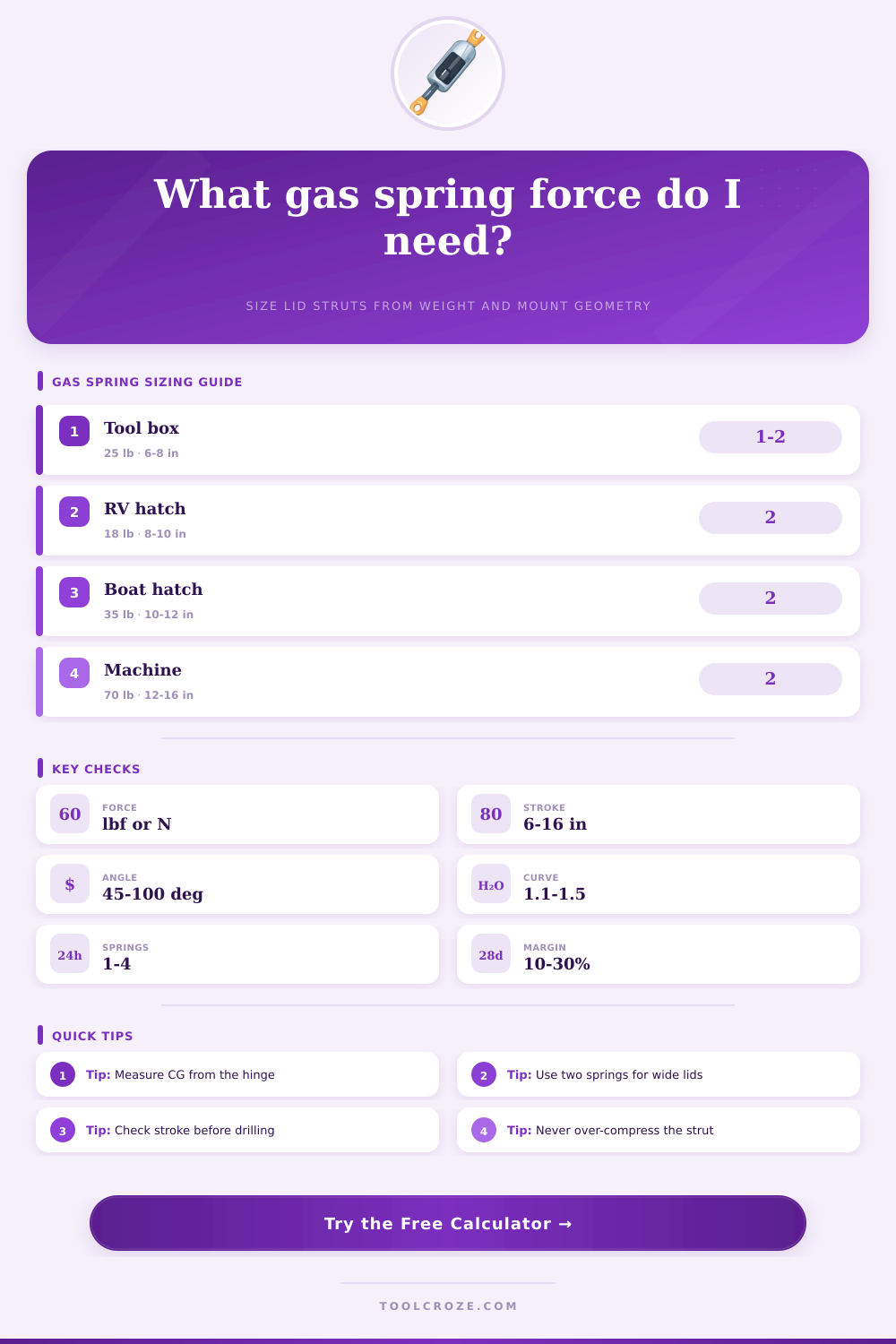
| RV baggage door | 12 to 25 lb | Two small struts | Keep both sides symmetric |
| Truck toolbox lid | 20 to 45 lb | One or two struts | Allow room for seal compression |
| Boat engine hatch | 35 to 90 lb | Two corrosion-resistant struts | Use stainless end fittings |
| Machine guard | 25 to 120 lb | Two guarded struts | Verify lockout and pinch points |
| Measurement | Where to measure | Effect | Watch point |
|---|---|---|---|
| CG distance | Hinge to lid balance point | Sets lid torque | Trim shifts CG outward |
| Lid bracket | Hinge to moving ball stud | Changes force leverage | Too far may reduce stroke fit |
| Body offset | Hinge to fixed mount forward | Sets compressed length | Negative offsets can bind |
| Body drop | Hinge down to fixed mount | Improves moment arm | Check closed clearance |
| Curve ratio | Compressed force | Best use | Feel at closing |
|---|---|---|---|
| 1.10 | 110% of rating | Long-stroke light lids | Smooth and mild |
| 1.20 | 120% of rating | General hatch work | Balanced |
| 1.30 | 130% of rating | Compact mounts | Firm near closed |
| 1.40 to 1.50 | 140 to 150% | Short heavy struts | Can pop open hard |
| Check | Good range | Problem sign | Adjustment |
|---|---|---|---|
| Stroke reserve | 10 to 20% extra | Strut bottoms out | Longer stroke or move mount |
| Open moment arm | 2 in or more | Huge force result | Lower or move body bracket |
| Closed assist | 60 to 90% | Lid hard to close | Lower force or shorten arm |
| Open angle | 60 to 100 deg | Unstable at open | Revise bracket geometry |
Selecting an gas spring for a lid or a hatch require precise measurements to ensure that the lid does not create too much effort for the individuals that must open it. The weight of the lid must be considered, as well as the center of gravity of the lid. The center of gravity is the point at which the weight of the lid are balance.
The distance from the hinge to the center of gravity is a measurement that indicate the force that the gas spring must provide. The lid can be considered a lever, and the gas spring must have enough force to allow for the lid to move from one position to an other. The center of gravity should be used in the calculations of the gas spring requirements, rather then the average weight of the lid.
How to Choose a Gas Spring for a Lid or Hatch
Another consideration of the gas spring is the mounting location. The location of the body bracket or the lid bracket will impact the force that the gas spring must provide. A small change in the mounting location may impact the force required from the gas spring by several percentage.
Each of the geometry input on the calculator can be manipulated to find the best location for mounting the gas spring. The stroke length of the gas spring must be long enough to allow for the lid to open, yet the spring should not bottom out against the stop that are built into the gas spring. The geometric stroke of the lid must be compared with the catalog stroke of the gas spring.
If the geometric stroke is close to the catalog stroke of the gas spring, you must increase the stroke length of the gas spring, or you must change the mounting position of the gas spring. The force curve of the gas spring can be considered once the gas spring is under a load. Gas springs of different design will create different amount of force when they are compressed compared to when they are extended.
Some gas springs will have a small difference in force between the compressed and extended gas springs, while other gas springs will require more force to be maintain in the extended positions. The requirements for the lid should determine the type of force curve that the gas spring will create. It is common for lids to have two or more gas spring.
The use of multiple gas springs will reduce the amount of twisting that is created on the lid, as well as ensure that the weather seal on the lid are compressed to an even degree. The use of a calculator to determine the force of each gas spring can allow for lids to use smaller and less expensive gas springs. The weight and center of gravity of the lid may change after it is completed.
Factors such as hardware, glass, insulation, and the weather seals will change the weight of the lid. Therefore, you will obtain the most accurately measurement of the weight and center of gravity of the lid after the lid is completed. Using tables to determine the weight of the lid may lead to the selection of a gas spring that does not provide enough force for the completed lid.
The mounting clearance of the gas spring should be considered one final selection for the gas spring. The body mounting bracket must provide enough clearance to avoid interfering with the lid or the structure of the body when the lid is in its closed position. Additionally, the rod end fitting of the gas spring must have enough clearance to avoid contacting the lid or the hinge of the lid when it is in its open position.
These clearances should be checked on paper prior to installing the gas spring. Finally, a safety margin should be provided for the calculations that were performed. As the gas spring age, it will lose gas pressure, especially with the changes in the temperature of the environment.
A safety margin will ensure that the lid will not become too heavy with time, or that the gas spring does not allow for the lid to drift closed on its own. The calculations will indicate where the bracket should be mounted to the lid and body. The holes should be drilled at these locations, but the motion of the lid should be tested.
If the lid is too easy to open, you can reduce the force of the gas spring. If the lid is too heavy, you should of changed the gas spring.