Weld Group Calculator
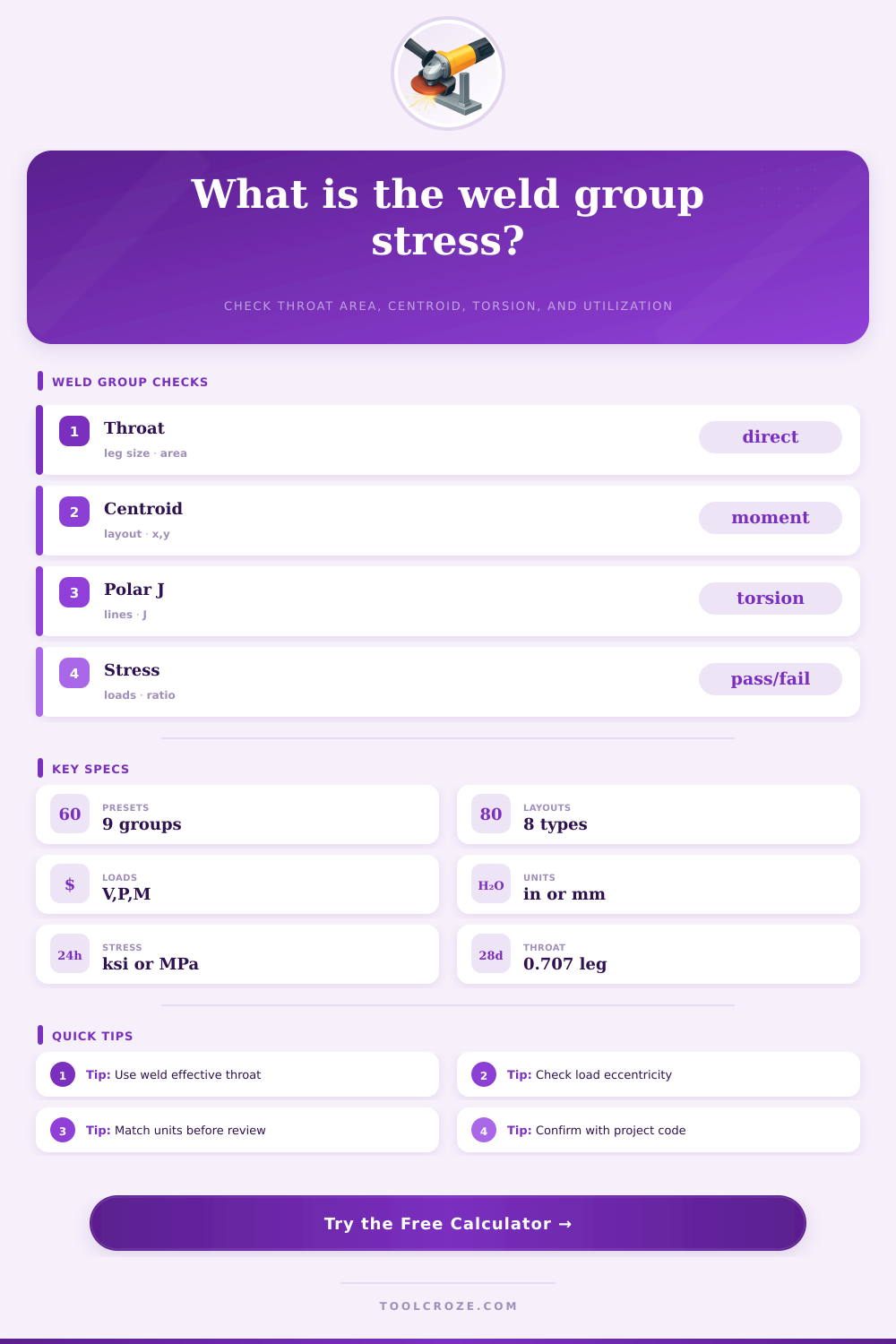
Calculate fillet weld throat area, weld-line centroid, direct load stress, eccentric moment, torsion, polar moment, resultant stress, and utilization.
Weld group result
| Fillet leg | Effective throat | Area per inch | Typical note |
|---|---|---|---|
| 1/8 in | 0.088 in | 0.088 in²/in | Light sheet and small tabs |
| 3/16 in | 0.133 in | 0.133 in²/in | Common light structural fillet |
| 1/4 in | 0.177 in | 0.177 in²/in | Frequent shop bracket size |
| 5/16 in | 0.221 in | 0.221 in²/in | Heavier brackets and frames |
| Layout | Best suited load | Centroid behavior | Watch item |
|---|---|---|---|
| Closed rectangle | Shear plus torsion | Near geometric center | Corner quality and returns |
| Two side fillets | Bracket shear | Centered between sides | High torsion at far ends |
| C or U group | Open bracket welds | Shifts toward closed side | Uneven stress distribution |
| L group | Corner angle welds | Shifts to weld corner | Large eccentricity effects |
| Spec item | Common value | Calculator field | Design comment |
|---|---|---|---|
| E60 electrode | 60 ksi FEXX | Allowable stress | ASD often near 18 ksi |
| E70 electrode | 70 ksi FEXX | Allowable stress | ASD often near 21 ksi |
| Fillet throat | 0.707 x leg | Throat factor | Equal-leg fillet assumption |
| Metric stress | MPa | Allowable stress | 1 ksi is about 6.895 MPa |
| Check | Formula basis | Output | Interpretation |
|---|---|---|---|
| Direct shear | V divided by throat area | Stress | Uniform over total weld length |
| Axial normal | P divided by throat area | Stress | Combined by vector resultant |
| Torsion | M times r divided by J | Peak stress | Largest at farthest weld point |
| Utilization | Resultant over allowable | Percent | Values over 100% need review |
Weld groups behaves in ways that are sometimes unexpected for those who view a weld group as a line. Weld groups may be used on various types of metal components, including brackets, gussets, and lifting lugs. Weld groups must be able to resist shear loads as well as torsion loads created through eccentricity.
Because the weld group is often not centrally located relative to the components that is to be loaded, it is important to know the actual center of resistance of the components, as well as the way in which the loads will travel to that center of resistance. One of the problems of eccentricity is the fact that the eccentric load create a moment (or torsion) that the weld group must resist. Torsion occurs when the load is applied a distance away from the weld group centroid.
Weld groups, eccentric loads and fillet weld size
Furthermore, torsion is not evenly distributed within the weld group; the highest torsional stress occur at the part of the weld group that is the farthest distance from the centroid. Thus, the shape of the weld group can impact the distribution of torsional stresses. For example, a closed rectangle distributes the loads more better than an open C shape or an open L shape; the centroid of an open shape shifts toward the side with the closed portion of the shape.
As a result, the open end of the weld group must be able to absorb the majority of the torsional stress. Thus, the pattern of the weld group should be considered relative to the way in which the component will be loaded. The size of fillet welds requires an understanding of the dimensions of those welds.
The leg size of the fillet weld is not the same as the throat of the fillet weld. For fillet welds of equal leg sizes, the throat is approximately 70% of the leg size of the fillet weld. The factor of 0.7 is use in calculations of the strength of the fillet weld.
Changing the leg size of the fillet weld will change the area of the throat of the fillet weld. For instance, increasing the size of a fillet weld from three-sixteenths of an inch to a quarter inch will increase the area of the throat of the fillet weld by about one-third. Thus, increasing the leg size of a fillet weld will increase its strength, but it will also increase the amount of heat input into the component.
The size of the fillet weld that is selected must also consider the fit-up of the components being welded together, as well as the ability of the welder to place the root pass of the weld. The size of the fillet weld may be selected for reasons other than the minimum size that is calculated for strength. For instance, quarter inch fillet welds are common in that a quarter inch fillet weld is large enough to cover for minor undercut of the edges of the components being welded together, but small enough to allow for finishing of the weld.
Weld sizes may also be chosen for other reasons, such as if the weld is to be able to withstand fatigue loads; in these instances, larger fillet welds may be required. Tables can provide the calculations of the relationship between the size of a fillet weld and the area of the throat of the fillet weld; however, the tables do not indicate if the component will be welded in the way that is represented in those tables. The polar moment of the weld group can be calculated, and this value is one that determine the level of torsion that the weld group can distribute.
The polar moment of the weld group is related to the distance of the weld from the centroid, and is related to the square of that distance. Thus, spreading the welds further from the centroid will have a greater impact on the polar moment of the group than adding length to the weld group. For instance, a pair of vertical fillet welds will have a higher polar moment than a single horizontal line of welds of the same length.
Thus, length and geometry of the weld group can be traded for one another to create a higher polar moment of the weld group. The longer path of weld may be the better path for the weld group. Ensuring that the allowable stress that is entered into a weld group strength calculator is the correct value according to the code to be used; additionally, the units of that stress should be correct.
The calculators may switch between imperial units and metric units, but the allowable stress should be the correct value for the code that will be used in the shop or in the field. For instance, many metal component fabrication shops use allowable stress design (ASD) for fillet welds. ASD uses thirty percent of the electrode tensile strength.
This value incorporates safety factors for weld quality and inspection. If the shop uses load and resistance factor design (LRFD), then the allowable stress and the utilization of the weld group will be calculated differently. Each calculator will provide appropriate calculations based off the assumptions that is entered into the calculator.
An error that is often made in calculating the eccentricity of a component is to measure from the edge of the component or from a bolt line. Eccentricity should always be measured from the centroid of the weld group. An error in measuring eccentricity may result in an error of an inch or two in measurement; such an error may make the utilization of the weld group marginal.
Additionally, many individuals make the mistake of assuming that the centroid of an open weld group is located at the geometric center of the open weld group. The centroid of the open weld group will shift with the change in the shape of the weld group, which will impact the radius of torsion that must be distributed by the weld group. In such instances, the calculations for the strength of the weld group should of been performed twice, once with the current setting of the weld return parameter, and again with a change to that setting to determine if the weld group will have a better utilization.
Many of the aspects of fillet weld calculations that have to be considered for metal components that will be fabricated include aspects that calculators are not able to see. For instance, the strength of the base metal will impact the size of the weld group. Additionally, the access that will be provided for welding and inspection of the component will impact the size of the weld group.
Furthermore, the fabrication sequence will impact the size of the weld group; for instance, some metal fabrication processes may require the component to be galvanized or coated, which will impact the size of the weld that is placed into the component. A weld that appears to be of the correct size for the component may, due to these factors, require a weld of a larger leg size. Thus, there can be trade-offs between an undersized weld that is easy to inspect and repair, and an oversized weld that is placed into a difficult to access portion of the component.
The goal is not to produce a weld group with the lowest utilization value; the goal is to produce a weld group where the stresses is understood, and where it is clear that the shop will be able to execute the weld group that is produced. A calculator is helpful in determining the strength of a weld group, but the individual that signs the drawing should have some understanding of the calculations, the variables of the weld group, and the trade-offs that must be made in the fabrication shop regarding the size of the weld.