Skewed Fillet Weld Calculator
Estimate effective throat and required fillet leg size for skewed tee, corner, lap, gusset, chute, and bracket joints using included angle, leg sizes, weld length, load angle, weld metal strength, and safety factor.
Pick a common skewed fillet weld layout. Each preset fills the geometry, load, and quality assumptions, then runs the calculation.
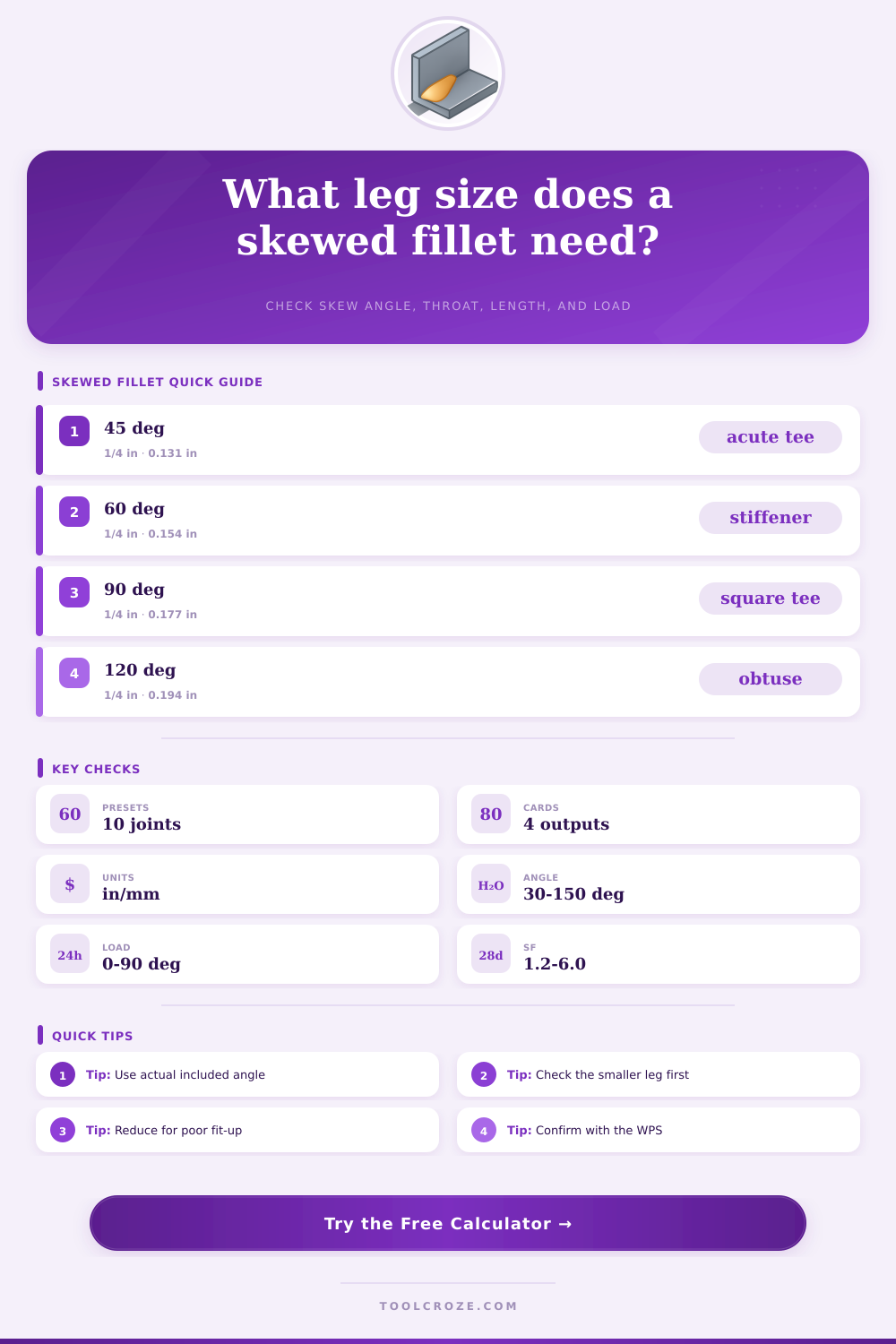
| Included angle | Equal-leg throat factor | What changes | Planning note |
|---|---|---|---|
| 45 degrees | 0.541 x leg | Acute root, lower throat | Often needs larger leg or detail review |
| 60 degrees | 0.612 x leg | Moderate acute skew | Common stiffener and chute angle |
| 90 degrees | 0.707 x leg | Standard square fillet | Baseline equal-leg fillet value |
| 120 degrees | 0.866 x leg | Obtuse joint geometry | Check access and weld profile limits |
| 150 degrees | 0.966 x leg | Very open included angle | Detail may behave more like surfacing |
| Basis | Stress model | E70 example | Use case |
|---|---|---|---|
| Conservative shop check | 0.24 x FEXX | 16.8 ksi | Unknown access or fit-up |
| ASD style allowable | 0.30 x FEXX | 21.0 ksi | Preliminary weld metal sizing |
| Nominal weld metal | 0.60 x FEXX | 42.0 ksi | Nominal comparison before factors |
| Custom allowable | User entered | By WPS | Procedure or code-specific value |
| Joint pattern | Typical angle | Common legs | Extra check |
|---|---|---|---|
| Skewed stiffener tee | 55 to 75 degrees | 3/16 to 5/16 in | Root access and undercut |
| Hopper or chute corner | 105 to 135 degrees | 1/8 to 1/4 in | Distortion and seal continuity |
| Gusset to sloped chord | 45 to 80 degrees | 1/4 to 3/8 in | Eccentricity and base metal tear-out |
| Tube saddle fillet | Variable | 3/16 to 1/4 in | Fit-up gap around the saddle |
| Skewed return weld | 45 to 90 degrees | 1/4 to 1/2 in | End returns and load path |
Skewed fillet weld are used when the two piece of metal that are being welded together are not in a 90-degree angle. A 90-degree angle is referred to as a square angle, and any angle that are not 90 degrees is known as a skewed angle. When a person forms a skewed fillet weld, the angle of the joint impact the effective throat of the weld.
The effective throat is the portion of the weld that perform the majority of the work for the joint, so it is the most important aspect of the weld. By using the same leg size for a fillet weld that is skewed at a 60 degree angle as a fillet weld that is skewed at a 120 degree angle, the resulting joint will not have the same strength as each of those angle will impact the effective throat of the weld. Many fabricator that use fillet welds may not have a method for accurately determining the size of skewed fillet welds; they may use visual estimate of the required sizes, or they may use old rule that were established for determining the sizes of square angles.
How Joint Angle and Fit Change Fillet Weld Strength
However, small changes to the angle of the joint will have an impact upon the effective throat of the weld; for instance, the difference between a 55 degree angle and a 60 degree angle may be small, but the change to the effective throat could be more than ten percent. Thus, skewed fillet welds require a consideration of the load angle, the length of the weld, and the quality of the joint fit-up to determine the size of the joint. Using the calculator that is provided, a person can calculate the properties of a skewed fillet weld by entering the included angle of the joint and the two leg sizes of the fillet weld.
Additionally, a person can enter a throat factor that determine the allowable capacity of the joint; the throat factor considers the root gap of the joint, the convexity of the weld limits, and the inspection level requirement for the joint. The calculator provides three different value: the effective throat of the joint, the allowable capacity of the joint with a safety factor applied to that joint, and the size of the equal-leg fillet weld that would provide the same throat as the skewed fillet weld. The geometry of the joint will impact the performance of the weld.
For instance, if the angle of the joint is acute, the welder may experience difficulty to gain access to weld portions of the joint; if the welder is unable to properly weld the metal to the metal, the joint may be lacking in the strength provided by that joint. Additionally, if the angle of the joint is obtuse allows for the welder to access the metal that is to be joined, the angle may cause the weld to shrink or distort as it sets. The calculator does not determine these aspect of the joint; however, it does ask that the person entering the values for the joint enter the included angle of the joint and the quality factor of the joint so that the individual is required to consider these aspects of the joint.
The direction of the load that the welded structure is to be distributed by will impact the strength of the skewed fillet weld. Skewed fillet welds will have more strength if the loads are applied in a transverse manner as opposed to in a longitudinal manner along the weld. Thus, the factor that considers the direction of the load should be considered for the allowable stress of the joint.
The quality of the fit-up of the joint will impact the size of the effective throat of the joint. For instance, even if the joint appear to be correctly formed, the root gap and misalignment of the metal may reduce the effective throat that is provided by the joint. Thus, if an individual would like to assess the impact of poor fit-up of the joint, the throat factor or the quality percentage for the joint can be lowered in the calculator.
If the allowable capacity of the joint drops significantly with a lowering of the throat factor, the leg size of the joint will have to be increased. The type of metal that is being welded is also an aspect of the skewed fillet weld. The calculator provides a reminder of the type of metal that is being welded; different metal will behave differently under the same load.
The strength of the weld is only as strong as the metal upon which it is welded; thus, an individual must apply a safety factor to the joint to account for the possibility of the metal being weaker than the weld. The calculator provides a reference table that shows the changes to the throat factor if the included angle of the joint is changed. While this table can be used as a general guide to determine the strengths or weaknesses of a joint based off the angles formed by the two piece of metal, a calculation of the joint is still required to determine the exact throat size of the joint.
The angles that are represented in the reference table are those that are below 50 degree or above 135 degree in the table, as the shape of a fillet weld does not behave the same as a triangle at those angles. While the calculator can provide the measurements of the joint, the actual welding must still be performed. The welder should review the welding procedure to ensure that it covers the angle of the joint and the position of the weld.
In addition, the welder must ensure that it is possible to inspect the leg of the joint with smaller size than the remainder of the joint; the inspection of the smaller leg will help to determine if the base metal is the factor that will control the strength of the joint. While the calculator removes the need for the engineer to perform the calculations for throat size, strength, and leg size of the joint, the calculator cannot remove the need for an engineer to make a decision as to whether or not the values that are obtained with the calculator are appropriate for the type of service that the structure will provide. Overall, the use of this type of calculator can help to ensure that individuals dont consider each of the angled skewed fillet welds to be the same as square welds.
Each of the aspects of the joint that are skewed will impact the throat size of the joint, the allowable stress at which the joint will fail, and the quality of fit-up between the metals being welded together. The engineer creating the joint should consider each of these aspect at the same time.