Fillet Weld Strength Calculator
Estimate fillet weld capacity from leg size or effective throat, weld length, electrode class, load angle, safety factor, and joint factor for preliminary shop or field checks.
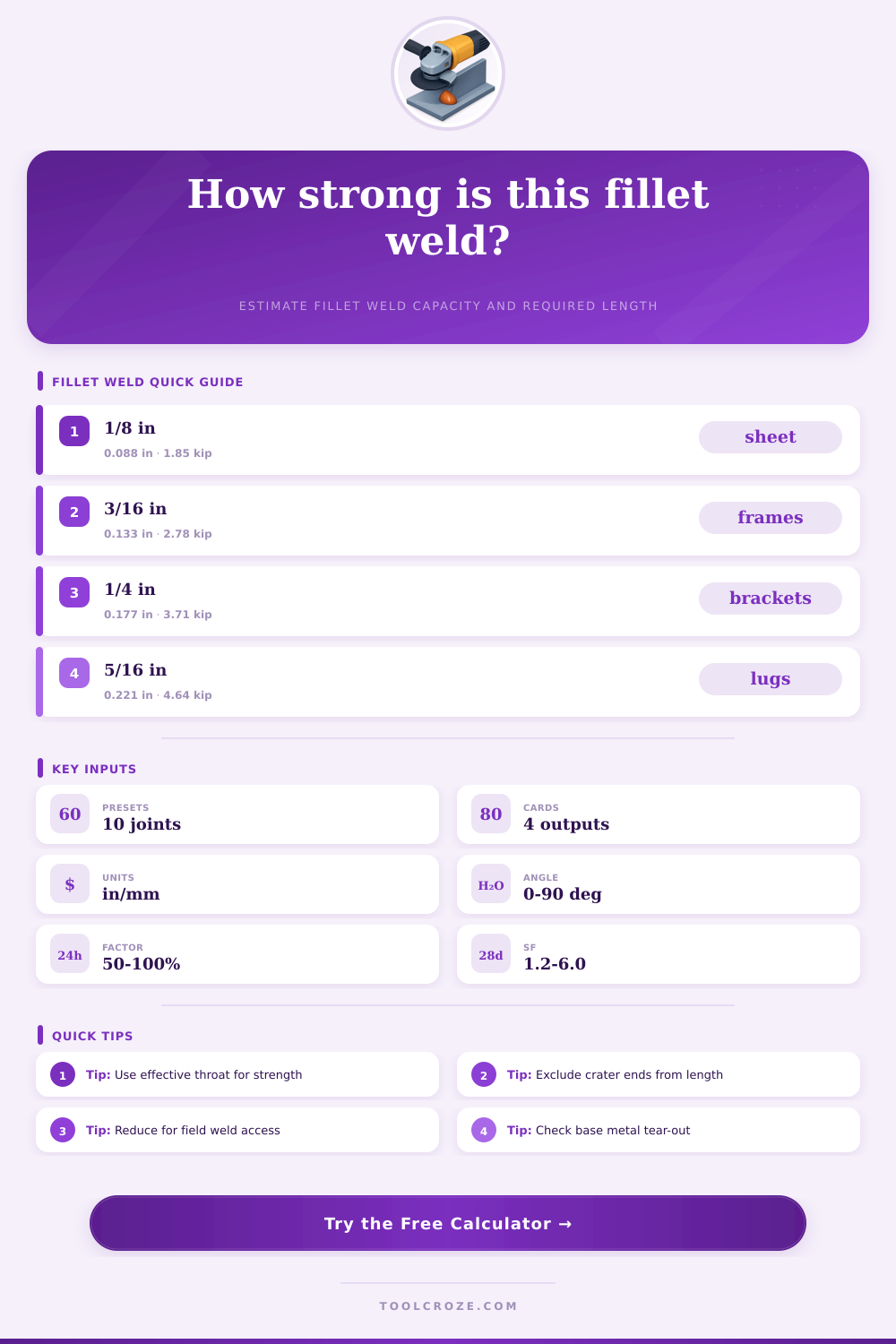
Choose a common fillet weld scenario. Each preset fills the inputs and runs the estimate.
| Equal leg size | Effective throat | Area per inch | E70 ASD capacity per inch |
|---|---|---|---|
| 1/8 in (3.2 mm) | 0.088 in (2.2 mm) | 0.088 in2 | 1.86 kip per line |
| 3/16 in (4.8 mm) | 0.133 in (3.4 mm) | 0.133 in2 | 2.78 kip per line |
| 1/4 in (6.4 mm) | 0.177 in (4.5 mm) | 0.177 in2 | 3.71 kip per line |
| 5/16 in (7.9 mm) | 0.221 in (5.6 mm) | 0.221 in2 | 4.64 kip per line |
| 3/8 in (9.5 mm) | 0.265 in (6.7 mm) | 0.265 in2 | 5.57 kip per line |
| 1/2 in (12.7 mm) | 0.354 in (9.0 mm) | 0.354 in2 | 7.42 kip per line |
| Electrode class | FEXX | 0.30 x FEXX | Common planning use |
|---|---|---|---|
| E60 | 60 ksi (414 MPa) | 18 ksi (124 MPa) | Light fabrication and repair welds |
| E70 | 70 ksi (483 MPa) | 21 ksi (145 MPa) | Common structural steel fillets |
| E80 | 80 ksi (552 MPa) | 24 ksi (166 MPa) | Higher strength steel members |
| 308L stainless | 75 ksi typical | 22.5 ksi typical | Stainless tray and frame joints |
| ER4043 aluminum | 38 ksi typical | 11.4 ksi typical | Aluminum fillets with reduced base strength |
| Condition | Typical factor | Calculator input | Reminder |
|---|---|---|---|
| Shop weld, good access | 0.90 to 1.00 | 90% to 100% | Use when fit-up, WPS, and inspection are strong |
| General fabrication | 0.80 to 0.90 | 80% to 90% | Useful for ordinary brackets and frames |
| Field or overhead weld | 0.65 to 0.80 | 65% to 80% | Reduce for position and access limits |
| Fatigue or vibration | 0.50 to 0.75 | 50% to 75% | Fatigue detail category may govern |
| Transverse fillet loading | up to 1.50x | 90 degrees | Directional strength is a weld metal model only |
Fillet welds is used in many different applications. However, the fillet welds must be able to handle the loads that are placed upon them. There are several variables in regard to fillet weld calculations that will determine the strength that can be provide by that specific fillet weld.
Some of the variables include the weld’s effective throat, length, electrode strength, and an angle of the load. Additional variables that must be considered include safety and joint factor and reference tables. Each of these variable is important to the calculation of the strength of a fillet weld.
What Affects Fillet Weld Strength
The effective throat of the fillet weld is the most important variable to consider in regard to the strength of that type of weld. For fillet welds with equal legs, the effective throat is 70% of the size of the leg. You can calculate the throat dimension by entering the leg size into a fillet weld calculator.
Additionally, the calculator will also provide the throat dimension if the joint has unequal legs or if it contain incomplete fusion. The measured throat dimension should be used for the input of the throat dimension as changing the dimension to the throat will change the results of the calculation. The length of the fillet weld is another critical variable.
People can often enter the length of the fillet weld incorrect into the calculation. The effective length of the fillet weld does not include the crater at the end of the weld. Any portion of the fillet weld that are blocked by the fit-up gaps are also not included in the effective length.
The first inch of fillet weld where the welder is establish the weld puddle is also not included in the length of the fillet weld. The length input can be adjusted for these variable to ensure the calculation accurately reflect the length of the fillet weld. Another variable is the strength of the electrode that is used to form the fillet weld.
The strength of the electrode depends upon the classification of the electrode. An E70 electrode will produce more allowable shear stress than an E60 electrode. However, the E70 electrode will only provide more strength if the metal upon which the fillet weld will be formed can handle the amount of heat that the E70 electrode will produce.
Many welding shop use E77 electrodes because the extra strength is relatively inexpensive. Another reason that the E70 electrode is preferred is because it provide more breathing room in the case that the drawing that was used to form the fillet weld was only specifying a small fillet weld. A fillet weld calculator can be used to test different classifications of electrodes, such as changing from an E70 to an E60 electrode or changing to stainless steel or aluminum filler.
The angle of the load that will be placed upon the fillet weld is another variable. Fillet welds are strongest in shear as opposed to tension. However, as the angle of the load approaches 90 degree from being in shear, the strength of the fillet weld decreases.
If the load contains a component that is in tension of the fillet weld, the allowable strength increase. However, it is important to remember that this increased strength is only of the fillet weld metal as the base metal must also be tested for tears that could occur in those case. Two additional variables are the safety and joint factors.
These are two variables that require some engineering judgment to calculate. For instance, if a shop welder will make the fillet weld in clean metal, the safety factor can be lower than if it will be made in the field by a field welder. Additionally, the access to the joint in the field might be limited so there may need to be a reduced joint efficiency factor in the calculation of that specific fillet weld.
Reference tables can be used in the same way that the fillet weld calculator can be used. The tables provides the allowable throat area for fillet welds with different sizes of legs when using an E70 electrode. These tables can be used to determine the impact of changing the leg size on the capacity of the fillet weld and to determine the different electrode classes for fillet welds.
A common mistake with fillet welds is to not consider the strength of the base metal of the fillet weld. Although a fillet weld calculator can determine the strength of the weld metal, the strength of the base metal must also be calculated as there could be tears in that metal. Other factor that must also be calculated are the block shear, fatigue category, and distortion.
Another common mistake with fillet welds is to enter the length of the fillet weld as entered with a welding torch. As mentioned, the length of the fillet weld does not include the crater at the end of the weld and the portion of the weld blocked by the fit-up gaps. Additionally, the first inch of weld where the welder is establish the weld puddle is also not included in the length of the fillet weld.
As such, an access factor can also be entered into the fillet weld calculator to apply a percentage to the length of the fillet weld. This will ensure that an engineer does not discover that the fillet weld was too short once the metal was installed in the field. Field conditions often require adjustments to the calculations for fillet welds.
For instance, field conditions might require overhead welding, which could reduce the joint factor. Additionally, if the fillet weld does not require ultrasonic testing, the joint factor can be reduced. Although there is no substitute for a qualified welding procedure, a fillet weld calculator can form the basis of calculations for weld strength.
Another value of a fillet weld calculator is being able to run the same fillet weld through several different calculations. For instance, the factor for the shop weld can be compared with the factor for the field weld. Additionally, you can compare the length of the fillet weld if E70 and E60 electrodes are used.
The number that are calculated for a fillet weld are not of much value unless they lead to the formation of a fillet weld that can be made and inspected. A fillet weld calculator will calculate the mathematics for the fillet weld once the engineer has entered the parameters for the joint, the electrode, and the quality of the welders. However, the decision of the parameters entered by the engineer are still based upon engineering judgment.
Its important to realize that the results can vary based off of how the variables are entered. You should of checked the math carefully. A lot of times, small errors lead to big problems.
Modern welding is precisly what we do, but errors can dissapear into the calculations easyly.