Poly Welding Calculator
Estimate plastic pipe fusion settings from pipe OD, SDR or wall thickness, material, heater temperature, bead target, heat soak time, fusion pressure, drag pressure, and cooling time.
| Material | Typical heater face | Interface pressure basis | Cooling behavior |
|---|---|---|---|
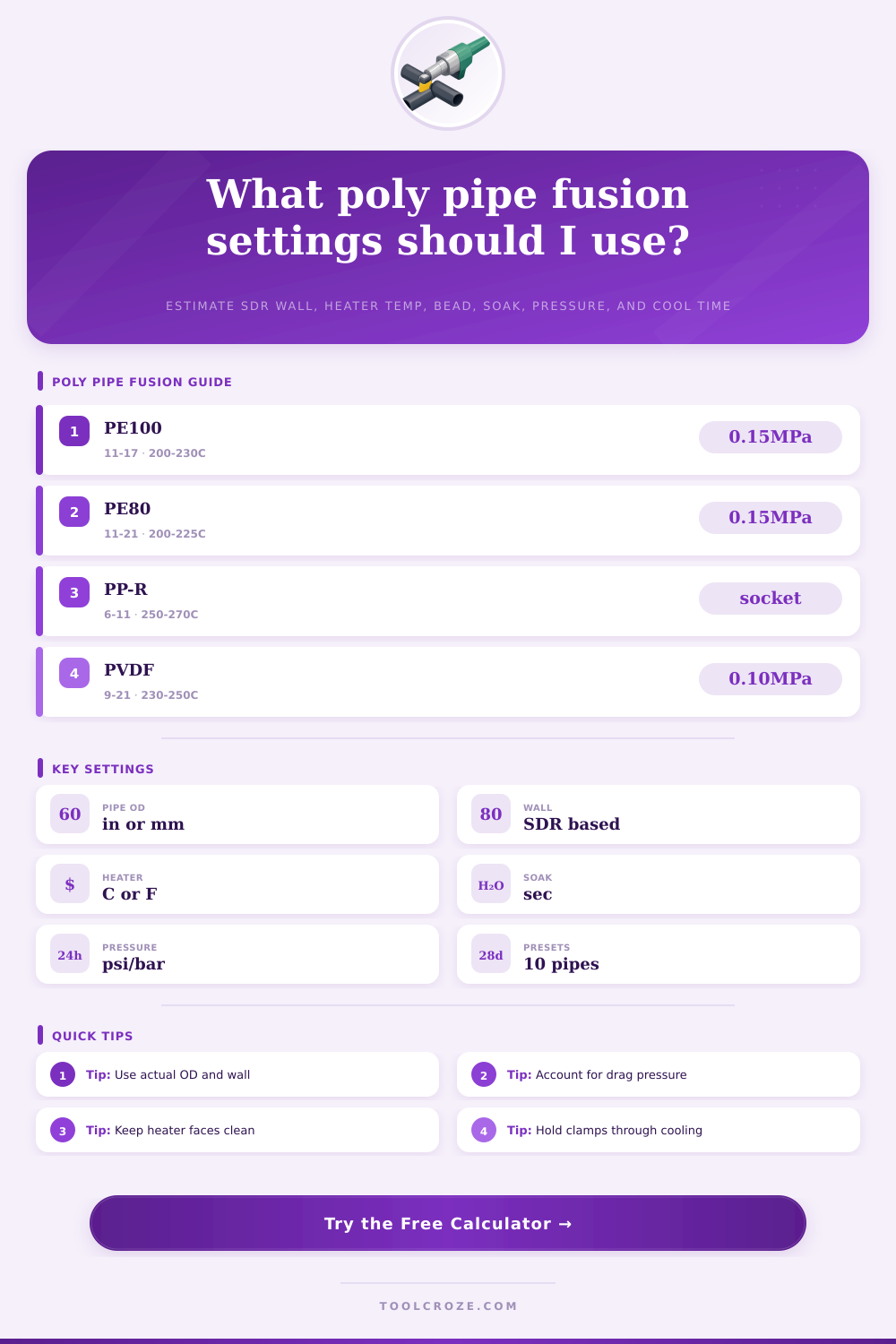
| PE100 / HDPE pressure pipe | 200 to 230°C / 392 to 446°F | About 0.15 N/mm² for butt fusion planning | Hold in clamps until bead is firm and joint is cool enough to move. |
| PE80 / MDPE utility pipe | 200 to 225°C / 392 to 437°F | Similar pressure, but utility procedures may specify exact values | Extra cooling is common in wind, cold pipe, or larger OD joints. |
| PP-R and PP-H pipe | 250 to 270°C / 482 to 518°F for many socket tools | Use insertion depth and tool dwell charts, not pipe-area gauge pressure | Avoid twisting during assembly and hold until the joint stops moving. |
| PVDF chemical pipe | 230 to 250°C / 446 to 482°F | Lower pressure than HDPE; keep ends very clean and square | Allow controlled cooling before stress, pressure, or chemical service. |
| SDR / DR | Wall formula | Common use | Fusion note |
|---|---|---|---|
| SDR 7.4 to SDR 9 | Wall = OD / SDR | Higher pressure service and PP-R systems | Thicker wall increases soak, clamp force, and cooling time. |
| SDR 11 | Wall = OD / 11 | Common water, gas, and pressure piping | Bead size and heat soak are usually easy to verify visually. |
| SDR 17 to SDR 17.6 | Wall = OD / 17 or 17.6 | Force mains, water mains, and larger distribution pipe | Lower wall area reduces gauge pressure for the same OD. |
| SDR 21 to SDR 26 | Wall = OD / SDR | Lower pressure or gravity applications | Thin walls are more sensitive to overheating and misalignment. |
| Fusion method | What the calculator estimates | Best input to verify | Important limit |
|---|---|---|---|
| Hot plate butt fusion | Bead target, soak, force, hydraulic gauge pressure, cooling | Actual drag pressure and cylinder area | Do not move the joint before clamp cooling time is complete. |
| Socket fusion | Temperature, dwell tendency, and hold/cool planning | Socket insertion depth chart for the fitting system | Gauge pressure by pipe wall area is not the acceptance method. |
| Saddle or branch fusion | Adjusted heat and cooling planning for curved contact | Branch fitting manufacturer pressure chart | Surface prep and uniform contact control the result. |
| Electrofusion prep | Scrape, clamp, cool, and barcode temperature awareness | Coupler barcode voltage and time | Never substitute a generic time for a coupler barcode. |
| Wall thickness | Typical bead target | Planning soak range | Cooling caution |
|---|---|---|---|
| Under 4.5 mm / 0.18 in | 0.5 to 1.0 mm | 30 to 60 seconds | Thin pipe can collapse if pressure is applied too early. |
| 4.5 to 12 mm / 0.18 to 0.47 in | 1.0 to 1.8 mm | 50 to 140 seconds | Keep changeover quick and square to avoid a cold joint. |
| 12 to 25 mm / 0.47 to 0.98 in | 1.8 to 3.0 mm | 140 to 300 seconds | Large annular area makes drag pressure measurement important. |
| Over 25 mm / 0.98 in | 3.0 mm or procedure value | 300 seconds and above | Use a qualified data logger or approved field procedure. |
Poly pipe fusion is a process where two piece of poly pipe are joined together. The quality of the joint rely upon a few specific numerical values relating to the fusion process. It is possible to create the appearance of a good joint, but that joint may fail later due to incorrect value for parameters like soak time or interface pressure.
A calculator can assist in the fusion process in that it can convert the measured values of the poly pipe fusion joint to the settings that must be used during the fusion process. The values that must be measured include the outside diameter of the pipe, the wall thickness, the area of the cylinder create by the pipe, and the drag pressure of the pipe. The first value that must be entered into the calculator is that of the material of the pipe.
How to Use a Poly Pipe Fusion Calculator
Different material have different melting points, and the amount of pressure that the worker requires for joining the two end of the pipe can differ with the material of the poly pipe. For example, poly pipes can be manufactured with materials like PE100 and PE80, each of which have its own recommended temperature range. PP-R and PVDF are two other pipe materials that require higher temperatures during fusion, as well as different amounts of time for the two pipe ends to remain within the clamps.
The second value that must be entered into the fusion pipe calculator is the wall thickness of the poly pipe and the Standard Dimension Ratio (SDR) of that pipe. These two values is important in that the thickness of the poly pipe will impact the amount of force that is required to join the two ends of the pipe. For instance, poly pipes that feature thick walls require longer soak times within the fusion heater than those with thin walls.
Similarly, the force that the carriage exerts onto thickwalled poly pipes will be stronger than for thin walled poly pipes. Using the actual wall thickness prevents any under-soaking of heavy-wall pipes or over-pressuring thin-wall pipes. Drag pressure is another setting that must be entered into the fusion calculator.
Drag pressure is created by the weight of the fusion carriage used to fuse the poly pipes together. Drag pressure must be added to the fusion force to determine the total force that will be applied to the poly pipe joint. If too little drag pressure is applied, there may not be enough force to create a good joint; too much drag pressure could crush the weld bead.
Drag pressure should of been measured following the facing of the poly pipe ends. Another factor that must be considered when fusing poly pipes together is the condition at the site where the pipes will be fused. Factors like ambient temperature and wind speed will impact the rate at which the poly pipe fusion joint loses heat and cools down.
These site conditions can be selected on the fusion calculator for settings like cold pipe, hot sun, and windy exposure. These settings will impact the soak time and cooling time of the fusion process; the joint will lose heat at a more fast rate in windy conditions than within a well-controlled shop environment. The fusion pipe calculator will provide several different output based off the settings entered by the fusion worker.
The calculator can calculate the size of the fusion bead, which ensure that the initial roll-back of the poly pipe ends is performed correctly before the soak phase. The calculator can determine the soak time to ensure that the ends of the poly pipe stay in contact with the fusion heater for the correct amount of time. Finally, the calculator calculates the fusion pressure and cooling times so that the worker can set the hydraulic gauge to the correct value, as well as to know after how long the clamps can be released from the newly-fused poly pipes.
These outputs reduce the need for workers to perform these calculations themselves. It is a good habit to record the drag pressure and the temperature of the heater face for each joint that is fused together. By keeping these records, the worker can determine the performance of the poly pipe fusion equipment over time.
For example, if the drag pressure and the heater face temperatures all remain low over time, it will become apparent to the fusion worker that the equipment isnt performing at its best. By using the poly pipe fusion calculator with these values, the worker can make any adjustment to the machine settings. The quality of the poly pipe fusion joint can be tested with a bend test or hydrostatic test.
If the joint pass the test, the settings and the inputs into the calculator were performed correctly. If the joints fail the tests, the calculator can help determine the cause of that failure. For instance, if the recorded values for the temperature and drag pressure show that those values differed from the settings required for fusion, those records will help determine the reason for that failing joint.
By ensuring that each of these parameter is correctly set for the pipes to be joined together, the fusion joint will have a better chance of success.