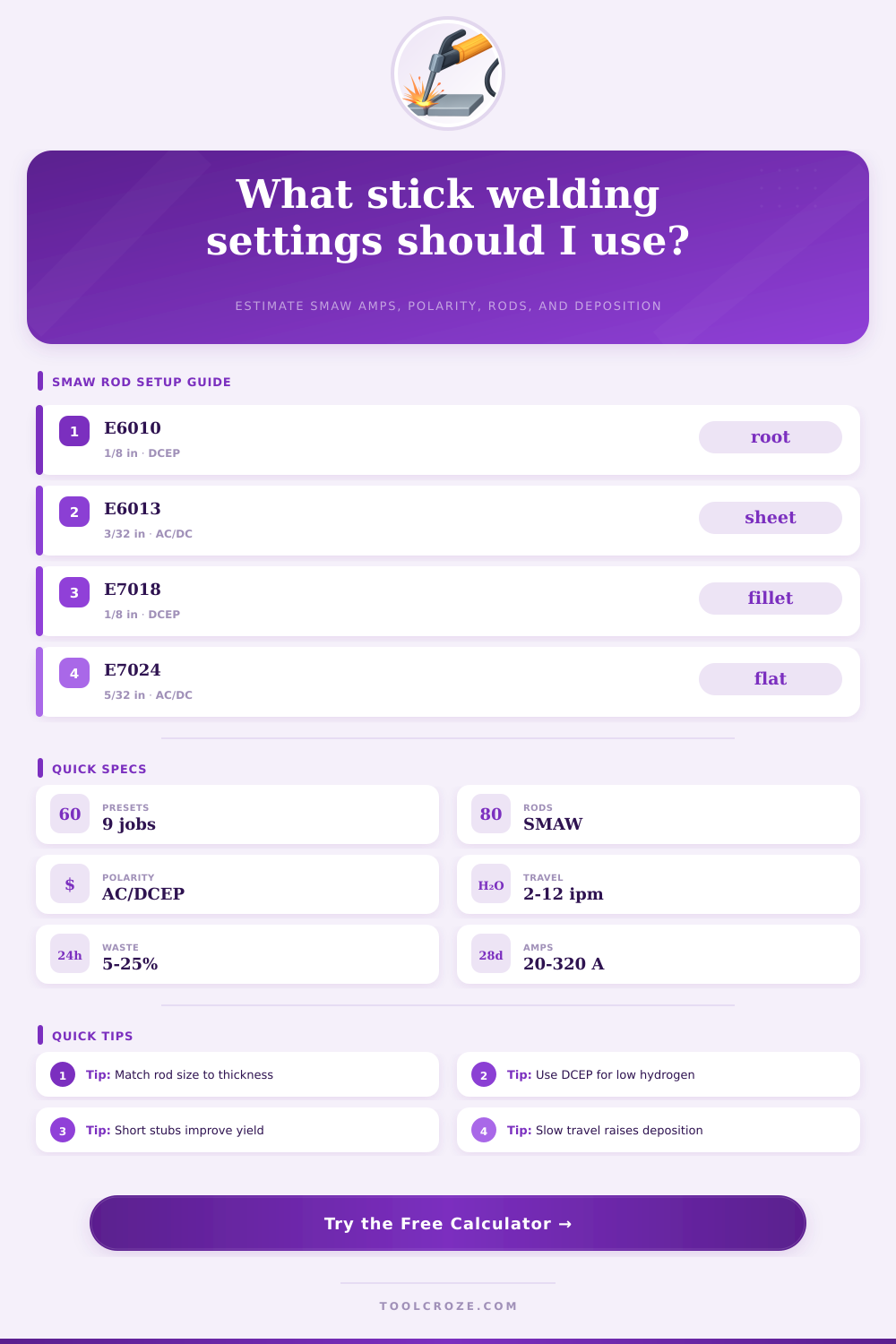
Stick Welding Calculator
Estimate SMAW electrode setup, amperage range, polarity fit, travel speed, filler deposition, arc time, and rod count from real shop inputs.
⚙ SMAW Presets
Choose a named stick welding setup, then tune the inputs for your joint, position, and rod handling.
🔧 Welding Inputs
Calculation Breakdown
📊 Electrode Data Grid
⚡ Amperage Reference
| Rod Diameter | Common Range | Best Thickness | Typical Travel |
|---|---|---|---|
| 1/16 in / 1.6 mm | 20 to 40 A | 16 ga to 1/16 in | 3 to 7 ipm |
| 5/64 in / 2.0 mm | 35 to 60 A | 1/16 to 3/32 in | 3 to 8 ipm |
| 3/32 in / 2.4 mm | 55 to 100 A | 1/8 to 3/16 in | 4 to 9 ipm |
| 1/8 in / 3.2 mm | 75 to 140 A | 3/16 to 3/8 in | 5 to 10 ipm |
| 5/32 in / 4.0 mm | 110 to 180 A | 1/4 to 1/2 in | 5 to 11 ipm |
| 3/16 in / 4.8 mm | 160 to 240 A | 3/8 in and up | 6 to 12 ipm |
🔌 Polarity and Electrode Table
| Electrode | Usual Polarity | Arc Character | Main Use |
|---|---|---|---|
| E6010 | DCEP | digging, fast freeze | pipe roots, dirty steel |
| E6011 | AC or DCEP | forceful, tolerant | outdoor repair |
| E6013 | AC, DCEP, DCEN | smooth, light dig | sheet and small frames |
| E7018 | DCEP or AC | smooth, low spatter | structural steel |
| E7024 | AC, DCEP, DCEN | heavy slag, high fill | flat fillets and plate |
| Stainless -16 | DCEP or AC | smooth, slower travel | stainless joints |
📏 Diameter and Thickness Table
| Material Thickness | Rod Diameter | Pass Strategy | Setup Note |
|---|---|---|---|
| 1/16 to 1/8 in | 1/16 to 3/32 in | single pass | use low heat and short arc |
| 1/8 to 1/4 in | 3/32 to 1/8 in | single or two pass | fit-up controls burn-through |
| 1/4 to 3/8 in | 1/8 to 5/32 in | multi-pass | bevel grooves when needed |
| 3/8 to 3/4 in | 5/32 to 3/16 in | multi-pass | control interpass cleaning |
| 3/4 in and up | 3/16 in and up | heavy multi-pass | follow qualified procedure |
🛠 Position, Travel, and Bead Table
| Position | Amp Adjustment | Travel Cue | Practical Note |
|---|---|---|---|
| Flat | baseline | steady puddle | largest rods and highest fill |
| Horizontal | minus 3% | hold toe line | watch undercut on upper toe |
| Vertical | minus 8% | slower weave | use small beads and pause edges |
| Overhead | minus 10% | tight arc | keep puddle small and controlled |
💡 Shop Tips
⚠ Safety Note
Stick welding is a welding process that can be used in a variety of conditions on job sites or in welding shops because stick welding can be used in windy conditions and stick welding can be performed on dirty or painted steel. Stick welding only requires a welding machine, welding leads, and a box of welding rods to perform the welding process. Before stick welding can be performed, there is a variety of choices that must be made, such as the type of electrode to use, the size of the electrode, the travel speed that will be used, and how many rods will be needed to complete the welding job.
A welding calculator can help a person to perform these tasks by making the mathematical calculations of these choices required before stick welding, and using a welding calculator help a person to remove the guesswork regarding these choices. The type of electrode to use will determine the characteristics of the weld that is performed, and each type of electrode have certain uses. For instance, an E6010 cellulose welding rod will allow for deep penetration into the metal being welded and is often used for root passes on pipe joints.
Using a Welding Calculator for Stick Welding
In contrast, an E7018 low-hydrogen welding rod will provide less penetration than an E6010 welding rod, but will provide more toughness to the weld and more resistance against cracking. An E7018 welding rod is often used in structural welds that can experience changes in the load or temperature of the structure being welded. An E7024 iron-powder welding rod will deposit large amounts of metal into a joint in the flat welding position, but will require a steady welding speed and a flat welding position.
Finally, if welding stainless steel, there are different characteristics to these welding rods, as they will affect how much heat can be applied to the weld area. Using a welding calculator will allow a person to select the electrode rod that will be used for the welding job first. By selecting the electrode type first, any other choices that a person is to make will ensure that all of the calculations are based off the specific welding rod that will be used to complete the welding job.
Another important factor that must be considered prior to welding is the diameter of the welding electrode. The diameter of the welding rod is just as important as the type of welding rod that will be used. If the welding rod is too large for the thickness of the steel plate that is to be welded, it is possible that the weld will burn through the thickness of the steel plate.
If the welding rod is too small for the thickness of the steel plate, then it is likely that the welding rod will require extra passes to complete the welding job. A welding calculator will allow a person to enter the thickness of the steel plate, and this will calculate the amperage that will be required for the welding job. An amperage setting for the welding rod will be provided, but it will be a range of numbers rather than a single number.
The range of amperage will change depending upon the welding position of the welded metal. Another important factor in the welding job is the type of joint that is to be welded, as well as the size of the weld. The type of joint and the size of the weld will determine the amount of metal that is deposited into the welded joint.
Different types of welds will deposit different amounts of metal into the welded joint. Welding calculators will allow a person to enter the type of joint that will be performed, as well as the size of the weld. Based upon these entries, the welding calculator will calculate the amount of metal that will be deposited into the welded joint, convert that amount of metal into the amount of pounds of metal that will be deposited, calculate the number of welding rods that will be needed for the welded joint, and account for the amount of metal (or welding rods) that are discarded from the welding rods after each welding rod is depleted of welding metal.
Thus, it is likely that a person will underestimate the amount of welding rods that will be required for the job, but the welding calculator will account for this. The fourth factor that is to be considered prior to beginning to weld with stick welding processes is the travel speed at which the person will move the welding rod along the welded metal. The travel speed will affect both the rate at which metal is deposited into the welded joint and the length of time that the weld will be completed (arc time).
If the travel speed is too slow for the thickness of the metal being welded, it is possible that too much metal will be deposited into the metal being welded and the metal will burn through. Welding calculators will allow a person to enter the travel speed that will be used for the welding process. Based upon the other variables that is entered into the welding calculator, the welding calculator will indicate if the travel speed that is entered is within the parameters of the weld job.
If the travel speed is too fast, the welding calculator will provide warnings to the person about this error so that they can decide whether they would like to make another pass over the welded joint, or whether they would like to change the travel speed of the welding rod. Another variable that may impact the stick welding process is the type of material that is to be welded together. The welding rods may not be compatible with every material that is to be welded together.
For instance, if the material that is to be welded contains zinc (such as galvanized metal), then certain welding rods may be attacked by the zinc vapor that is released during the welding process. Another example involves cast iron, which may require the use of welding rods that contain nickel, since the nickel rods can tolerate high amounts of carbon within the cast iron. Finally, stainless steel may require the use of welding rods that have the same base alloy as the steel that is to be welded.
These type of variables will be recognized by the welding calculator so that a person is aware of these choices prior to welding. The final variable to be entered into a welding calculator is the polarity setting of the welding rod. The setting of the polarity for the welding rod must be correct for the weld to function properly.
For instance, welding rods that require DCEP will provide deeper penetration into the metal that is to be welded, which is an advantage for welding into dirty metal plates or metal welds with open roots. Alternatively, welding rods that contain AC or DCEN settings may be used for welding thin sheet metal so that the welds are smoothed out during the welding process. Another important variable is that the welding calculator will recognize whether or not the polarity setting that is to be used is compatible with the welding rods that will be used.
Any discrepancy in polarity will be noted by the welding calculator so that a person is aware of any corrections that must be made to that setting. Despite the fact that welding calculators can recognize each of the variables mentioned above, there are still other variables to the stick welding process that are beyond the abilities of the calculator. For instance, the fit-up of the welded metal to the weld joint, the amount of wind that is blown onto the weld site, the interpass temperature, and the condition of the welding leads are still variables that must be accounted for by the welder.
Thus, while a welding calculator will make it easier for a person to calculate the required parameters for welding metal together with stick welding processes, the calculations that are provided by a welding calculator will still not provide the final welding procedure. Welding parameters will still have to be verified by the welder prior to beginning to weld with stick welding processes. Another benefit of the use of welding calculators includes the fact that a person using the welding calculators will have fewer cutouts of welding rods that are being welded, as well as fewer instances of half-burned welding rods at the end of a shift.
By entering the parameters for the welding job into a welding calculator, as well as making the calculations of the required parameters for the welding process, each person will save time and money in the welding process. Thus, there is a practical advantage to the use of welding calculators for stick welding processes.