MIG Welding Settings Calculator
Estimate starting MIG voltage, wire feed speed, amperage, travel speed, stickout, deposition rate, and heat input from material, thickness, gas mix, wire diameter, and transfer mode.
Pick a common shop scenario. Each preset fills the MIG settings fields and runs the estimate.
MIG Settings Result
Calculation breakdown
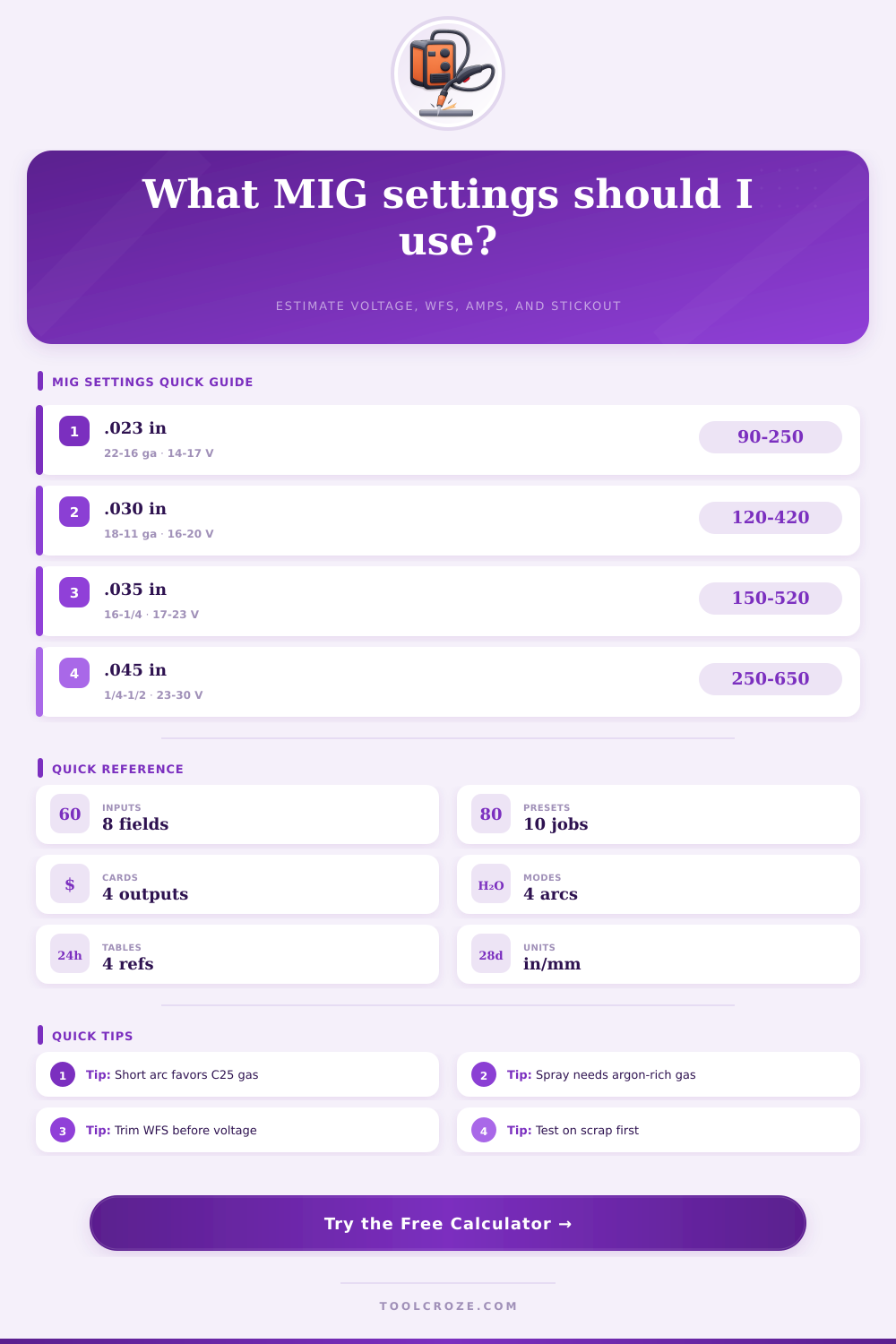
| Wire diameter | Common thickness | Typical current | Usual transfer |
|---|---|---|---|
| .023 in / 0.6 mm | 22 to 16 ga sheet | 30 to 90 A | Short circuit |
| .030 in / 0.8 mm | 18 ga to 1/8 in | 60 to 150 A | Short circuit |
| .035 in / 0.9 mm | 16 ga to 1/4 in | 90 to 220 A | Short or pulsed |
| .045 in / 1.2 mm | 1/4 to 1/2 in plate | 160 to 320 A | Spray or pulse |
| .052 in / 1.3 mm | 3/8 in and thicker | 220 to 380 A | Spray transfer |
| Gas mix | Best transfer | Voltage tendency | Arc note |
|---|---|---|---|
| 75/25 argon CO2 | Short circuit | Moderate voltage | Stable sheet and light fabrication arc |
| 90/10 argon CO2 | Spray or pulse | Higher voltage | Clean arc for thicker steel |
| 98/2 argon CO2 | Stainless pulse | Moderate voltage | Good wetting with low oxidation |
| 100 percent CO2 | Short or globular | Raise voltage | More penetration and more spatter |
| 100 percent argon | Aluminum spray | Higher voltage | Needed for aluminum MIG |
| Steel thickness | Wire | Voltage range | WFS range |
|---|---|---|---|
| 22 to 20 ga | .023 in | 14 to 16 V | 90 to 180 in/min |
| 18 to 16 ga | .030 in | 16 to 18.5 V | 140 to 260 in/min |
| 1/8 in | .030 or .035 in | 18 to 20.5 V | 220 to 360 in/min |
| 1/4 in | .035 in | 20 to 23 V | 360 to 520 in/min |
| 3/8 in | .045 in | 24 to 29 V | 300 to 600 in/min |
| Transfer mode | Stickout | Travel speed | Setup check |
|---|---|---|---|
| Short circuit | 3/8 to 1/2 in | 10 to 24 in/min | Listen for steady crackle |
| Globular | 1/2 to 5/8 in | 8 to 18 in/min | Expect more spatter |
| Spray transfer | 5/8 to 3/4 in | 10 to 22 in/min | Needs argon rich gas |
| Pulsed spray | 5/8 to 3/4 in | 8 to 24 in/min | Good for positional welds |
| Thin edge weld | 3/8 in or less | 18 to 32 in/min | Watch burn-through |
To understand the settings for MIG welding, one must understand the interaction of a different variables in the process. The variables of voltage, wire feed speed, travel rate, and stickout all impact the final weld that is produced. Each of these variable impacts the way the weld interacts with the metal, and the settings need to be understood once the arc begins the weld, small changes in these settings can lead to the weld burning through the metal or changing the shape of the weld bead.
Wire diameter is one of the variables that determines the limit of the system. Thinner wires will melt at a faster rate and allow for more control when welding thin metal, but limit the current that can be used. Thicker wires will carry more amperage and allow for faster welding but require more voltage and a steady hand to avoid cold laps.
MIG Welding Settings and What They Do
The diameter of the wire that a user uses can be dependent upon the thickness of the metal that is to be welded; for thick joints, a user may use a larger diameter wire to allow for faster welding, while smaller diameters may be used with thinner metal to allow for more control. Shielding gas play a role in the stability of the arc that is created during the welding process. A 75/25 argon-CO2 gas mix will provide stability to the arc, whereas a CO2 gas will provide more penetration of the metal but with a harsh arc.
If spray transfer welding is to be used, you must use shielding gas that is rich in argon. The position of the metal relative to the welder will also impact the amount of heat that is applied and the way that shielding gas is used; overhead or vertical welds will use less heat to ensure that the weld puddle does not fall on the metal, while flat metal can be welded with more heat. One of the primary factors in MIG welding is the thickness of the metal.
If the voltage is too low, the weld will not penetrate the metal. If the voltage and speed is too high, the weld will burn through the metal. If the metal that is being welded has two different thickness, the voltage should of been set according to the thinner thickness of metal; burn through will occur at this thinner thickness.
The heat must be set to ensure that the weld satisfies the needs of that specific joint. Stickout is a variable in MIG welding that impact the current in the arc. Long stickout settings will increase the resistance in the circuit, which will lower the current at the arc.
This may be used to cool the weld without changing the MIG weld settings. However, longer stickouts make for a less even weld; stickout should be set between three-eighths and one-half of an inch for even welding with short circuit welding. Another of the variables for MIG welding is travel speed.
Travel speed can be set according to the size of the weld puddle; too fast of a travel speed will create undercut metal with no fusion between the weld and the metal. Travel speeds that are too slow will create tall welds that may crack open. The travel speed should be chosen so that the toes of the weld metal tie into the base metal.
Once the welder has established the correct speed, only wire feed speed or voltage should be adjusted. Heat input is a measurement of how much energy that is delivered to the metal during welding. High heat input can cause thin metal sections to distort.
Low heat input can cause fusion to be incomplete in the metal. Changing the travel speed or the voltage can manipulate heat input. If either of these variables is changed, the heat input will change, too; if it moves outside of the parameter of the heat input that worked with previous metal parts being welded, the user will have to adjust the settings.
MIG welding settings may be mastered individually, but many mistakes are made in regard to treating one variable while ignoring others. For instance, voltage may be set, but the user may adjust wire feed to fix the weld; however, changing the wire feed may not fix problems caused by an incorrect voltage. Additionally, shielding gas may be ignored until porosity is noticed; however, increasing the flow rate of the shielding gas will fix most porosity issue.
While a calculator will allow a person to set the correct voltage, wire feed speed, and travel speed, these settings must be tested on scrap metal of the same type as the metal to be welded. The final test of MIG welding settings is the finished weld and whether or not it meets the requirements of the metal part. Weld settings that work for flat metal parts may not work for metal parts in vertical position.
While the welding calculator will provide settings for MIG welding, the welder must be able to recognize when the behavior of the arc indicate a change in settings for the metal part being welded.