Carbon Equivalent Calculator Welding
Estimate IIW carbon equivalent, weldability band, hydrogen cracking risk, and practical preheat guidance from steel chemistry, thickness, hydrogen level, and restraint.
1Units and named steel presets
Presets use typical chemistry ranges for planning. For production weld procedure work, enter the actual mill test report values.
2Steel chemistry and welding conditions
Welding carbon equivalent result
3Quick interpretation cards
4Welding CE reference tables
| CE range | Weldability | Typical control | Practical note |
|---|---|---|---|
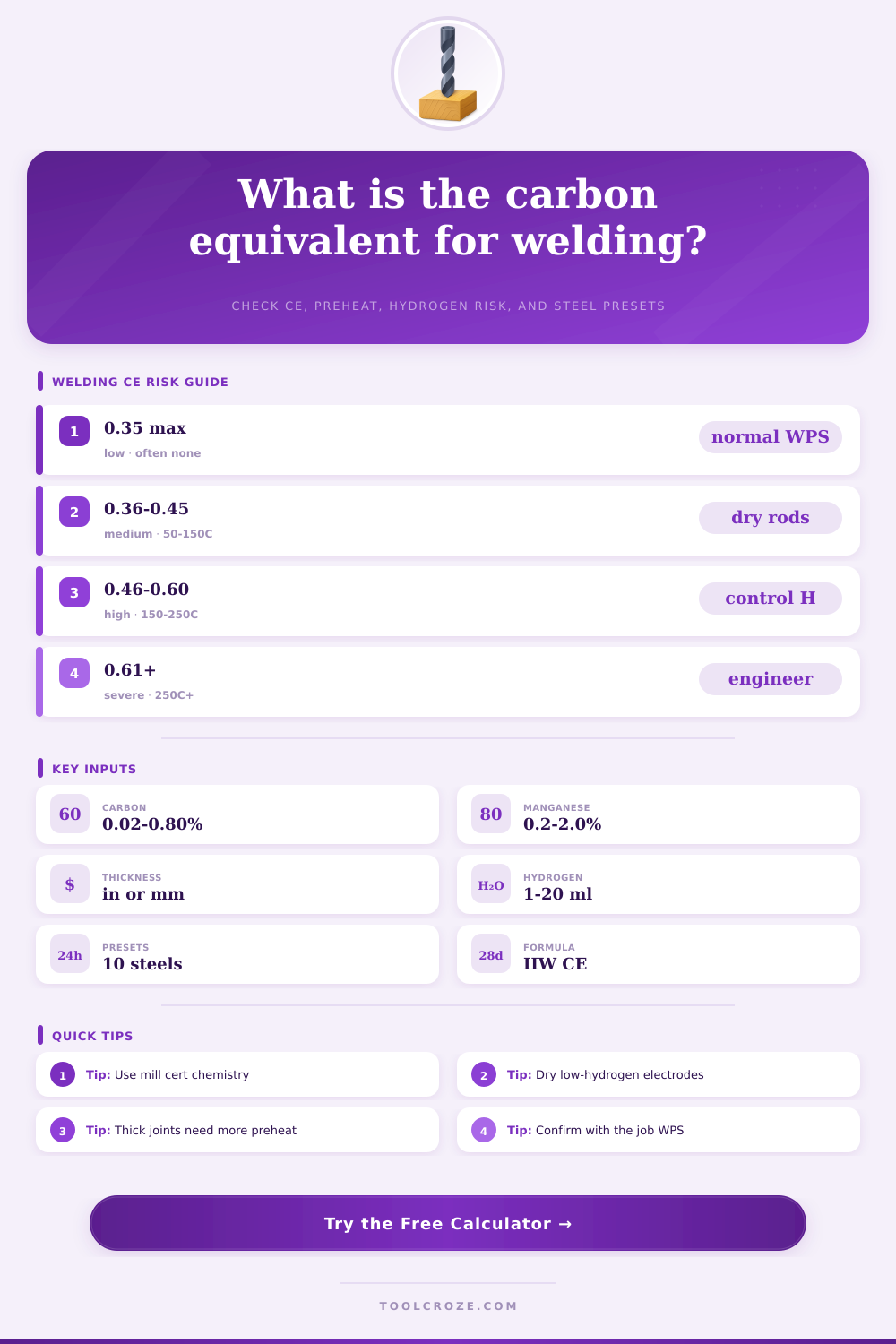
| 0.35 and below | Good | Normal workmanship | Preheat often not needed on thin plate when dry consumables are used. |
| 0.36 to 0.45 | Moderate | Dry low-hydrogen practice | Consider preheat as thickness, restraint, or hydrogen level increases. |
| 0.46 to 0.60 | Difficult | Preheat plus hydrogen control | Slow cooling, avoid damp electrodes, and keep interpass controlled. |
| Above 0.60 | High hardenability | Qualified procedure required | Use code-approved WPS, possible postheat, and engineering review. |
| Thickness | Hydrogen condition | Restraint | Risk influence |
|---|---|---|---|
| Under 1/2 in or 12 mm | H4 to H8 | Low | Lower risk if fit-up allows shrinkage and the steel is not high CE. |
| 1/2 to 1 in or 12 to 25 mm | H8 to H16 | Medium | Moderate risk; use preheat when CE approaches 0.40 or higher. |
| 1 to 2 in or 25 to 50 mm | H8 to H16 | High | Higher cooling restraint; preheat and controlled interpass are common. |
| Over 2 in or 50 mm | Any unknown H | High or severe | Use a formal preheat method and a procedure qualified for the joint. |
| Named steel preset | Typical CE | Common welding concern | Shop control |
|---|---|---|---|
| ASTM A36 | About 0.42 | Variable chemistry by heat | Use mill cert; preheat thick restrained joints. |
| A572 Grade 50 | About 0.38 | HSLA strength level | Control heat input and hydrogen. |
| A516 Grade 70 | About 0.43 | Pressure vessel plate | Follow the qualified WPS and impact requirements. |
| SAE 1045 | About 0.78 | High carbon cracking | Preheat, slow cool, and verify procedure. |
| AISI 4130 | About 0.56 | Chromium-moly hardenability | Use suitable filler and controlled cooling. |
| AR400 Plate | About 0.83 | Hard abrasion plate HAZ cracking | Use manufacturer preheat guidance. |
Welding decision depend on many detail of the steel plate, including chemical detail that are not visible to an inspector. Thus, despite the fact that the steel plate feature the correct strength numbers for the application, that same steel plate can create problem if an arc is placed onto the metal plate, due to the chemistry of that steel plate. A calculation of the carbon equivalent of the steel plate is often used to resolve this issue.
The calculation converts each of the elements that comprise the steel into a single number that indicate the weldability of that metal; the higher the number, the less weldable the metal. Though an old practice, the carbon equivalent calculation remain an important one given that a single missed step before welding can result in cracked metal that must be repaired. The calculation creates a weighted sum of the elements that comprise that metal to find the carbon equivalent of the metal.
How Carbon Equivalent Helps Stop Cracks in Welding
Carbon is primarily weighted in the calculation, though the other elements that contribute to the formation of potentially harmful crystals within the metal that are known to form during the cooling of the metal after welding (such as manganese, chromium, molybdenum, vanadium, nickel, and copper) are also include in the calculation. The result of the calculation provide a means of comparing metals of different types and compositions, and allow fabricators to ensure that metals with higher values of the carbon equivalent are treated differently from metals of lower values. For instance, metals with high values of the carbon equivalent must be preheat prior to welding to ensure that they do not crack during that welding process.
Along with calculating the carbon equivalent of the metal plate, a fourth factor to consider prior to welding the metal plate is the thickness of that metal plate. The thicker metal plates will lose heat from the weld faster than thinner metal plates of the same composition. Thus, metals of high carbon equivalent value may be able to be welded without preheat if the metal plates are thin in thickness.
However, if those same metal are of high thickness, preheat will be required prior to welding. In addition to the thickness of the metal plates, a fourth factor to consider is the amount of restraint that will be placed upon the welded metal. High levels of restraint upon a welded joint will lead to cracking in those metal.
The joint that is restrained from cooling will create high level of stress upon the metal joints, leading to cracking in those metal plates even if the carbon equivalent values of those metals are within normal limits. Fifth and last factor to consider prior to welding the metal plate is the level of hydrogen in the plate. Hydrogen levels in metal plates can be introduced during welding processes.
For instance, moisture can be present within flux, rust can be present upon the metal plate, and the low-hydrogen welding electrodes can be store improperly. All of these issue can introduce hydrogen into the weld metal. Levels of hydrogen can also be accounted for in the calculation of the carbon equivalent prior to welding; the user can select hydrogen levels as a factor in the calculation.
For instance, if the welding process switch from low-hydrogen welding rods to standard welding rods that may have been stored open on the welding shop bench, the risk of hydrogen in the weld will increase. Prior to welding the metal plates, a decision must be made regarding preheat. Preheat decisions are based off the same factor as the calculation of the carbon equivalent.
Preheat is not performed to heat the metal plate to a forging temperature prior to welding, but to slow the cooling rate of the steel plates. The calculation of the carbon equivalent, the thickness of the metal plates, the hydrogen levels, and the level of restraint upon the metal plates can all be combine to determine the preheat temperature that should be used prior to welding the plates. This preheat temperature will be checked against the code for that type of metal plate, as well as the welding procedure that is qualified for that type of metal plate; variables in actual metal plates may differ from those assume by the formula.
Many people make mistakes when using this calculation of the carbon equivalent. One mistake is treating the number as a value of the metal grade, but it is actually a value of the specific heat of that metal. Two heat of the same metal grade may have different levels of carbon equivalent.
Another mistake is to ignore the relationship between hydrogen and restraint. Thus, even if the carbon equivalent values of the metal is low, if the hydrogen levels are too high and there is restraint upon the metal joint, cracking will occur during welding. The formula is a means of indicating one aspect of the risk of welding metal plates; other variable must be managed in the welding process.
The calculator is programmed to execute the calculation after the user enter the actual chemical composition of the metal plate, the thickness of the metal plate, the hydrogen levels in the metal plate, and the restraint upon the metal plates. The calculator will return each of the factor to the user. Additionally, a risk label will be created that consider each of the four factor.
Tables within the calculator illustrate the weldability bands of the metal plates of various thickness and of various type of welding electrodes. The editability of each of the factors within the calculation allow the welder to test the risks of changing to low-hydrogen welding rods or increasing the preheat temperature to reduce risk of cracking within the welded metal plates. Though the calculations are helpful, no welding process is based solely upon the outcome of the carbon equivalent calculation.
Factors outside of the welding parameters can affect the outcome of welding metal plates. For instance, ambient temperature to the welding area, the action of the wind upon the welding plates, and the changes in interpass temperature can all change the cooling rate of the welded metal plates. These factor are ignored in the calculation; the output indicates the parameters that should be followed during the welding process.
Thus, the value of such a calculation is that it force the fabricator to consider the chemistry, the joint, and the welding consumables prior to beginning the welding process. The calculation is a translation tool; it translates the chemistry and the welding parameters into a joint expectation. If the parameters followed in the welding of metal plates are those that are indicated from the carbon equivalent calculation, the risk of unexpected cracking in those metal plates is reduced.
Should the actual welding controls utilized within the shop that fabricates metal plates and joints differ from the expectations indicated by the calculation, the result of the welding process will likely become visible in the first few inch of the welded metal plates.