Welding Machine Power Consumption Calculator
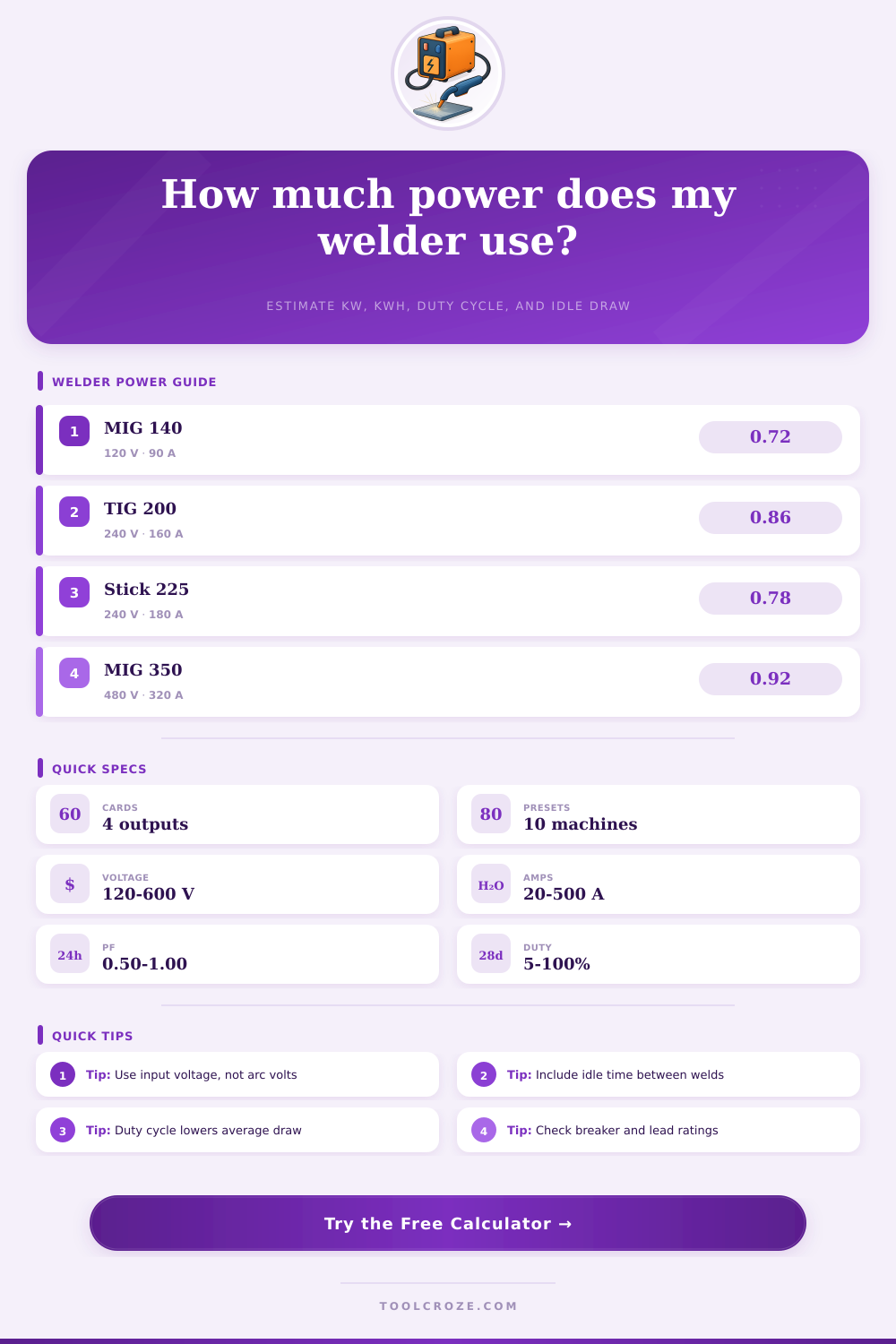
Estimate welding machine input power, duty-cycle average load, idle energy, total kWh, apparent power, and supply current from voltage, amperage, power factor, efficiency, arc-on hours, duty cycle, and idle draw.
Calculation Breakdown
| Machine type | Typical input | Power factor range | Efficiency range |
|---|---|---|---|
| 120 V MIG or flux-core | 15 to 25 A single-phase | 0.60 to 0.78 | 65% to 82% |
| 240 V inverter TIG or MIG | 20 to 50 A single-phase | 0.80 to 0.95 | 80% to 90% |
| Transformer stick welder | 35 to 60 A single-phase | 0.65 to 0.82 | 60% to 78% |
| Industrial CV power source | 30 to 90 A three-phase | 0.85 to 0.95 | 82% to 92% |
| Submerged arc system | 60 to 150 A three-phase | 0.88 to 0.96 | 84% to 93% |
| Formula | Single-phase | Three-phase | What it means |
|---|---|---|---|
| Apparent power | V x A / 1000 | 1.732 x V x A / 1000 | kVA load seen by the supply before power factor. |
| Real input power | kVA x PF | kVA x PF | kW drawn while welding at the entered current. |
| Output power estimate | kW x efficiency | kW x efficiency | Useful welding output after machine losses. |
| Duty average | arc kW x duty + idle watts | same | Average kW over a repeating work-and-rest window. |
| Total energy | kW x hours | same | kWh combines arc energy, rest-idle energy, and standby. |
| Work pattern | Arc-on share | Idle share | Planning note |
|---|---|---|---|
| Tack and short repair welds | 10% to 25% | High | Idle draw can matter because the machine waits between starts. |
| Bench MIG fabrication | 30% to 55% | Medium | Use measured duty cycle for a realistic average load. |
| Stick field work | 20% to 40% | Medium | Rod changes and chipping lower average power draw. |
| TIG tube or sheet work | 15% to 35% | High | Coolers and purging can add steady auxiliary watts. |
| Mechanized long welds | 60% to 100% | Low | Use the continuous rating and include feeders or tractors. |
Welding machines is electrical device that consume power whenever they create an arc or even when they are not welding. While most individuals dont measure the cost of the electricity that their welding machine uses, the consumption of electricity have an impact upon the welding shops monthly utility bill. The amount of electricity that welding machines use are determined by the electrical conversion of energy into heat, the length of time that the welding arc is burning, and the amount of energy that the welding machine draw while idling.
Each of these measurements can help individuals to determine whether an electrical service can handle a new welding machine and to determine whether changes must be made to the work schedule of welders. The voltage and amperage of the welding machine are the primary factor in calculating the amount of power that a welding machine use. The voltage and amperage of a welding machine are factors in determining the amount of current that must be supplied to the welding machine.
How Welding Machines Use Electricity
For instance, a welding machine that runs at 240 volts and draws 32 amps will require less current than a welding machine that runs at 120 volts and draws 32 amps because the 120 volt welding machine would require twice the amperage to perform the same amount of work. Power factor is another of the main factors in calculating power draw of a welding machine. Machines that use transformers, such as older welding machines, have a low factor for power.
Newer welders that use inverters typically has a high power factor. This indicates that they require less current to perform the same work. Additionally, an individual can enter the voltage, amperage, and power factor of the welding machine into a calculator to make it easier to compare the power draw of two welding machines.
Another factor that fabricators often underthink is the duty cycle. The duty cycle is essential for determining the length of time that the welding arc will be burning. While a fabricator may weld for eight hours in one workday, for example, the welding arc will only burn for three hours because the welder need to take breaks to change welding rods and to weld different part of the job.
The welding machine will, however, draw power during those non-welding hours for its fans and welding apparatus. By using a welding machine calculator, an individual can determine the number of hours of welding during the workday and convert that to the total amount of time that the welding machine will be energized. This is important for determining how often the welder will be using the welding machines power during the workday.
Another factor that is often overlooked is the amount of power that a welding machine will draw while idling. This factor is rarely list on the welding machine nameplate. A welding machine will draw power from its fan motor, coolant pump, and other controls while idling, even when the welding machine is off.
Such power draw ranges from 100 to 400 watt. If a fabricator has jobs that require the welder to perform many short welds with long breaks between them, the amount of power that the welding machine draws while idling can be the largest portion of the welding machines power consumption. Other electrical accessories to the welding machine will also draw power while the welding machine is on.
These accessories will impact the total electricity bill and the heat load on the electrical power service that is supplied to the welding machine. Three-phase power and single-phase power have different requirements for welding shop. Three-phase power spreads the electrical load across three electrical legs.
Single-phase power applies to only one electrical leg. Many welding shops will require three-phase power, especially if they purchase large wire feeder. The high current that single-phase power requires could damage the electrical breaker in the shop.
A welding machine power calculator will automatically adjust for three-phase power, which will help to determine what the electrical supply to the shop. The measurements that are performed inside the welding machine can also impact the power draw of the welding machine. Factors like the ambient temperature in which the welding machine is used, the voltage that is supplied to the welding machine, and the age of the welding machine will all impact the efficiency of that welding machine.
A welding machine that is new and clean will have a high efficiency. As time passes, however, the welding machine will accumulate dust that will reduce its efficiency. Additionally, the voltage supplied to the welding machine may reduce the efficiency of the welding machine.
These variable will impact the outcome of the power measurements of the welding machine, potentially causing the measured outcome to be five or ten percent different than the calculated power draw of the welding machine. Reference tables exist for the power factor and efficiency of welding machines. Small welding machines that run on 120 volts will have lower efficiency and power factors than the three-phase welding machines that are manufactured for industrial use.
These tables allow an individual to determine whether the input current for a welding machine is a reasonable amount before they purchase the welding machine. These tables will also provide the reason that two welding machines has different power requirements and draw different amounts of electricity. Finally, another tool that could be used to calculate the power draw of welding machines is a planning margin.
A planning margin of ten or fifteen percent will ensure that the electrical service in the shop is safe from voltage fluctuation and power changes to the welding process. A welding power calculator will adjust for these percentages to determine how the welding machine will impact the electrical supply to the shop. By understanding the relationship between each of these variables, an individual can better plan the work schedules of the welders in the shop.
Additionally, an understanding of these variables will allow an individual to determine whether replacing an old transformer-based welding machine with an inverter-based welding machine will lead to more cost savings for the welding shop.