Welding Productivity Calculator
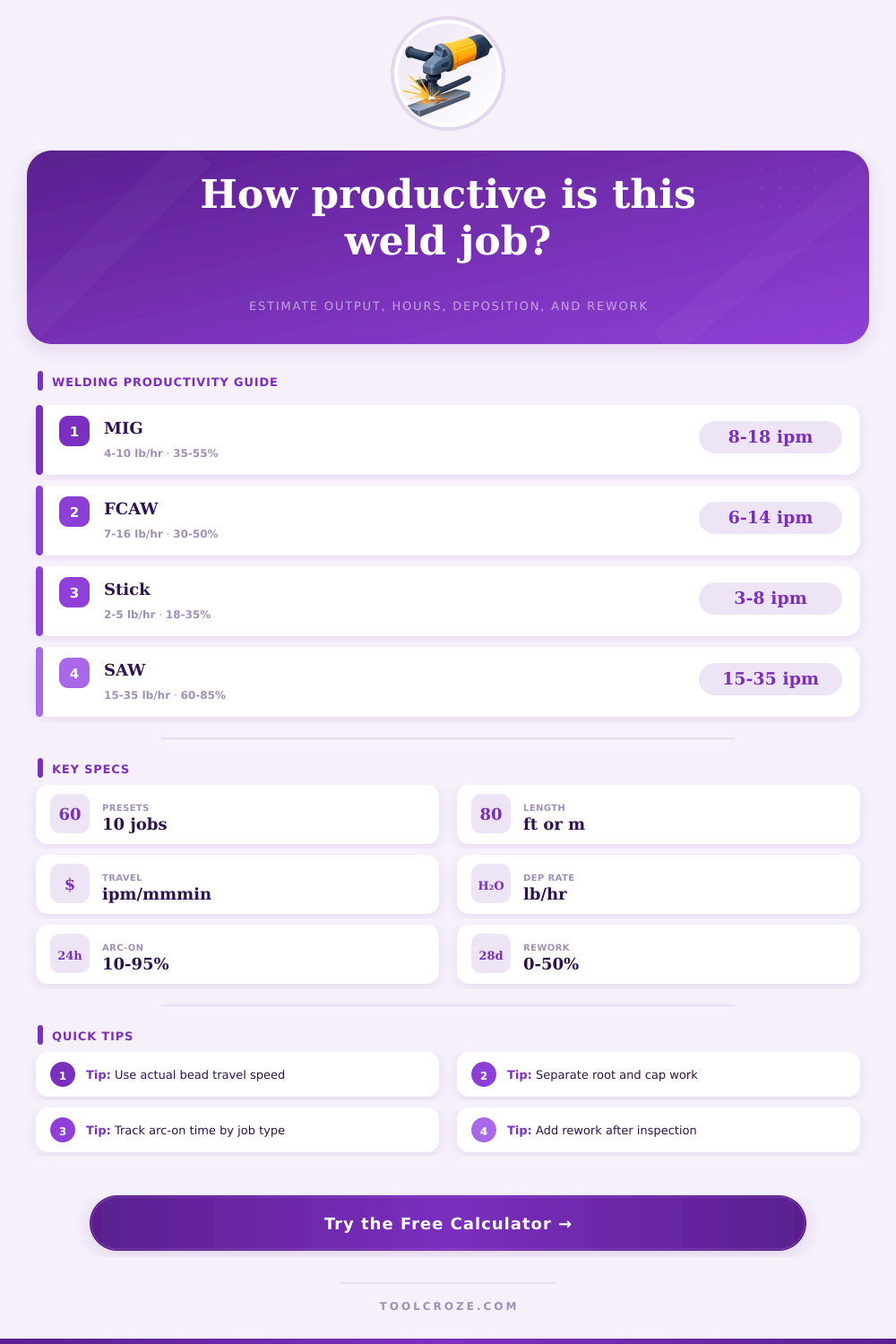
Estimate finished weld output from weld length, deposition rate, arc-on ratio, travel speed, pass count, operator efficiency, handling allowance, and inspection rework.
Calculation Breakdown
| Process | Typical deposition | Arc-on planning range | Productivity use |
|---|---|---|---|
| MIG / GMAW shop | 4 to 10 lb/hr | 35% to 55% | Good for repeated fixtures, frames, brackets, and moderate fillet runs. |
| Flux-core / FCAW | 7 to 16 lb/hr | 30% to 50% | Strong deposition for structural work, but slag and handling lower net output. |
| Stick / SMAW | 2 to 5 lb/hr | 18% to 35% | Useful for field repair, small batches, access-limited welds, and position work. |
| TIG / GTAW | 0.8 to 3 lb/hr | 15% to 35% | Best for precise welds where quality and access matter more than output rate. |
| Submerged arc / SAW | 15 to 35 lb/hr | 60% to 85% | High productivity on long seams, thick plate, and mechanized repeat work. |
| Work condition | Arc-on ratio | Operator efficiency | Planning note |
|---|---|---|---|
| Robotic or mechanized cell | 65% to 90% | 85% to 98% | Keep loading, part presentation, and fixture changeover in the handling field. |
| Fixture-held bench welding | 40% to 60% | 75% to 90% | Use higher values only when parts are clean, staged, and repeatable. |
| Structural field welding | 20% to 40% | 60% to 82% | Access, weather, lifts, grinding, and inspection can dominate the schedule. |
| Pipe or multi-pass groove | 18% to 38% | 62% to 85% | Interpass cleaning, fit-up, preheat, and position changes reduce throughput. |
| Job pattern | Pass count | Rework allowance | Productivity note |
|---|---|---|---|
| Light sheet stitch seams | 1 pass | 4% to 10% | Cooling sequence can lower output even when travel speed looks high. |
| Medium frame fillets | 1 to 2 passes | 5% to 12% | Fixture repeatability usually matters more than peak deposition rate. |
| Pipe spool welds | 3 to 6 passes | 8% to 18% | Split root, hot pass, fill, and cap if each pass uses a different speed. |
| Heavy groove plate | 4 to 16 passes | 8% to 20% | Deposition rate often controls output after joint volume increases. |
| Overlay and hardfacing | 2 to 6 passes | 6% to 15% | Track overlap, bead width, and heat input before increasing speed. |
Welding productivity is a measurement of an amount of work that is completed by the welding operation within a specified amount of time. Welding productivity is important in that welding productivity impacts the total cost of a project and the schedule of that project. The welding shop can track welding productivity by measuring the amount of time that is spent welding versus the amount of time spent on non-welding tasks.
Many welding shops struggles with determining their welding productivity because they do not account for the time required to perform tasks like cleaning the weld areas before welding. One of the tools that can be used to calculate the total time that is required for a welding job is a welding productivity calculator. Welding productivity calculator requires several different inputs to provide an accurate calculation of the time that will be required to complete the welding job.
How to Use a Welding Productivity Calculator
For instance, the welder must enter the length of the weld that is to be performed into the calculator, as must the deposition rate of the welding process, the arc-on ratio, the travel speed for the weld, the number of passes that are to be made along the weld, the efficiency of the weld operator, any allowances for moving the workpieces to be welded, and an estimate of the amount of time that may be required to correct any mistake during the welding process. The welding productivity calculator will utilize each of these inputs to determine the total amount of time that will be required for the welding operation to complete its tasks. One of the variables that can be entered into the welding productivity calculator is the travel speed of the welders torch along the weld.
The travel speed can change based off the position of the welder. For instance, welders may have high travel speeds while welding on flat surfaces, but have lower travel speeds if the welding is to be performed in an overhead position. The welder will have less access to the weld in an overhead position, thus the welder will move at a slow speed.
Another of the variables that can be entered into the welding productivity calculator is the deposition rate. The deposition rate is the amount of metal that is deposited into the weld during a specific time period. The deposition rate can change based upon the welding process that is used to perform the weld and the type of joint that is to be welded.
For instance, submerged arc welding processes tend to have high deposition rates, but flux-cored welding processes may have lower deposition rates due to the requirement for more interpass cleaning in flux-cored welding processes. Thus, the welding productivity calculator can utilize different deposition rates to determine how deposition rates may impact the total time required for the welding job. Arc-on ratio is another of the critical variables that can be entered into the welding productivity calculator.
The arc-on ratio is the percentage of the welding operator’s shift that the welding arc is active. Many welding shops will make the assumption that the arc-on ratio is high. However, if the parts to be welded are not properly set up prior to welding, high arc-on ratios are difficult to maintain.
If a welder spends much of their time cleaning weld areas, the arc-on ratio will decrease. Thus, a low arc-on ratio will lead to increased station times for the welder, indicating that the welding job will take longer to complete with those parameters. Two of the remaining variables for the welding productivity calculator are the efficiency of the weld operator and the allowances for handling the workpieces.
The welder can determine the efficiency of the welder by measuring the amount of work that the welder performs during a shift. Allowances for handling the workpieces includes the amount of time that is required to move the workpieces after they have been welded. A welder can have high travel speeds for the welds that they are required to perform, but if the handling allowance for the workpieces is high, the welder may have low overall productivity rates.
These two variables are entered into the welding productivity calculator as percentages, allowing the welder to determine which parameter has the greatest impact on the productivity of the welding shop. Another of the variables that the welding productivity calculator gathers is the amount of time that is required to correct any mistakes in the weld. Welding may have to be performed to fix mistakes in the weld; thus, the allowance for rework is required to be entered into the welding productivity calculator.
This value is required to be entered because it will increase the total amount of time that the welding job takes to be completed. For short welding jobs, allowances for rework may be low. However, for long and complex welding jobs, allowances for rework will be high.
Thus, the welding productivity calculator accounts for this variable in its total calculation. Another of the variables that will impact the calculations of the welding productivity calculator is the welding process that is used for the welding job. For instance, stick welding processes have low deposition rates for the welds, as welders must change electrodes very often.
Therefore, stick welding processes are typically used for repairing welds. Mig and flux-cored welding processes have higher deposition rates than stick welding processes; however, flux-cored welding processes require the welder to remove slag from the weld and change welding wire. Submerged arc welding and robotic welding processes have very high arc-on ratios, meaning that welders do not have to take breaks to turn the welding on and off.
Submerged arc welding and robotic welding processes are used in high-volume production settings. Another of the steps that an individual can perform to ensure that the values that are entered into the welding productivity calculator are accurate is the use of reference tables. Reference tables exist for welding processes that list the typical arc-on ratios and deposition rates for those welding processes.
If values for arc-on ratio are too high or too low when entered into the welding productivity calculator, the calculations will not be accurate. Thus, reference tables help to ensure that the values are realistic, and that the welding productivity calculator will provide an accurate estimate of the time that will be required to complete the welding job. Another of the methods for improving welding productivity is to alter the variables within the welding productivity calculator.
The welding productivity calculator can be performed with the current variables for the welding shop. The calculation can then be performed again with only one of the variables altered. For instance, the arc-on ratio can be altered to determine how fast the weld will take if the weld parts were better fitted together.
Another of the variables that can be altered is the handling allowance; if the workflow for the welding shop was better organized, welds would be performed in less time. By running these two calculations with the welding productivity calculator, a shop can decide whether improvements should of be made to the welding process or the workflow in the shop.