Welding Strength Calculator
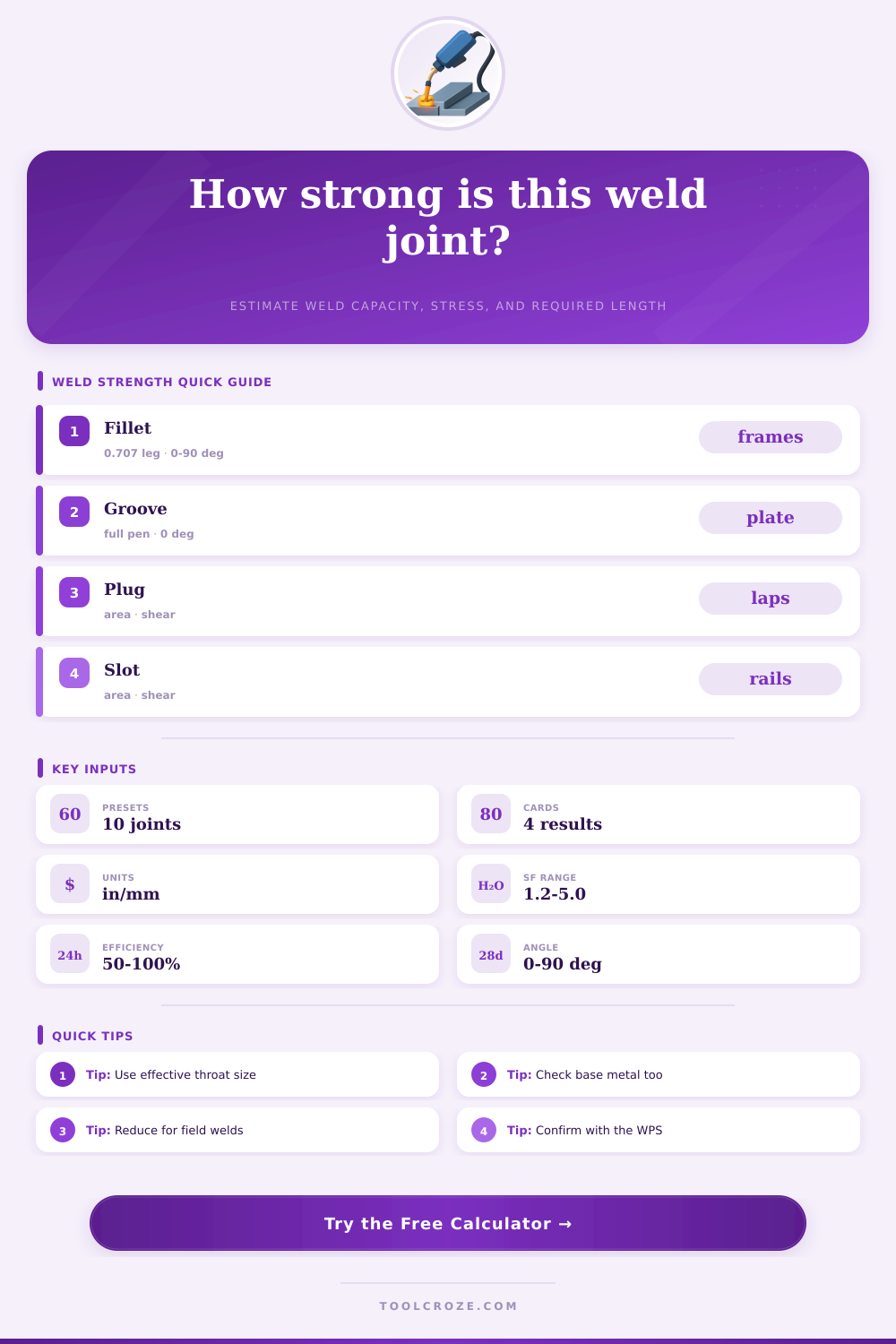
Estimate weld joint capacity from weld type, effective throat, weld length, electrode strength, load angle, safety factor, and joint efficiency.
| Weld type | Area model | Typical input | Use note |
|---|---|---|---|
| Fillet weld | throat x length | 0.707 x leg | Most brackets, frames, and tabs |
| Double fillet | 2 x throat x length | two weld lines | Tee joints, lugs, and lap plates |
| Full penetration groove | thickness x length | plate thickness | Butt joints with qualified procedure |
| Partial groove | effective throat x length | qualified depth | Use inspected effective throat |
| Plug or slot weld | effective area | diameter or slot width | Lap sheet or plate shear transfer |
| Flare bevel weld | effective throat x length | code throat | Round bars, tubes, and curved members |
| Electrode class | Tensile strength | 0.30 x FEXX | Common use |
|---|---|---|---|
| E60 series | 60 ksi | 18 ksi | Light mild steel fabrication |
| E70 series | 70 ksi | 21 ksi | General structural steel welding |
| E80 series | 80 ksi | 24 ksi | Higher strength steel weldments |
| E90 series | 90 ksi | 27 ksi | Qualified high strength joints |
| ER308L | about 75 ksi | 22.5 ksi | Common austenitic stainless joints |
| ER5356 aluminum | about 38 ksi | 11.4 ksi | Aluminum weld strength estimates |
| Condition | Efficiency range | Why it changes | Calculator setting |
|---|---|---|---|
| Shop weld, good access | 90-100% | Controlled position and fit-up | Use 95% when inspected |
| Field weld | 75-90% | Access, wind, position, cleanup | Start near 85% |
| Thin wall tube | 65-85% | Burn-through and base metal limits | Check base metal separately |
| Fatigue or cyclic load | 50-75% | Detail category and stress range | Use low efficiency |
| Plug or slot welds | 70-90% | Fill quality and hole preparation | Verify effective area |
| Unknown procedure | 50-70% | No verified WPS or inspection basis | Use conservative values |
| Check | Typical value | Calculator effect | Practical note |
|---|---|---|---|
| Longitudinal load | 0 degrees | 1.00 angle factor | Shear along weld axis |
| Mixed load | 30-60 degrees | moderate factor | Common bracket resultant load |
| Transverse load | 90 degrees | higher angle factor | Fillet welds often test stronger |
| Eccentric load | moment present | not included | Analyze weld group separately |
| Base metal shear | plate dependent | not included | Check tear-out and net section |
| Fatigue | stress range | use lower efficiency | Apply code detail category |
When you are designing a weld that will be used structural, one of the first thing to consider is the weight that the weld will have to hold. The machineries that will be using that weld will transfer the weight to that weld, so it is critical that the weld can handle that weight. While many people feels that a weld will be strong if it is a large weld, the strength of the weld is based upon its geometry and metallurgy, not how it may visually appear.
A weld must be designed to be sufficiently strong to provide enough safety for the machinery and processes that will use that weld, but adding to much heat to the weld will cause the weld to warp. In determining the strength of a fillet weld, it is important to understand the difference between the leg length of the weld and the throat thickness of the weld. The leg length is the visible thickness of the weld, but the throat thickness is the distance from the root of the weld to the face of the weld.
How to design a safe and strong weld
It is critical to use the thickness of the throat in the calculations of the strength of that weld. If the length of the leg are used in place of the thickness of the throat, the calculated strength of the weld will be 30% more high. Therefore, calculating the throat thickness of the weld will ensure that the calculations of the welds strength are accurate.
The type of welding electrode that is used will impact the chemical properties of the weld. For structural welds, E70 series welding rods is often used. While it may seem like using an electrode that is rated for more strength will result in a stronger weld, that is not always true.
If the strength of the weld is significantly strong than the metal that is being welded, the metal may crack at the weld. The weakest part of a welded joint is the heat affected zone, which is the part of the metal that has been heated during the welding process. The direction of the loads that will be placed on that weld will also impact its strength.
It is important to consider the angle of the load that will be placed on that weld. For instance, loads that are placed transverse to the joint will place different stress on the joint different than loads that are placed longitudinally along the structure. By accounting for the angle of the load, engineers can ensure that the weld is not overbuilt.
Avoiding overbuilding the weld will save time in the building of that structure, and will also prevent the base metal from distort. The environment in which the weld will be made will impact the efficiency of that weld. Welds made in controlled environments will typically be strong than welds made in field environments.
This is due to the fact that there are many variable in a field environment that can impact the weld, such as the presence of rain, snow, wind, or even the stability of the area where the weld is made. Welds made in the field will be more imperfect than welds made in a shop. For these reasons, the efficiency of welds made in the field will be lower than welds made in the shop.
Thus, using a lower percentage of efficiency will account for the potential imperfection in the weld made in the field. When engineering design for welds, the use of a safety factor should of been incorporated into the calculations. A weld that is calculated to only handle the weight that is to be placed upon it is not a safe design.
In these cases, a safety factor of two or three should be used. Additionally, the utilization percentage for that weld should be monitor. If the percentage is too high, that indicates the weld is near it’s point of break.
A welding calculator is helpful in determining the dimensions of a weld. However, a calculator will never replace a professional welding procedure specification. A welding calculator cannot account for slag inclusion or welds that will be exposed to vibration over long periods of time.
However, using the calculator will ensure that the dimensions are within the correct range for that structure to be approved by the engineers. These mathematical relationship will help an engineer or welder to transform guesswork into a proven structural design.