Soap Mold Size Calculator
Estimate soap mold volume, oil weight, lye and water planning amounts, fill height, bar count, cavity size, cut dimensions, and cure shrink allowance.
Batch Breakdown
| Mold type | Typical fill height | Best input | Bar planning | Allowance cue |
|---|---|---|---|---|
| Loaf mold | 2.5 to 3 in | Inside L x W x fill height | Cut thickness sets bar count | Leave headroom for top texture |
| Slab mold | 1 to 1.5 in | Inside L x W x fill height | Rows x columns sets bars | Plan divider and edge trim loss |
| Cavity tray | Per cavity | Measured cavity volume | One bar per cavity | Round batter upward slightly |
| Column mold | Depth of column | Diameter x fill height | Slice count sets puck height | Cure shrink changes puck thickness |
| Irregular mold | Measured fill | Water volume to fill line | Use intended finished portions | Measure actual displacement |
| Recipe style | Oil factor | Typical water ratio | Cure shrink | Planning note |
|---|---|---|---|---|
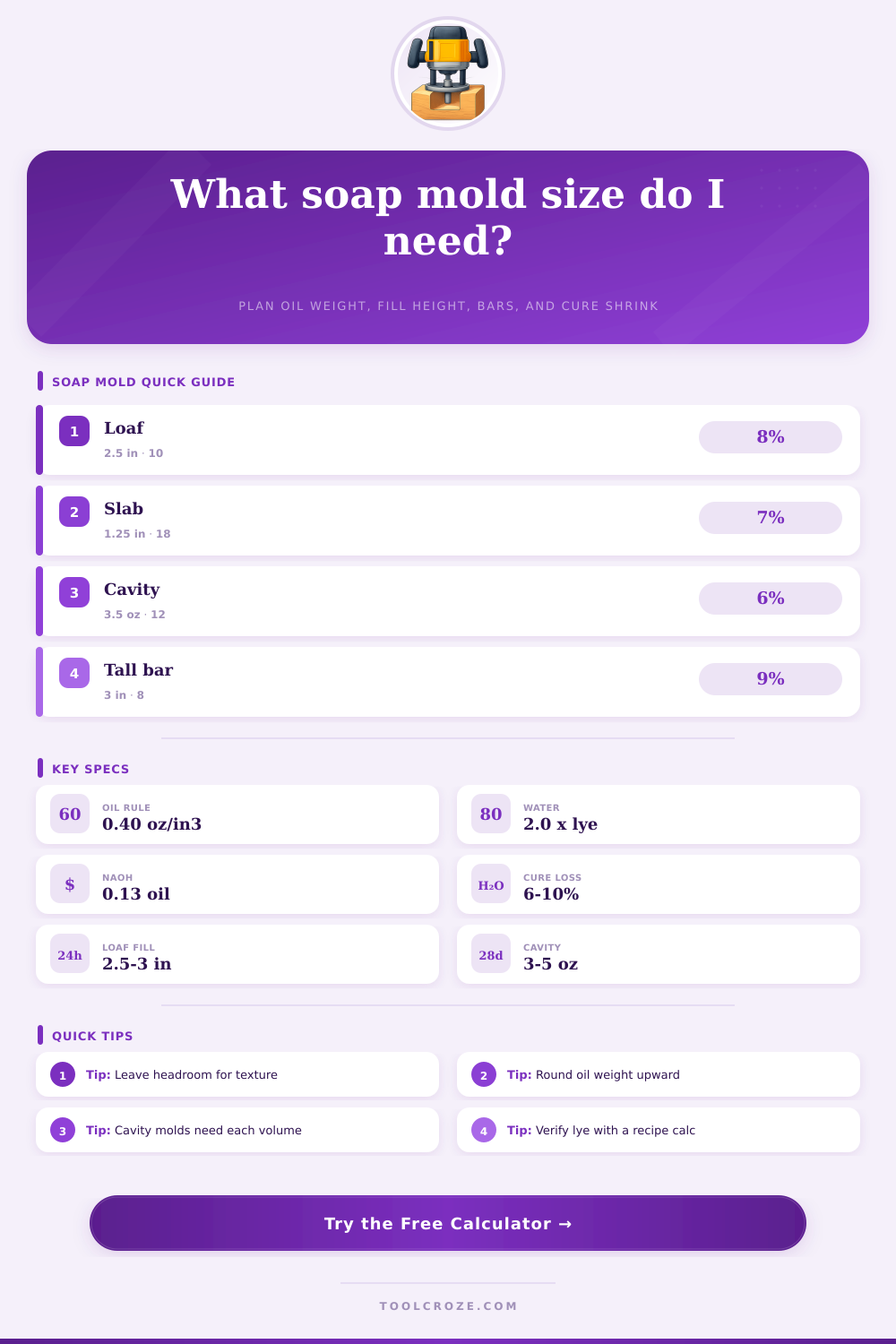
| Balanced cold process | 0.400 oz/in³ | 2.0 x lye | 7 to 9% | Good default for loaf molds |
| High olive | 0.390 oz/in³ | 2.2 x lye | 9 to 12% | Long cure and more water loss |
| Hard bar blend | 0.410 oz/in³ | 1.9 x lye | 6 to 8% | Often unmolds firm |
| Milk soap | 0.395 oz/in³ | 1.8 x lye | 6 to 9% | Keep temperatures conservative |
| Salt bar | 0.430 oz/in³ | 1.7 x lye | 4 to 7% | Cavity molds simplify cutting |
| Hot process | 0.405 oz/in³ | 2.4 x lye | 8 to 11% | Allow room for thicker batter |
| Project | Typical mold size | Finished bar target | Likely oil weight | Cut or cavity cue |
|---|---|---|---|---|
| Standard loaf | 10 x 3.5 x 2.75 in | 4 to 4.5 oz | 38 to 40 oz | Cut about 1 in thick |
| Tall skinny loaf | 8 x 2.5 x 3.25 in | 4 oz | 25 to 27 oz | Taller face, thinner width |
| Slab mold | 12 x 9 x 1.25 in | 3.5 to 4 oz | 53 to 55 oz | 3 x 6 grid is common |
| Oval cavity tray | 4 fl oz each | 3.3 to 3.8 oz | 19 oz per 12 cavities | Fill each cavity evenly |
| Round puck mold | 3 in dia x 8 in | 3 to 4 oz | 23 oz | Slice after firm unmold |
Soap making require precise measurement of the ingredients to be added. The reason for this is that the volume of the batter change during the soap making process. If the problems with a mold prevent the mold from correctly filling with the batter, it is possible for the bar of soap to either be too thin (if the batter levels in the mold are too low) or for the batter to overflow the mold (if the level of the batter in the mold is too high).
Because of the way in which the chemicals interacts within soap, the volume of the batter will change. For these reasons, it is impossible to determine the amount of soap batter that will be needed based off the size of the mold visually. Another reason that it is impossible to visually estimate the amount of soap batter that will be needed for the molds is that molds comes in various shapes and sizes.
How to Measure Soap for Molds
For example, molds include both loaf molds and molds that contain individual cavity for individual bars of soap. In such cases, it is necessary to use the oil weight rule to calculate the proper amount of soap batter for the mold. Because oils are the main ingredient of most soap recipes, calculating the number of cubic inches of the mold and multiplying it by the density of the soap will indicate the amount of oil that will be required in the recipe.
Using this rule allows individuals to calculate how many oil they should purchase and how much oil to melt when preparing to make soap. Another factor to consider when preparing to create soap in molds is the fact that soap will shrink during the curing process. As water evaporate from the bars of soap, the soap physically contract in size.
For these reasons, bars of soap will be larger when they are first cut from the mold than if they are cut after thirty days of curing. If the shrinkage of the soap during the curing process is not accounted for in the creation of the soap recipes, the bars will be more smaller than the requirements of the packaging for the soap bars. Recipes that contain high amount of olive oil or water will shrink more during the curing process.
Furthermore, headroom should be provided in the mold when you pour the soap into the mold. Headroom is the space within the mold that remains empty and that allows for room for decorative elements to be added to the bar of soap. If headroom is not provided, the decorative elements may either flatten or cause the soap to overflow out of the mold.
By providing headroom for the soap bars, the soap will not overflow within the mold. The chemistry of the soap also alter the amount of soap batter that will be required to fill the molds with which the soap will be poured. For instance, salt bars contains more coconut oil and salt than other types of bar soaps.
Additionally, salt bar soap is more compact than other types of soap. For these reasons, salt soap will have a different oil factor than other types of soap that are to be poured into molds of the same size. Similarly, milk bar soap will behave different because the milk requires the soap to be thicker.
In these cases, reference tables will help to inform individuals of the proper amount of soap to pour into molds of different type. In addition to the factors described above, individual equipment also play a role in the amount of soap batter that should be poured into molds. For instance, if the mixing equipment has a limited capacity to hold the soap, it is possible for the batter to overflow the equipment.
If this occurs, the soap will be difficult to clean. In these cases, it is best to determine in advance if the mixing equipment is large enough for the recipe. Finally, it is necessary to recognize that the fresh weight of the soap will not equal the cured weight of the soap.
Furthermore, the fresh weight will always be higher than the cured weight. For instance, if an individual desire bar soap products that weigh four ounce when they are finished curing, it is necessary for the fresh bar of soap to contain a weight higher than four ounces. If the fresh weight and cured weight of the soap are tracked, it is easy to ensure that the bars of soap will weigh the amount that is described on the labels.
Through calculating each of these factor, individuals will know how much lye solution to prepare, and how many bar will come from the mold.