Wax to Silver Casting Calculator
Convert carved, injected, or printed wax weight into a silver casting charge with alloy density, sprue button allowance, linear shrinkage, and casting loss separated in the breakdown.
Load a common bench casting scenario, then adjust the wax weight, alloy, sprue system, shrinkage, and cleanup loss for the actual job.
Silver Casting Charge
Breakdown
| Material | Typical density | Wax multiplier | Bench use |
|---|---|---|---|
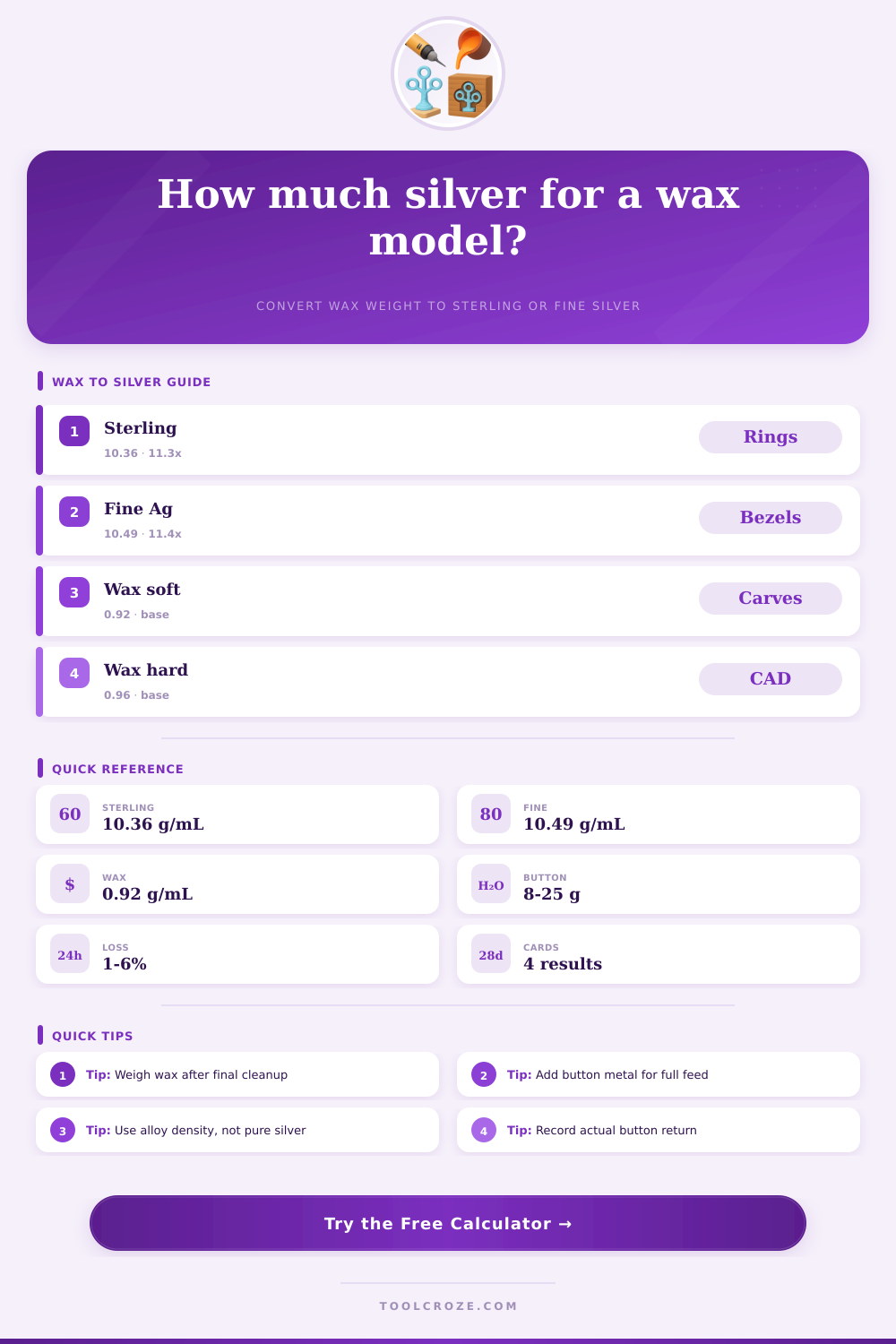
| Sterling silver 925 | 10.36 g/mL | 11.26x at 0.92 wax | General rings, pendants, charms, and findings |
| Fine silver 999 | 10.49 g/mL | 11.40x at 0.92 wax | Bezels, metal clay compatible work, and soft high-purity pieces |
| Argentium 935 | 10.30 g/mL | 11.20x at 0.92 wax | Tarnish-resistant jewelry with sterling-like mass |
| Carving wax | 0.96 g/mL | 10.79x for sterling | Hard carved patterns and thicker signet models |
| Injection wax | 0.92 g/mL | 11.26x for sterling | Rubber mold injections and common production trees |
| Castable resin wax print | 1.05 g/mL | 9.87x for sterling | Printed resin patterns measured like wax by mass and density |
| Jewelry casting | Button range | Gate allowance | Cleanup loss |
|---|---|---|---|
| Single light ring or pendant | 8-15 g | 8-15% | 2-4% |
| Wide ring, signet, or heavy pendant | 15-30 g | 10-18% | 3-6% |
| Charm tree with many small pieces | 18-35 g | 15-28% | 4-8% |
| Open bangle or long thin form | 25-45 g | 18-35% | 4-8% |
| Fine filigree or delicate earring pair | 10-22 g | 18-30% | 4-7% |
| Small solid art object | 35-80 g | 20-40% | 5-10% |
| Preset | Wax weight | Alloy | Starting allowance |
|---|---|---|---|
| Thin Stacking Ring | 0.55 g | Sterling | 10 g button, 10% gates |
| Heavy Signet Ring | 3.80 g | Sterling | 24 g button, 15% gates |
| Fine Silver Pendant Bezel | 1.10 g | Fine silver | 12 g button, 12% gates |
| Six Charm Casting Tree | 0.42 g each | Sterling | 20 g button, 22% gates |
| Open Bangle Section | 5.20 g | Argentium | 36 g button, 28% gates |
| Printed Wax Sample Batch | 0.80 g each | Sterling | 18 g button, 20% gates |
When you are preparing to pour the molten silver into the flask, you must calculate the correct amounts of metal that you will need to fill the mold. The amount of metal that you use will determine the success of the casting. If you use too little metal, the mold will not be complete filled with metal, and the metal will contain porosity in the completed silver piece.
Using too much silver will waste both you’re time and your heat source in the metal casting process. To determine the proper amount of silver to use, you must understand the relationship between the volume of the wax model and the density of the silver alloy. Silver have a different density compared to wax.
How Much Silver You Need for Casting
Because of this difference in density, you cannot use the weight of the wax model to determine the weight of the silver that will be poured into the mold. A gram of wax will take up more space then a gram of silver. Therefore, the silver will be heavier than the wax model that you use to create the mold.
To find the weight of silver that you will need for your mold, you must calculate the volume of the wax model and then multiply that by the density of the silver alloy. Because silver is denser than wax, the silver piece will weigh more then the wax model. You must account for this difference in density when you are determining the amount of metal that will be used in the mold to ensure that you dont undercharge the mold with silver.
The types of wax that is used will change the density of the model. The wax will change the final weight of the silver that is created from the model. Hard carving wax has a different density than soft injection wax.
Additionally, 3D printed castable resin has a different density than traditional wax models. Using a heavy resin will change the weight of the silver that is created. Using too much resin and calculating the silver weight according to standard wax will lead to not having enough silver to fully charge the mold.
Therefore, you must account for the specific type of wax or resin in order to calculate the weight of the silver correctly. Another factor to consider in the calculation of the amount of silver that will be poured into the mold is the inclusion of a reservoir of molten metal call a button. The button is a reservoir of metal that remains at the bottom of the casting tree.
This button will keep the silver hot during the casting process. Furthermore, the button will push the silver through the sprue into the intricate details of the silver design. If the button contain too little silver, the silver may solidify before the mold is completely filled.
A specific weight of silver will be required for the button, as well as a percentage of silver for the runners and gates that will assist the silver in fully filling the mold. Another factor that you must account for in the calculation of the amount of metal for the molds is the shrinkage of silver as it cools. When silver is poured into the mold, it is in a liquid form.
Once it solidifies into a metal form, it will shrink in weight. Therefore, when you calculate how much silver to use, you must plan for the shrinkage in size of the silver once it solidify. Casting loss is another factor to consider in the calculation of the amount of silver.
Silver loss can happen during the melting of the silver and the removal of the silver from the molds. Silver will oxidize during the melting process. Furthermore, to remove the silver from the molds, you will need to use tools like flush cutters and files to remove the sprues and excess metal that was used to fill the molds.
This loss of metal during the melting and extraction process means that the final weight of the silver will be less then the silver that was melted. By keeping a log of the silver that is returned from the button and sprues, you can calculate the specific percentage of silver loss during the jewelry making process. By logging this percentage, you can adjust the amount of silver needed to account for this loss.
By doing so, you can accurately calculate your costs for silver and ensure that you have enough metal to cast each piece of jewelry.