Wax Casting Calculator
Convert a wax pattern or wax tree into estimated casting metal using wax density, alloy density, sprue and gate factor, burnout loss, shrink allowance, and pour reserve.
⚙Named Wax Casting Presets
Load a common lost-wax or investment casting setup. Each preset fills wax weight, alloy, tree factor, burnout loss, shrink, and pour reserve.
📏Wax Pattern Inputs
Wax Casting Results
Calculation Breakdown
🧪Active Material Snapshot
📊Metal Density Conversion Table
| Metal / alloy | Density g/cm³ | Wax ratio at 0.93 | Typical shrink | Common wax casting use |
|---|---|---|---|---|
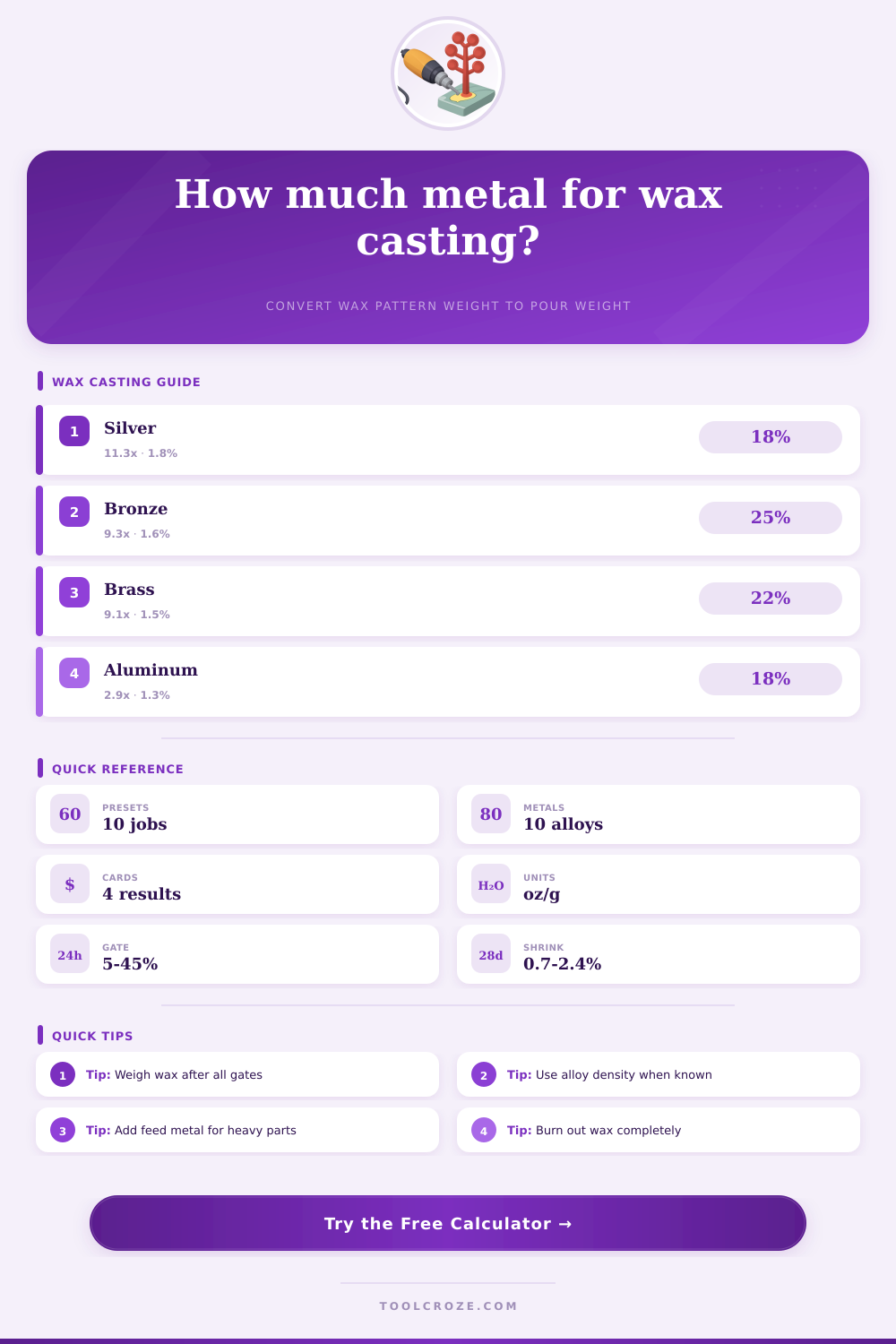
| Sterling silver | 10.36 | 11.14x | 1.8% | Jewelry, small sculpture |
| 14K yellow gold | 13.10 | 14.09x | 1.6% | Rings, settings, signets |
| Silicon bronze | 8.70 | 9.35x | 1.6% | Sculpture, hardware |
| Yellow brass | 8.47 | 9.11x | 1.5% | Knobs, plaques, fittings |
| A356 aluminum | 2.68 | 2.88x | 1.3% | Art panels, light parts |
| Cobalt chrome | 8.30 | 8.92x | 2.2% | Dental and fine framework |
⚖Sprue, Gate, and Burnout Guide
| Wax setup | Gate factor | Reserve | Burnout loss | Use when |
|---|---|---|---|---|
| Small jewelry tree | 12-22% | 5-10% | 0.5-2% | Fine waxes with short gates |
| Pendant or charm batch | 18-30% | 10-15% | 1-3% | Many repeated small patterns |
| Sculpture branch tree | 25-45% | 15-20% | 2-5% | Large gates and feed buttons |
| Dental framework | 8-18% | 5-10% | 0.5-1.5% | Controlled investment casting |
| Complete weighed tree | 0% | 5-15% | 1-3% | Sprues are already in wax weight |
📋Preset Reference Table
| Preset | Wax weight | Metal | Gate factor | Planning note |
|---|---|---|---|---|
| Sterling ring tree | 0.50 oz x 8 | Sterling silver | 22% | Normal jewelry tree |
| Bronze pendants | 18 g x 6 | Silicon bronze | 28% | Batch pendant flask |
| Brass knobs | 0.85 oz x 5 | Yellow brass | 25% | Hardware cluster |
| Gold signet | 1.20 g x 1 | 14K gold | 18% | Small reserve, dense metal |
| Bronze sculpture | 420 g x 1 | Silicon bronze | 38% | Heavy branch tree |
ℹWax Casting Tips
When you perform the lost wax casting process for metals like gold or silver, you must be able to calculate the correct amounts of metal that you will need to pour into the mold. If you dont pour in enough metal, the metal will not completely fill the mold with the wax. Pouring in too much metal will waste the metal and create excess metal that you will have to remove from the mold once the metal solidifies.
Therefore, there must be a way to calculate the amount of metal needed to completely fill the mold without waste the metal. Calculating the amount of metal needed to fill the mold is difficult due to the fact that wax and metal has different densities. Wax is a light material, while metals like gold and silver are very dense materials.
How to Calculate Metal Needed for Lost Wax Casting
Metal will weigh more then wax. To calculate the amount of metal needed, you will have to divide the density of the metal by the density of the wax. This will allow you to calculate the amount of metal that is needed based on the weight of the wax.
People often make mistake when calculating the amount of metal needed to fill the mold. One of the most common mistakes is only weighing the wax pattern. You must also account for the weight of the sprues and gates in the calculation.
These sprues and gates allows the metal to travel to the wax pattern. The weight of these components will be added to the calculation to determine the total amount of metal needed. Another issue with the casting process is metal shrinkage.
As the metal cools, it shrinks in size. The final metal product will be more smaller than the original wax pattern. The shrinkage of the metal must be accounted for when calculating the amount of metal needed to pour into the mold.
Without accounting for shrinkage, the final product will be too small to perform the intended function of the metal. Furthermore, another metal addition is the pour reserve, also known as the button. The pour reserve is added to the mold and allows the metal to remain in the mold during the pouring of the metal.
This allows the metal to feed the casting as it shrinks. Without including a pour reserve in the calculation, there will be porosity in the metal. This forms the hole in the metal.
A pour reserve of at least ten percents of the metal is needed in the mold. The density of the wax that you use must also be accounted for in the calculation. Not all wax has the same density.
The densities of injection wax, carving wax, and casting wax may not be the same. Using a generic ratio for metal to wax will not provide a proper metal amount. Using the specific density of the wax will allow the calculations to match the metal and wax that will be used in the mold.
Finally, there are other variable to control in the foundry to create the metal casting. You must control the wax, the investment, and the heat. By calculating the weight of the metal pattern, the sprues, the metal shrinkage, and the pour reserve, you can calculate the total amount of metal that must be poured into the mold.
Knowing the amount of metal needed before the pour will allow the metal caster to know how much metal to use.