
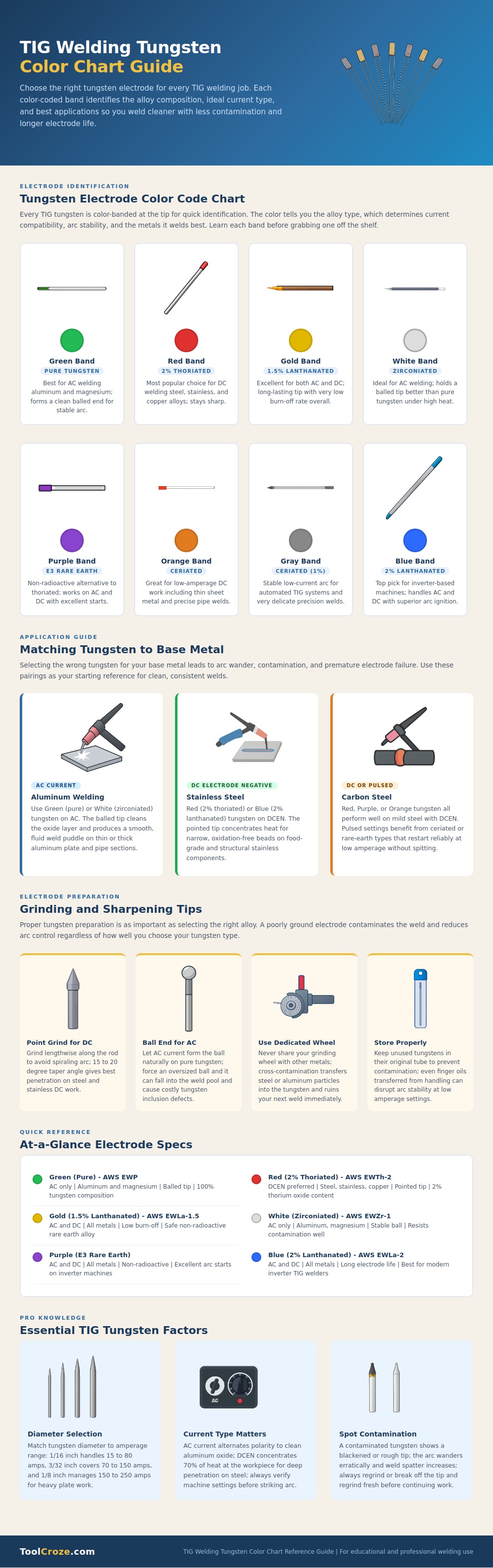
Since TIG welding require the use of a tungsten electrode, it is necessary for those desiring to perform succesful welding to understand the various types of tungsten electrode that can be utilized in the welding process. A tungsten electrode is an metal rod that conducts electricity to an area that is to be welded, and many tungsten electrodes have a color band present at the end of the electrode to indicate the composition of the alloy of the tungsten electrode. Each color band indicates to the welder how the tungsten electrode will react to heat and to various types of electrical currents.
If the welding machine is not of the type that is designed to function with the tungsten electrode, the welding process will not perform correct. For instance, attempting to utilize a tungsten electrode designed for use with DC current in an AC welding machine will result in the welding process fail altogether due to the lack of compatibility between the tungsten electrode and the welding machine’s electrical current. Each type of metal require different types of electrical current to be applied during the welding process, as well as different responses to heat from the welding process.
Types of Tungsten Electrodes and How to Prepare Them
Tungsten electrodes that are composed of pure tungsten often feature a green color band on the electrode. Pure tungsten electrode are used in the welding of aluminum metals, as aluminum metals require electrical current of the AC type to remove the oxide layer from the metal’s surface. Additionally, the tip of the tungsten forms a rounded ball when subjected to the AC current.
Thoriated tungsten electrodes feature a red color band. These types of electrode are used in welding metals like stainless steel and mild steel. The thoriated tungsten electrodes maintain a sharp point with the welding process, which focus the heat onto the metal piece that is being welded.
Additionally, lanthanated tungsten electrodes feature a blue or gold color band on the tungsten electrode. These types of electrodes is versatile in that they can conduct electrical currents of both the AC and DC type. Additionally, they are often used in welders that utilize inverter machines, as lanthanated tungsten electrodes are reliable, and tend to last more long than other types of tungsten electrodes.
The preparation of the tungsten electrode is also an important component of the welding process. When performing welding on metals of the DC type, such as steel, the welder must ground the tungsten electrode to a sharp point. The tungsten electrode should be ground in a lengthwise direction, rather than in a circular motion.
If the tungsten electrode is ground in a circular motion, spiraled groove will be formed along the metal rod, which will cause the welding arc to wander during welding. For metals like aluminum, which require alternating current to form a ball at the end of the tungsten electrode, no attempt should of be made to force a ball of large diameter onto the tungsten electrode. If forced, the tungsten electrode may break off into the weld pool.
Tungsten electrodes must be prepared to avoid any form of contamination. For instance, if a wheel that has previously sharpened carbon steel tungsten electrodes sharpens a tungsten electrode, impurities will be introduced into the tungsten electrode. These impurities will also enter the weld.
As a result, using the wrong sharpening tool will also ruin the weld. Using a diamond sharpening wheel for the tungsten electrode is recommended. Additionally, the tungsten electrodes should be stored within the storage tube until they are to be utilized.
The oil from the welders fingers may introduce contamination into the tungsten electrode if the welders direct manipulate the tungsten electrodes. The diameter of the tungsten electrode should be matched to the amperage of the welding machine. Thin tungsten electrodes are appropriate for welding thin metal sheets with low amperage settings, but will melt quick when applied to heavy metal metal plates.
A thicker tungsten electrode can handle the amount of electrical current necessary to weld heavy metal metal plates. Additionally, if the tungsten electrode melts into the weld pool, the electrode was too small for the amperage settings of the welding machine. Each of these component of the welding process are essential for ensuring that the welding process is effective and that the weld is of high quality and strength.
