
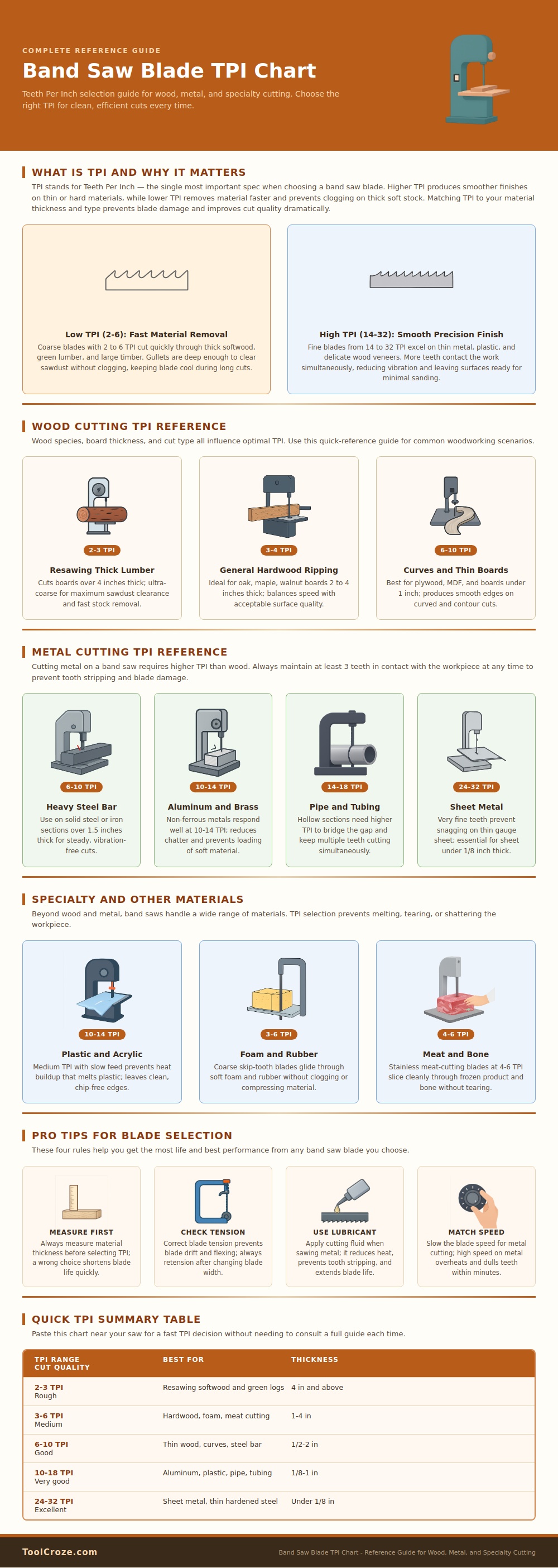
The performance of a band saw blade depend on the number of teeth on the blade. The number of teeth on a band saw blade are referred to as the TPI, which stands for the number of teeth on the blade per inch of the blade. The TPI of a band saw blade determine the number of cutting edge of the blade that contact the material being cut.
You must ensure that the band saw blade that you use have the appropriate TPI for the material that you are cutting. Using a band saw blade with the wrong TPI can cause problem when cutting the material. Using a band saw blade with too few teeth for thin material will cause the blade to snag and jump on the material.
Pick the Right Number of Teeth (TPI) for Your Band Saw
This can damage the workpiece or cause danger for the saw operator. Using a band saw blade with too many teeth for thick material will cause the sawdust to become trapped on the blade. This trapped sawdust will make the blade overheat and drift from its cutting path.
When selecting the appropriate band saw blade, you must consider the type of material that you are cutting. For cutting massive slabs of softwood or green lumber, you should use a band saw blade with a coarse TPI. A coarse TPI band saw blade have large gaps between its teeth and can remove large amount of waste material from the cutting process quick.
For cutting hardwoods, such as oak or maple, you should use a band saw blade with a medium TPI. A medium TPI blade allow for a good balance between the cutting speed of the blade and the quality of the sawn wood’s cutting surface. For making precise incision in materials like plywood or wooden curve, a band saw blade with a high TPI should be used.
A high TPI band saw blade will allow the blade to make a smoother cut in the wood and require less sanding of the cut edge after cutting the wood. When cutting metal, the metal is dense, and three or more teeth of the band saw blade should be in contact with the metal at any given time. Using a band saw blade with a coarse TPI on thin metal material will cause the teeth of the blade to grab the metal.
The grabbing of the metal will strip the teeth of the blade on the band saw machine. To prevent this, you should use a band saw blade with a fine TPI when cutting thin metal materials. For cutting metal materials such as heavy steel bar, you can use a relatively coarse TPI band saw blade.
For cutting materials such as plastics and acrylics, the band saw blade must be set to specific setting because these materials will melt if they become too hot during the cutting process. A band saw blade with a medium TPI should be used when cutting plastics, and the band saw should be slowly feed into the material. When cutting materials such as foam or rubber, the band saw blade can become clogged with the material.
To avoid this, use a skip-tooth band saw blade when cutting foam or rubber material. The way that you operate the band saw blade is also important to the cutting process. The operator should never operate metal-cutting band saw blade at full speed.
Operating a metal-cutting band saw blade at full speed will quickly dull the teeth of the blade. To avoid this, the operator should slow the speed of the band saw, and you can add lubricant to the blade to reduce the amount of heat produced during the cutting process. This will extend the life of the band saw blade.
Additionally, you should check the tension of the band saw blade each time you change the width of the band saw blade. If the blade is too loose for the width of the material, the blade will drift when cutting the material. By ensuring that the teeth of the band saw blade have the correct TPI for the thickness of the material that you are cutting, the project that you produce will have a more better appearance, and your blades will last longer.
