
When you are using pneumatic tool, it is possible that the pneumatic tool isnt providing the power that you are experiencing with the tool. One indication of the lack of power of the pneumatic tool is that it make a weak sound when it is operating. Furthemore, adjusting the regulator on the compressor to increase the pressure that is supplied to the pneumatic tool dont increase the performance of the pneumatic tool.
Each of these issue can occur due to the difference between air pressure and air volume. Air pressure is a measurement of the potential of the air to accomplish work, while air volume is a measurement of the actual amount of work that is being provided to the pneumatic tool. Air volume is measured in cubic feet per minute, and is a necessary component for the proper functioning of most pneumatic tool.
Choose the Right Air Hose for Your Air Tools
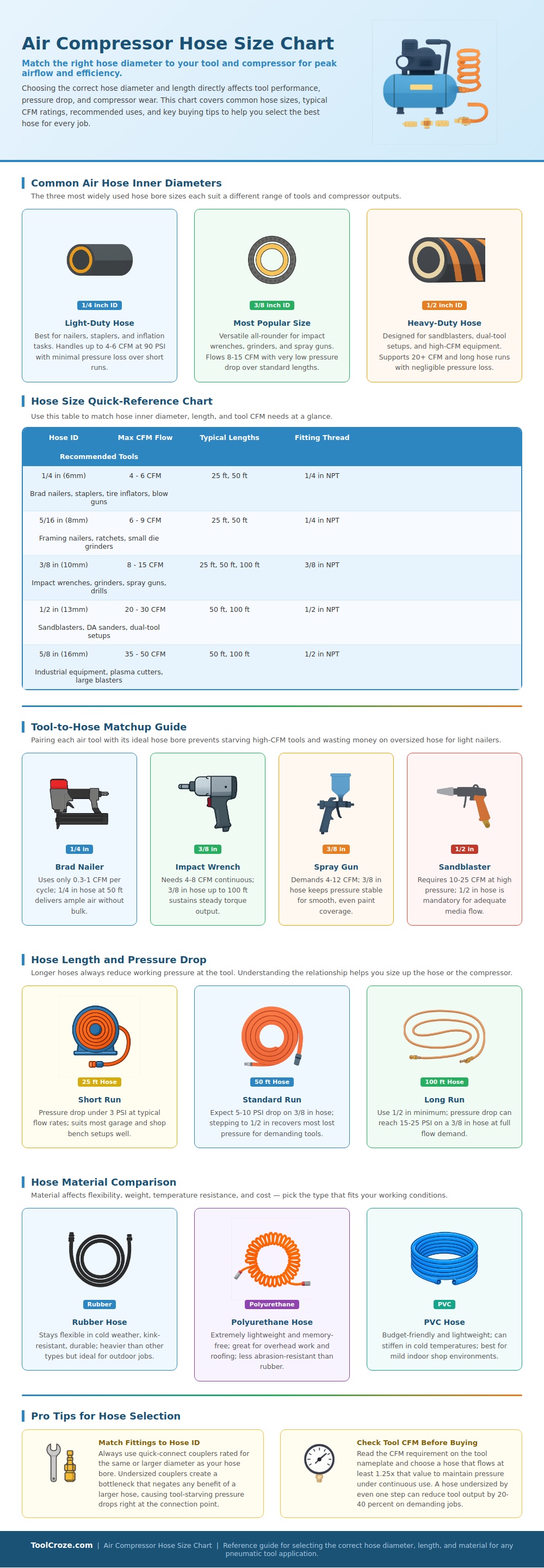
Air volume may be unable to reach the pneumatic tool that is connected to the compressor if the hose that connects the pneumatic tool to the compressor is too narrow in diameter. Such a narrow hose will prevent the air volume from reaching the pneumatic tool, effectively starving the tool of the air volume that it need to perform at its expected speeds and with its necessary torque. The diameter of the hose that is used to supply air to the pneumatic tool will determine the amount of air volume that can reach the pneumatic tool.
For pneumatic tools that are to be used for relatively light-duty tasks, such as brad nailers or tire inflator, the use of a hose that has a narrow diameter is appropriate for those tools. The narrow diameter hoses tend to be lightweight and easy to coil, which are desirable characteristic for pneumatic tools used for relatively light-duty tasks. Furthermore, light-duty pneumatic tools require small amount of air volume to perform their tasks, so a narrow diameter hose will provide the air volume requirements for those pneumatic tools.
For pneumatic tools that is of medium-duty tasks, however, such as impact wrenches and spray gun, a larger air volume is required to supply the demands of those tools. Medium-demand pneumatic tools require hoses of medium bore size to ensure that they dont stall while performing their tasks. Medium-duty tasks will slow down if supplied with a narrow hose and air volume.
For heavy-duty pneumatic tools, such as sandblasters, the air hose that is connected to the compressor needs to have a wide diameter hose. The reason for the requirement of such a wide diameter hose for these tools is because the heavy-duty pneumatic tools require a large volume of air to be moved from the air compressor to the pneumatic tool’s nozzle. Using a wide diameter hose prevents any loss of air volume as it move from the compressor to the pneumatic tool.
Furthermore, another factor that can impact both air pressure and air volume is the length of the hose. Every foot of hose creates friction, which results in a drop in air pressure. Therefore, if you use a very long hose, the air pressure will drop before it can reach the pneumatic tool.
In this case, a longer hose would of required a wider diameter hose to compensate for the loss of air pressure that results from friction in the hose. The material of the hose is another component that must be considered when purchasing the air hose for pneumatic tools. For example, rubber hoses maintain there flexibility even in low temperature.
The downside to rubber hoses, however, is that they can be heavy to move. Polyurethane hoses are often used for pneumatic tools due to the fact that polyurethane hoses do not retain a coiled shape, making them useful for tasks that require the pneumatic tools movement overhead. PVC hoses are an inexpensive material for hoses, but they can become stiff in cold temperature.
Another factor to consider is the size of the fittings. If the size of the fitting is smaller than the pneumatic tool’s hose, it can create a bottleneck in the system. The size of the fitting needs to either match the size of the pneumatic tool’s hose or be a larger size to allow for the same air volume to travel through it to the pneumatic tool.
By ensuring that the air hose meets the air volume requirements for the pneumatic tool, the pneumatic tool will perform at its peak level.
