Resin to Glass Ratio Calculator
Estimate fiberglass dry reinforcement weight, target resin by weight, wet-out allowance, mixed resin volume, fiber fraction, and practical batch count for laminating work.
⚙ Named Layup Presets
📏 Laminate Inputs
Laminate Resin Estimate
🧱 Material and Method Grid
📊 Reference Tables
| Laminate Method | Typical Resin:Glass | Glass Weight Share | Best Planning Use |
|---|---|---|---|
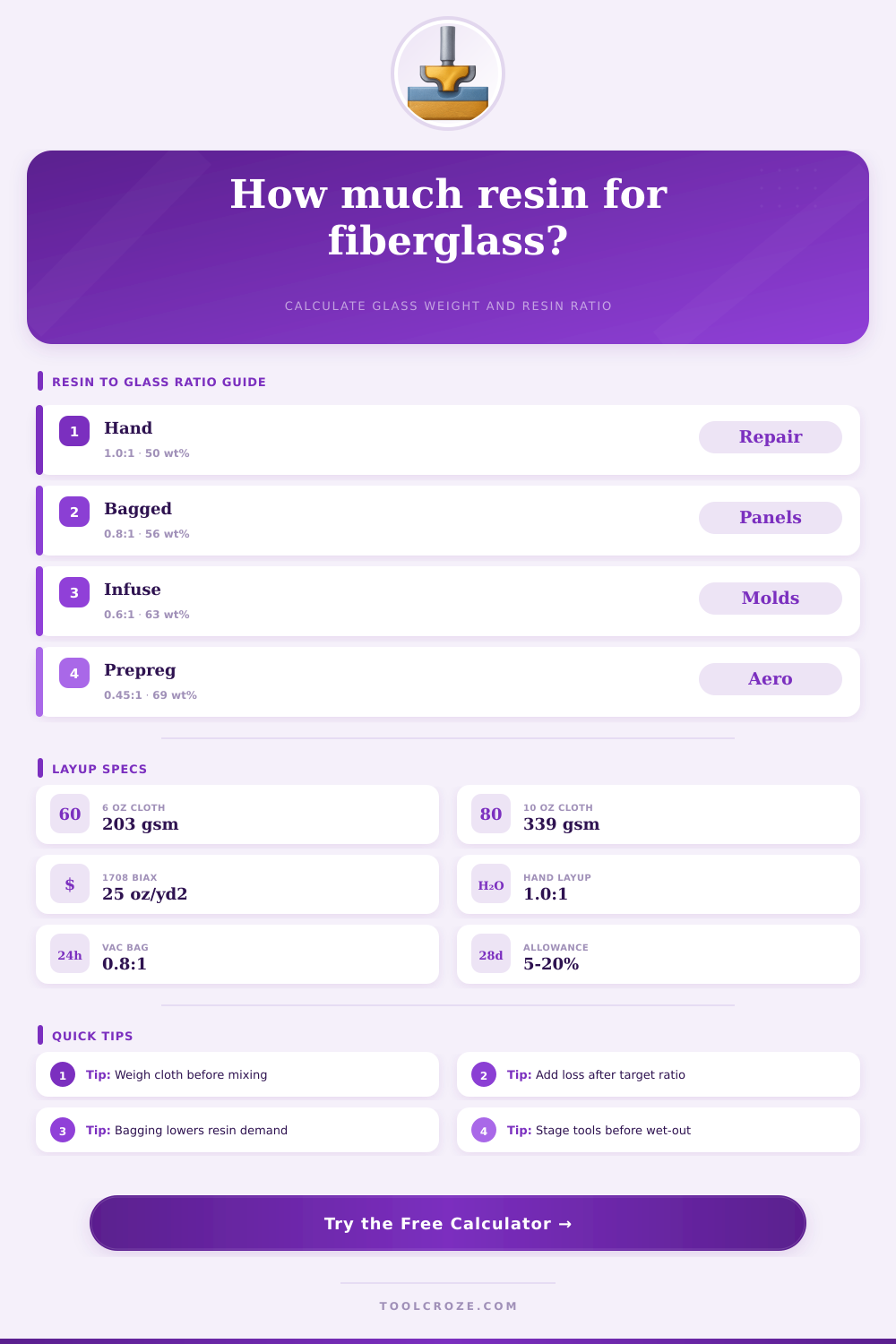
| Hand layup | 0.95 to 1.20 | 45% to 51% | Repairs, sheathing, small molds |
| Squeegee controlled | 0.80 to 1.00 | 50% to 56% | Flat cloth, careful workshop wet-out |
| Vacuum bagged wet layup | 0.65 to 0.85 | 54% to 61% | Light panels and skins |
| Resin infusion | 0.50 to 0.70 | 59% to 67% | Closed-bag panels and molds |
| Prepreg style target | 0.40 to 0.55 | 65% to 71% | Controlled fiber-rich laminates |
| Fiberglass Fabric | Imperial Weight | Metric Weight | Common Use |
|---|---|---|---|
| Finish cloth | 4 oz/yd² | 136 gsm | Fairing, surfboard finish, light patches |
| Plain weave cloth | 6 oz/yd² | 203 gsm | Canoe sheathing, deck skins, small repairs |
| Medium cloth | 10 oz/yd² | 339 gsm | Boat floors, dinghy parts, durable skins |
| Biaxial fabric | 12 oz/yd² | 407 gsm | Directional panel strength and repairs |
| 1708 biaxial mat | 25 oz/yd² | 848 gsm | Hull tabbing, structural reinforcement |
| Project Type | Starting Ratio | Allowance | Batch Note |
|---|---|---|---|
| Small woven cloth patch | 1.05:1 | 10% | One small cup usually works |
| Large flat panel | 0.85:1 | 5% to 10% | Pre-cut all plies before mixing |
| Heavy biaxial tabbing | 1.15:1 | 15% | Mix in staged batches |
| Chopped strand mat | 1.30:1 | 20% | Mat needs full binder wet-out |
| Infused hatch or mold | 0.60:1 | 5% to 12% | Include feed line and catch pot resin |
| Area Check | Fabric Weight | One Ply Dry Glass | At 1.0:1 Resin |
|---|---|---|---|
| 10 sq ft | 6 oz/yd² | 6.7 oz / 189 g | 189 g resin |
| 20 sq ft | 10 oz/yd² | 22.2 oz / 630 g | 630 g resin |
| 1 m² | 450 gsm | 450 g | 450 g resin |
| 1 m² | 600 gsm | 600 g | 600 g resin |
💡 Ratio Tips
Fiberglass are a composite material and is composed of glass fiber and resin. The glass fibers will provide tension and strength to the composite material, while the resin will act as a binder for the fibers to hold them in place within the material. The resin-to-glass fiber ratio is the weight of the resin that will be used in comparison to the weight of the dry glass fiber cloth.
A ratio of one to one mean that the weight of the resin that is used is the same as the weight of the glass cloth. Many people makes the mistake of using too many resin when preparing fiberglass materials. Using too much resin can lead to the resulting laminate material being both heavy and brittle.
How Much Resin to Use with Fiberglass
While fiberglass is a brittle material, the glass fibers are the strong elements of the material. Using too much resin can make the laminate more susceptibility to cracks forming within the material. It is necessary to use enough resin to ensure that the resin fully wets the glass fibers, but it is also necessary to make sure that there are no pools of resin within the laminate.
The resin should only be used as a binder for the fibers, not as a paint like substance. The method in which the resin is applied to the fibers will impact the amount of resin that is required for the fiberglass material. For instance, if hand layup technique are used to apply the resin to the fiberglass material, more resin will be required than if the material is vacuum bagged.
By using a vacuum bag to press the laminate material, the vacuum bag can force excess resin out of the laminate material. Therefore, less resin is required with the use of a vacuum bag, and the laminate in which less resin is used is a stronger laminate. The type of glass cloth that is used for the laminate will also impact the amount of resin required to treat the fiberglass material.
For instance, a light four ounce fiberglass cloth will require a different amount of resin than a heavy biaxial mat or a chopped strand mat. The weave of the cloth will impact the amount of resin that is required to properly treat the bundles of glass fibers. Some glass cloths will be more porous than others and will allow the resin to soak into the cloth more easy.
More resin will be required for glass fibers that is less porous to the resin. It is also necessary to account for the trim allowance of the glass cloth. The cloth will need to be cut to be larger than the item that the laminate is to form to allow for the curves and overlaps of the laminate.
More glass cloth means more resin to treat the additional amount of fiberglass cloth. It is also necessary to account for resin waste in the calculation. Some of the resin will become lost to the sides of the mixing cup, the bristles of the brush that treats the fiberglass material with the resin, and the mold in which the fiberglass material will be cured.
Therefore, if only the resin required for the glass fibers is calculate, there will be insufficient amounts of resin for the treatment of the fiberglass material. A small percentage of extra resin should be accounted for in the calculations to provide enough resin for the fiberglass material. Another consideration in the preparation of fiberglass materials is the pot life of the resin.
The pot life is the length of time during which the resin remains liquid after the hardener is mixed with the resin. Once the hardener is mixed with the resin, an exothermic reaction begin. This exothermic reaction will cause the resin to harden if the batch of resin is large and contains a large amount of resin.
If large batches of resin are mixed at once, the resin may harden in the mixing cup before it can be applied to the fiberglass material. To avoid this potential issue, the user should mix smaller batches of resin to ensure that the resin maintains its liquid form until it is applied to the fiberglass material. Another measurement of fiberglass materials is the fiber volume fraction.
The fiber volume fraction is a measurement of the percentage of glass fiber in the fiberglass material compared to the percentage of the resin in the fiberglass material. Parts that have high-performance requirement will have a higher percentage of glass fiber than resin. Simple repairs to fiberglass materials may allow for a higher percentage of resin than glass fibers.
By determining the purpose of the fiberglass material that is to be produced, the resin and glass fiber ratio can be set accordingly. By carefully planning the amount of resin that will be used in relation to the amount of fiberglass cloth, it is possible to produce a fiberglass part that is both light in weight and strong in its performance.