Craft Resin Calculator
Estimate resin for silicone molds, cups, trays, domed charms, pigment loads, inclusions, A/B ratios, waste, and small color batches.
Calculation breakdown
| Shape | Inputs used | Volume logic | Best use |
|---|---|---|---|
| Rectangle / tray | Length, width, depth | Length x width x fill depth | Coasters, trays, bookmarks, flat panels |
| Round mold | Diameter, depth | Pi x radius squared x fill depth | Round coasters, discs, cabochons |
| Oval / ellipse | Major axis, minor axis, depth | Pi x half major x half minor x depth | Pendants, bookmarks, oval cabochons |
| Tapered cup | Top diameter, bottom diameter, depth | Frustum formula for sloped cup walls | Shot-cup molds, small planters, cup castings |
| Measured volume | Water-tested amount | Entered volume multiplied by cavities | Irregular silicone molds and mixed cavities |
| Additive | Typical amount | Calculator input | Practical note |
|---|---|---|---|
| Mica powder | 1-3% of mix | Pigment load | Too much powder can soften or dull the cure. |
| Alcohol ink | 1-2% of mix | Pigment load | Keep transparent tints low for reliable cure. |
| Opaque paste | 2-6% of mix | Pigment load | Thicker paste adds volume and can trap bubbles. |
| Dried flowers | 5-25% displacement | Inclusion displacement | Seal porous inclusions when the project requires clarity. |
| Shells / stones | 10-45% displacement | Inclusion displacement | Heavy inclusions can leave less resin than the mold suggests. |
| Glitter piles | 2-15% displacement | Both inputs | Fine glitter behaves like pigment; chunky glitter displaces resin. |
| Project | Typical depth | Waste setting | Batch note |
|---|---|---|---|
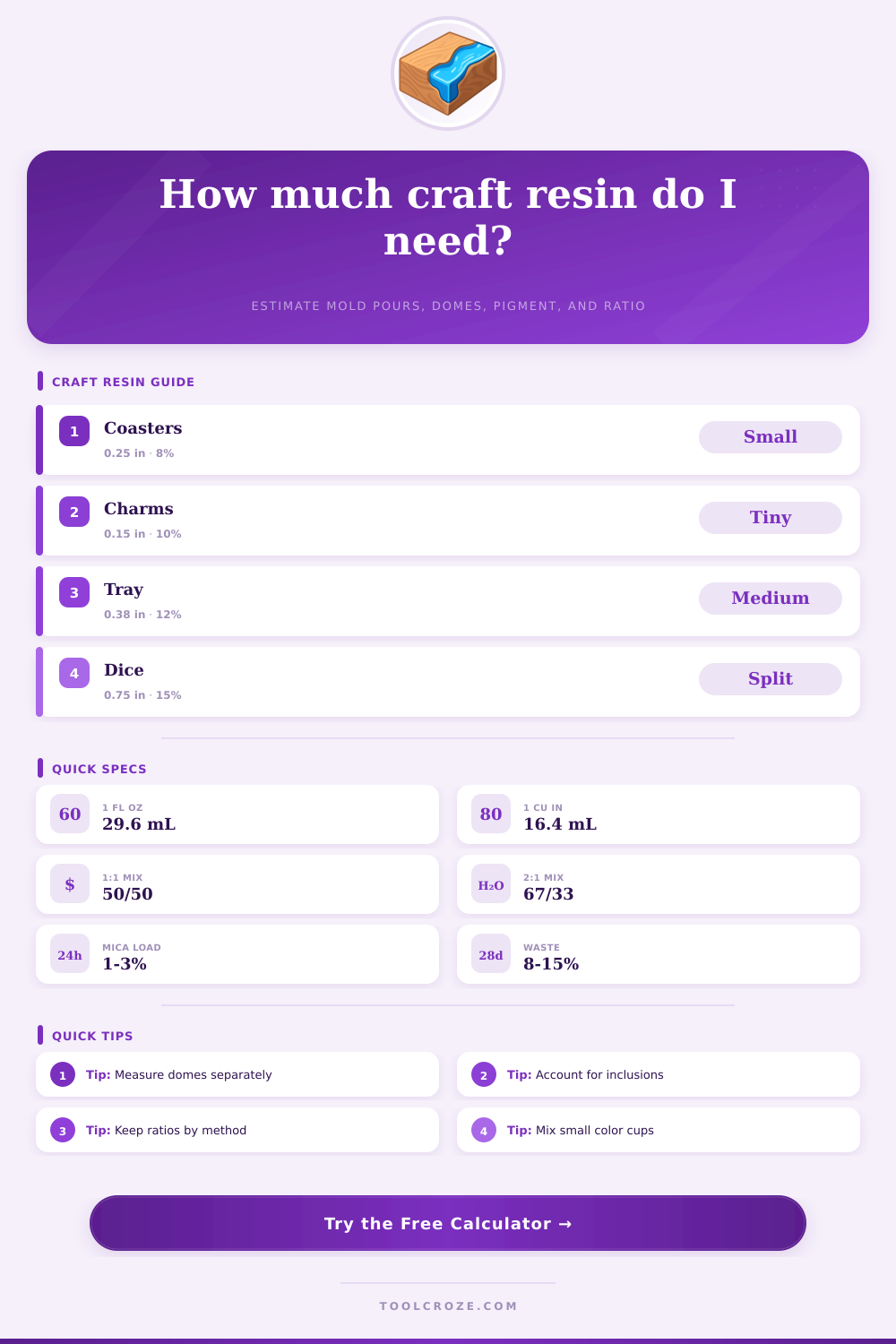
| Coaster set | 1/4 in or 6 mm | 8-10% | One mixed batch is usually enough for four pieces. |
| Domed pendants | 1/8 in plus dome | 10-15% | Use a small cup and add dome depth as a separate input. |
| Dice molds | Measured cavity | 12-20% | Split colors into tiny cups to avoid overmixing. |
| Tray pour | 3/8 in or 10 mm | 10-15% | Round up for edge drips, wave lines, and mica cells. |
| Cabochon sheet | 2-4 mm | 8-12% | Low fill depth makes cup residue a larger share of the mix. |
Resin artists often experiences a shortage of resin during the resin pour process. The resin shortage typicaly happens because a person does not have enough resin to fill the silicone mold completely. If a person dont have enough resin to fill the mold, they may attempt to adding more resin later.
However, pouring resin later into mold can create bubbles and seams in the resin. Conversely, if a person pours too much resin into the mold, it will waste the resin material that is expensive to purchase. The resin casting process require that a person calculates the volume of the mold.
How to Calculate the Right Amount of Resin for Your Mold
Silicone molds are often deceptive in that a person cannot easily see the depth and width of the mold with an naked eye. As such, it is easy for a person to miscalculate the amount of resin need for casting. Using a resin calculator will allow a person to calculate the molds volume and avoid running out of resin during the pouring of the resin into the mold.
In addition to calculating the mold’s volume, a person must also consider the dome when pouring the resin into the mold. Pouring resin into molds creates a rounded dome of resin around the silicone molds rim. Typically, a person will need to create a convex lens effect for the resin to be useful for certain projects.
If the person do not calculate the volume for the dome, they may not have enough resin to create the dome. Calculating the volume of the resin require for the dome is a necessary step prior to the resin pouring process. Another consideration for resin artists is the consideration of inclusion displacement.
If a person is pouring resin into a mold that has solid inclusions within it, such as stones and glitter, the solid items will displace part of the resin needed to fill the mold. The solid items taking up the volume in the mold will require the artist to use less resin. If a person ignores the inclusion displacement of the solid items, they will end up having to mix too much resin.
This will waste resin that was purchased for the project. Pigments are also a consideration for resin artists. Adding pigment, such as mica powder or opaque paste, will add mass to the resin.
Using too much pigment will interfere with the resin’s chemical reaction. If a person introduces resin with too much pigment, it may cause soft spot in the cured resin. Knowing the percentage of additive in the resin will allow a person to avoid introducing too much pigment into the resin.
A person must use the correct method to measure the resin. Resin can be measured by volume or by weight. Depending on the type of resin that a person is using for casting, there may be a requirement to measure resin by volume or by weight using a digital scale.
A 1:1 ratio of resin to hardener by volume does not necessarily equal a 1:1 ratio by weight. Using the wrong method to measure the resin will result in resin that does not harden proper and is therefore not usable by the resin artist. A person should also account for the resin waste that happens during the resin pouring process.
When a person pours resin into mixing cups and poured into other cups to distribute to various molds, the resin sticks to the sides of the mixing cup and the stirring sticks used to mix the resin. If a person split a batch of resin into various smaller cups, some of the resin will be wasted. Therefore, to account for this, a person should include an allowance for resin waste in the initial calculation of the amount of resin that is needed.
This will ensure that the person has enough resin to fill the molds with resin. For those using irregular molds, a person can use the water test to determine the volume of molds. To perform the water test, a person can fill the mold with water or rice and measure the volume of material used to fill the mold.
By knowing the volume of the mold, the resin artist can easily calculate the amount of resin needed. Using the water test to determine the volume of resin needed is an efficient method that yields a pinpoint accurately estimate of the volume of resin needed for the pour. By considering the factors mention above, a resin artist will have a better understanding of the requirements of the resin casting process.
By considering the use of calculations instead of guesses for the amount of resin needed, the resin artist can have better control of the resin casting process. When a person calculates the resin needed to fill the mold, they can focus on other aspect of the resin art project, such as the placement of objects within the mold and the color of the resin.